Peng Z Ellen, Waz Sebastian, Buss Emily, Shen Yi, Richards Virginia, Bharadwaj Hari, Stecker G Christopher, Beim Jordan A, Bosen Adam K, Braza Meredith D, Diedesch Anna C, Dorey Claire M, Dykstra Andrew R, Gallun Frederick J, Goldsworthy Raymond L, Gray Lincoln, Hoover Eric C, Ihlefeld Antje, Koelewijn Thomas, Kopun Judy G, Mesik Juraj, Shub Daniel E, Venezia Jonathan H
Boys Town National Research Hospital, Omaha, Nebraska 68131, USA.
University of California, Irvine, Irvine, California 92697, USA.
J Acoust Soc Am. 2022 May;151(5):3116. doi: 10.1121/10.0010422.
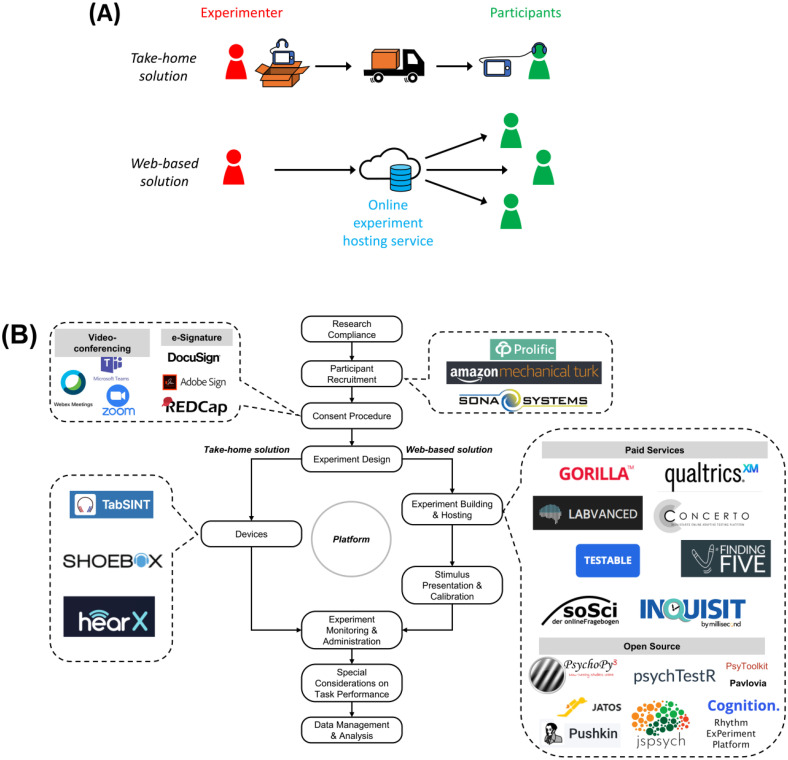
Acoustics research involving human participants typically takes place in specialized laboratory settings. Listening studies, for example, may present controlled sounds using calibrated transducers in sound-attenuating or anechoic chambers. In contrast, remote testing takes place outside of the laboratory in everyday settings (e.g., participants' homes). Remote testing could provide greater access to participants, larger sample sizes, and opportunities to characterize performance in typical listening environments at the cost of reduced control of environmental conditions, less precise calibration, and inconsistency in attentional state and/or response behaviors from relatively smaller sample sizes and unintuitive experimental tasks. The Acoustical Society of America Technical Committee on Psychological and Physiological Acoustics launched the Task Force on Remote Testing (https://tcppasa.org/remotetesting/) in May 2020 with goals of surveying approaches and platforms available to support remote testing and identifying challenges and considerations for prospective investigators. The results of this task force survey were made available online in the form of a set of Wiki pages and summarized in this report. This report outlines the state-of-the-art of remote testing in auditory-related research as of August 2021, which is based on the Wiki and a literature search of papers published in this area since 2020, and provides three case studies to demonstrate feasibility during practice.
涉及人类参与者的声学研究通常在专门的实验室环境中进行。例如,听力研究可能会在消声室或无回声室中使用校准换能器呈现受控声音。相比之下,远程测试是在实验室之外的日常环境中进行(例如参与者的家中)。远程测试可以让更多的参与者参与进来,获得更大的样本量,并有机会在典型的听力环境中描述表现,但代价是对环境条件的控制减少、校准不够精确,以及由于样本量相对较小和实验任务不直观而导致注意力状态和/或反应行为不一致。美国声学学会心理与生理声学技术委员会于2020年5月发起了远程测试特别工作组(https://tcppasa.org/remotetesting/),目标是调查支持远程测试的可用方法和平台,并确定潜在研究人员面临的挑战和需要考虑的因素。该特别工作组的调查结果以一组维基页面的形式在线发布,并在本报告中进行了总结。本报告概述了截至2021年8月听觉相关研究中远程测试的最新情况,这是基于维基以及对2020年以来该领域发表的论文进行的文献检索,并提供了三个案例研究以证明实践中的可行性。