Sasidharan Shan, Kp Srinivasakumar, Bhaumik Amiya, Kanti Das Sreemoy, Nair J Hareebndran
Department of Pharmacy, Lincoln University College, Petaling Jaya, Malaysia.
Small Animal Research Centre, Department of Toxicology and Pharmacology, CARe KERALA, Thrissur, Kerala, India.
Res Rep Urol. 2022 May 26;14:225-239. doi: 10.2147/RRU.S365598. eCollection 2022.
Benign prostatic hyperplasia (BPH) is a major chronic disease affecting men, and the therapeutic agents currently used to manage it have significant side effects. As a result, an alternative medicine with improved therapeutic properties with no side effects is desperately needed. The current investigation aims to study whether the seed extracts (ethanolic-A, hydroalcoholic-B, and aqueous-C) have inhibitory potential on testosterone propionate (TP)-induced BPH in Wistar rats.
Wistar rats (male) were randomly allocated to one of five groups: control, BPH (TP-3 mg/kg, subcutaneously daily), low dose (TP + seed extracts - 200 mg/kg body weight), high dose (TP + seed extracts - 400 mg/kg body weight), and standard drug (TP + finasteride - 10 mg/kg body weight). At the end of drug treatment, the rats were sacrificed and their serum and prostates were taken for biochemical and histological studies.
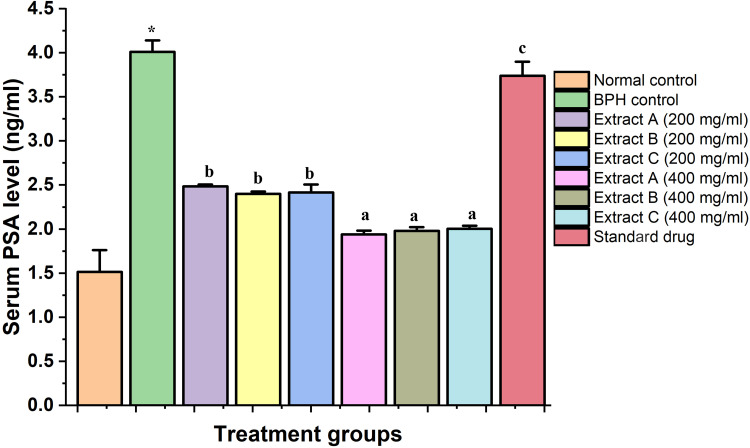
seed extracts treatment significantly decreased prostate weight and prostatic index in rats with TP-induced BPH. The seed extracts exhibited a potent inhibitory effect on dihydrotestosterone (DHT) in serum and prostate. In addition, the PSA level in the serum showed a noteworthy decrease in comparison with the BPH group. Histopathological examination also indicated that extracts improved the tissue morphology of the prostate significantly. Out of three extracts tested, ethanolic and hydroalcoholic extract recorded significant effect. Finally, liquid chromatography quadrupole time-of-flight mass spectrometry (LC/MS-QTOF) analysis showed that the major compounds present in the extracts were tocopherols, fucosterol, linoleic acid, β-amyrin, β-sitosterol, campesterol, cassane furanoditerpene, norcassane furanoditerpene and other diterpenes.
Thus, seed extracts could be a potential source for the formulation of new drug for managing BPH. To the best of our knowledge, this is the first scientific animal investigation into the use of seed extract for the management of BPH.
良性前列腺增生(BPH)是一种影响男性的主要慢性疾病,目前用于治疗该疾病的药物有显著的副作用。因此,迫切需要一种具有改善治疗特性且无副作用的替代药物。当前的研究旨在探讨种子提取物(乙醇提取物-A、水醇提取物-B和水提取物-C)对丙酸睾酮(TP)诱导的Wistar大鼠良性前列腺增生是否具有抑制潜力。
将Wistar雄性大鼠随机分为五组之一:对照组、BPH组(TP-3mg/kg,每日皮下注射)、低剂量组(TP+种子提取物-200mg/kg体重)、高剂量组(TP+种子提取物-400mg/kg体重)和标准药物组(TP+非那雄胺-10mg/kg体重)。在药物治疗结束时,处死大鼠并采集其血清和前列腺用于生化和组织学研究。
种子提取物治疗显著降低了TP诱导的BPH大鼠的前列腺重量和前列腺指数。种子提取物对血清和前列腺中的双氢睾酮(DHT)表现出强大的抑制作用。此外,与BPH组相比,血清中的PSA水平显著降低。组织病理学检查还表明,提取物显著改善了前列腺的组织形态。在所测试的三种提取物中,乙醇提取物和水醇提取物有显著效果。最后,液相色谱四极杆飞行时间质谱(LC/MS-QTOF)分析表明,提取物中存在的主要化合物为生育酚、岩藻甾醇、亚油酸、β-香树脂醇、β-谷甾醇、菜油甾醇、乌苏烷呋喃二萜、降乌苏烷呋喃二萜和其他二萜类化合物。
因此,种子提取物可能是用于制备治疗BPH新药的潜在来源。据我们所知,这是首次对种子提取物用于治疗BPH进行的科学动物研究。