Qian Mengjia, Zhu Bijun, Zhan Yanxia, Wang Lingyan, Shen Qi, Zhang Miaomiao, Yue Lei, Wu Duojiao, Chen Hao, Wang Xiangdong, Cheng Yunfeng
Institute of Clinical Science, Zhongshan Hospital, Fudan University, Shanghai, China.
Department of Hematology, Zhongshan Hospital, Fudan University, Shanghai, China.
Front Cell Infect Microbiol. 2022 May 16;12:892076. doi: 10.3389/fcimb.2022.892076. eCollection 2022.
Metagenomics next-generation sequencing (mNGS) has been increasingly used in the clinic, which provides a powerful tool for the etiological diagnosis of infectious diseases. Precise treatment can be carried out according to the positive mNGS results. However, the role of negative results of mNGS remains poorly defined in clinical practice.
The results of 1,021 samples from patients who received the mNGS test at Zhongshan Hospital, Fudan University, between January 2019 and December 2019 were analyzed.
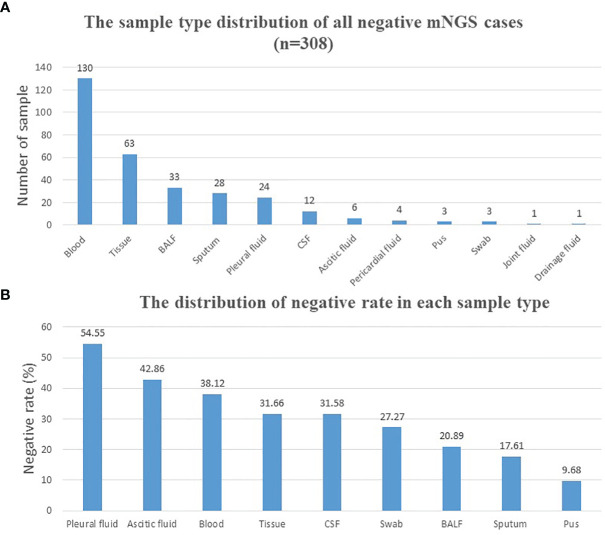
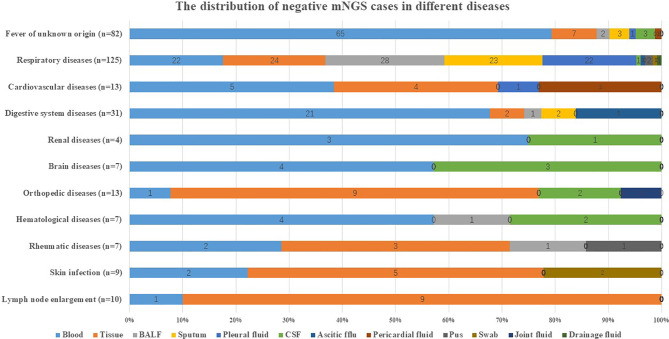
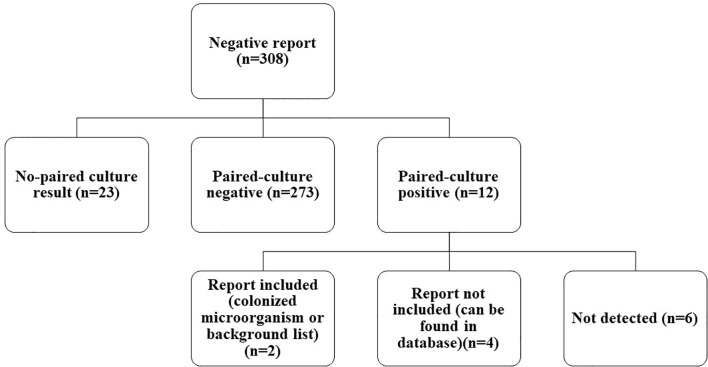
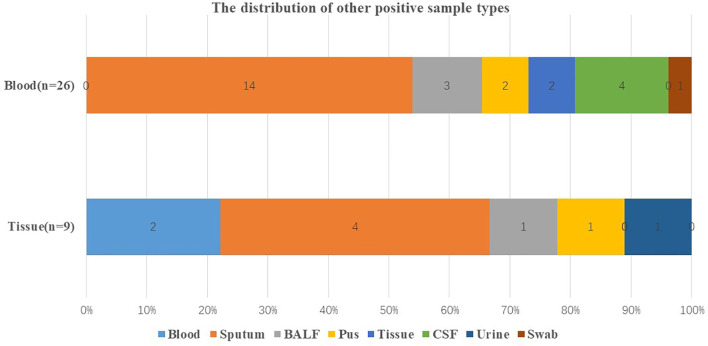
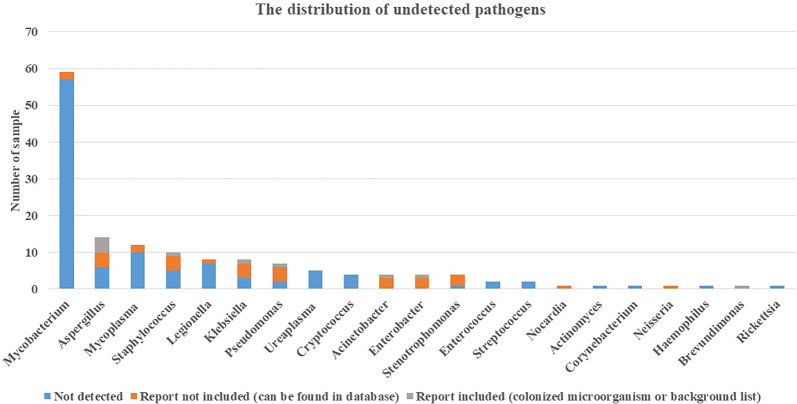
There were 308 samples (30.17%) of negative results included in the current study. The top 2 types of negative samples were blood (130/308) and tissue (63/308), which also accounted for the highest negative proportion in diseases. Sputum and bronchoalveolar lavage fluid (BALF) were more likely to have positive results. In false-negative results (defined as negative in mNGS test but reported positive in other sample types or assays), 118 samples were found when compared to regular microbiological assays. The negative predictive value (NPV) of mNGS was 95.79% [95%CI, 93.8%-97.8%] as compared to culture and smear. , , and ranked as the top 3 microorganisms on the undetected pathogen list.
The present data indicate that when the mNGS test is negative, the negative prediction accuracy rate of the original specimen is significant. However, other laboratory assays results and clinical presentations should always be carefully considered prior to drawing a diagnosis.
宏基因组学下一代测序(mNGS)在临床上的应用越来越广泛,它为传染病的病因诊断提供了一个强大的工具。可根据mNGS阳性结果进行精准治疗。然而,mNGS阴性结果在临床实践中的作用仍不明确。
分析了2019年1月至2019年12月在复旦大学附属中山医院接受mNGS检测的1021例患者的样本结果。
本研究纳入了308份(30.17%)阴性结果样本。阴性样本中排名前两位的类型是血液(130/308)和组织(63/308),这两种样本类型在疾病中的阴性比例也最高。痰液和支气管肺泡灌洗液(BALF)更易出现阳性结果。在假阴性结果(定义为mNGS检测为阴性但在其他样本类型或检测中报告为阳性)中,与常规微生物检测相比,发现了118份样本。与培养和涂片相比,mNGS的阴性预测值(NPV)为95.79%[95%CI,93.8%-97.8%]。 、 和 在未检测到的病原体列表中排名前三位。
目前的数据表明,当mNGS检测为阴性时,原始样本的阴性预测准确率较高。然而,在做出诊断之前,应始终仔细考虑其他实验室检测结果和临床表现。