Liu Sheng, Wang Chenyang, Guo Jinzhu, Yang Yunxiao, Huang Mengling, Li Li, Wang Yu, Qin Yanwen, Zhang Ming
Center for Coronary Heart Disease, Beijing Anzhen Hospital, Capital Medical University, Beijing, China.
Department of Cardiology, Baotou Jiuyuan District Hospital, Baotou, China.
Front Cardiovasc Med. 2022 May 16;9:896810. doi: 10.3389/fcvm.2022.896810. eCollection 2022.
Various cytokines were involved in the process of atherosclerosis, and their serum levels were correlated with coronary artery disease (CAD) to varying degrees. However, there were limited reports about the correlation between serum cytokines and the severity of coronary atherosclerotic lesion in patients with non-acute myocardial infarction (AMI). The purpose of this study was to investigate the relationship between serum cytokines and the severity of CAD, and identify the predictors of severe CAD in patients suspected to have CAD but AMI had been ruled out.
A total of 502 patients who had suspected CAD and underwent coronary angiography were enrolled. The serum levels of IL-1β, IL-2, IL-4, IL-5, IL-6, IL-8, IL-10, IL-12p70, IL-17, TNF-α, IFN-α,and IFN-γ were determined by multiplexed particle-based flow cytometric assays technology. And the severity of CAD was evaluated by Gensini score (GS).
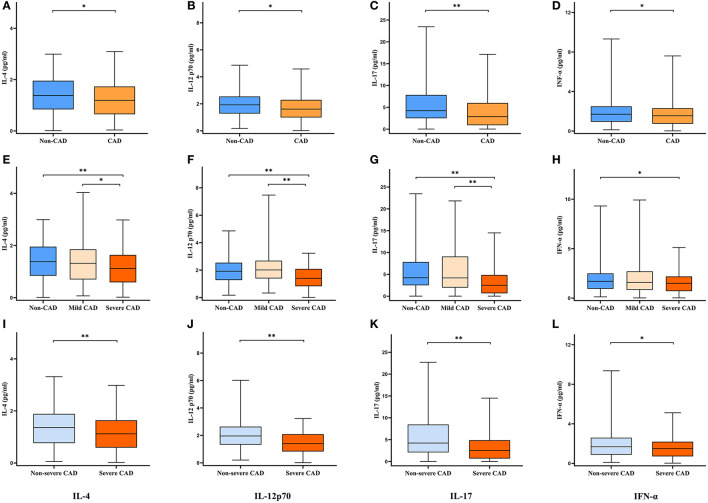
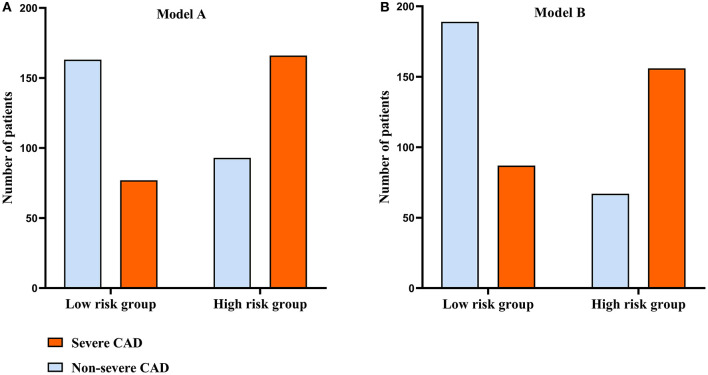
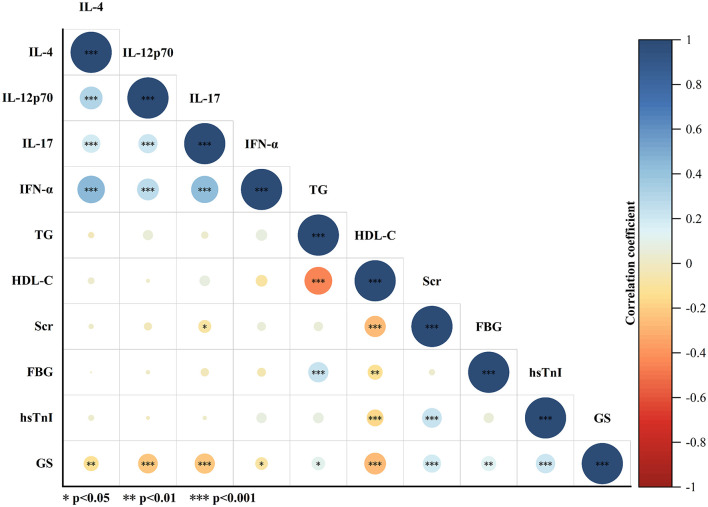
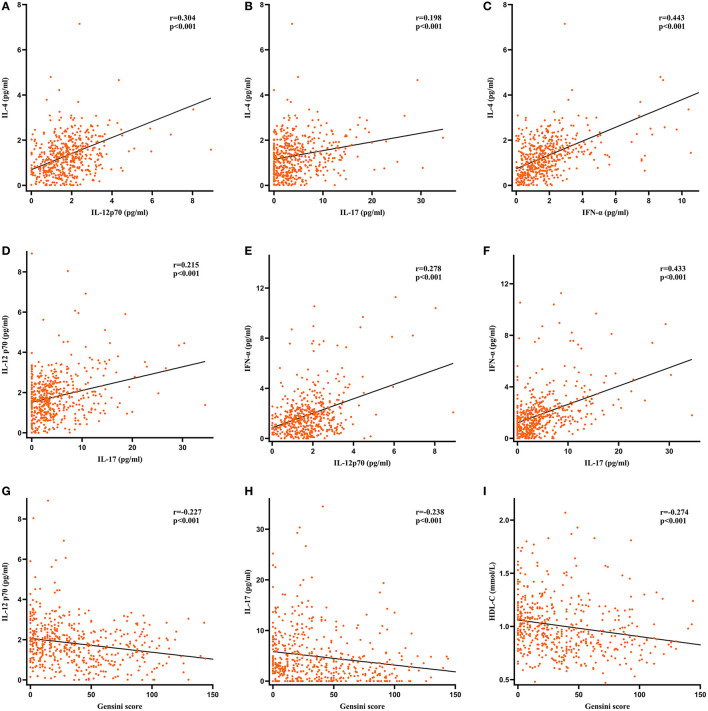
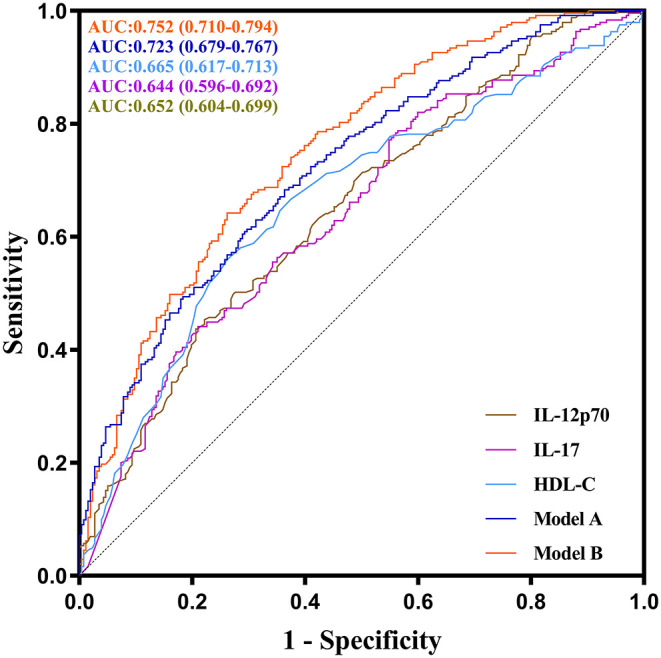
The serum levels of IL-4, IL-12p70, IL-17, and IFN-α were significantly lower in the severe CAD group (GS≥30) than those in the non-severe CAD group (GS < 30). And IL-12p70 and IL-17 were negatively correlated with the severity of CAD. Multivariate logistic regression analyses demonstrated that two serum cytokines (IL-12p70 and IL-17), one clinical protective factor (HDL-C), and two clinical risk factors (gender and diabetes) were the independent predictors of severe CAD. ROC curve analysis showed that multivariate mode combined these predictors had a good performance in predicting severe CAD.
The combination of serum cytokines (IL-12p70 and IL-17) and clinical risk factors (HDL-C, gender, and diabetes) may help identify patients with more severe coronary artery lesions from those with suspected CAD but not AMI, and may contribute to guiding the risk stratification for patients with chest discomfort in health care facilities without sufficient medical resources (especially cardiac catheterization resources).
多种细胞因子参与动脉粥样硬化的发生过程,其血清水平与冠状动脉疾病(CAD)存在不同程度的相关性。然而,关于非急性心肌梗死(AMI)患者血清细胞因子与冠状动脉粥样硬化病变严重程度之间的相关性报道较少。本研究旨在探讨血清细胞因子与CAD严重程度之间的关系,并确定疑似患有CAD但已排除AMI患者中严重CAD的预测因素。
共纳入502例疑似CAD并接受冠状动脉造影的患者。采用基于多重微粒的流式细胞术检测技术测定血清白细胞介素-1β(IL-1β)、白细胞介素-2(IL-2)、白细胞介素-4(IL-4)、白细胞介素-5(IL-5)、白细胞介素-6(IL-6)、白细胞介素-8(IL-8)、白细胞介素-10(IL-10)、白细胞介素-12p70、白细胞介素-17、肿瘤坏死因子-α(TNF-α)、干扰素-α(IFN-α)和干扰素-γ(IFN-γ)水平。采用Gensini评分(GS)评估CAD的严重程度。
严重CAD组(GS≥30)的血清IL-4、IL-12p70、IL-17和IFN-α水平显著低于非严重CAD组(GS<30)。IL-12p70和IL-17与CAD严重程度呈负相关。多因素logistic回归分析表明,两种血清细胞因子(IL-12p70和IL-17)、一种临床保护因素(高密度脂蛋白胆固醇,HDL-C)和两种临床危险因素(性别和糖尿病)是严重CAD的独立预测因素。ROC曲线分析显示,联合这些预测因素的多变量模型在预测严重CAD方面具有良好的性能。
血清细胞因子(IL-12p70和IL-17)与临床危险因素(HDL-C、性别和糖尿病)相结合,可能有助于从疑似CAD但非AMI的患者中识别出冠状动脉病变更严重的患者,并可能有助于在医疗资源(尤其是心脏导管检查资源)不足的医疗机构中指导胸痛患者的风险分层。