Min Xiaoyan, Lu Miao, Tu Su, Wang Xiangming, Zhou Chuanwei, Wang Sen, Pang Sisi, Qian Jin, Ge Yiyue, Guo Yan, Xu Di, Cao Kejiang
Department of Geriatric Cardiology, The First Affiliated Hospital of Nanjing Medical University, Nanjing 210029, China.
Department of Emergency, Wuxi No. 2 People's Hospital Affiliated Nanjing Medical University, Wuxi 214000, China.
Biomed Res Int. 2017;2017:4013685. doi: 10.1155/2017/4013685. Epub 2017 Mar 2.
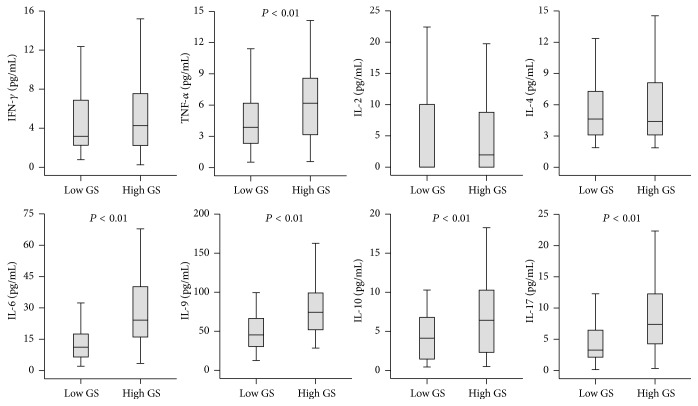
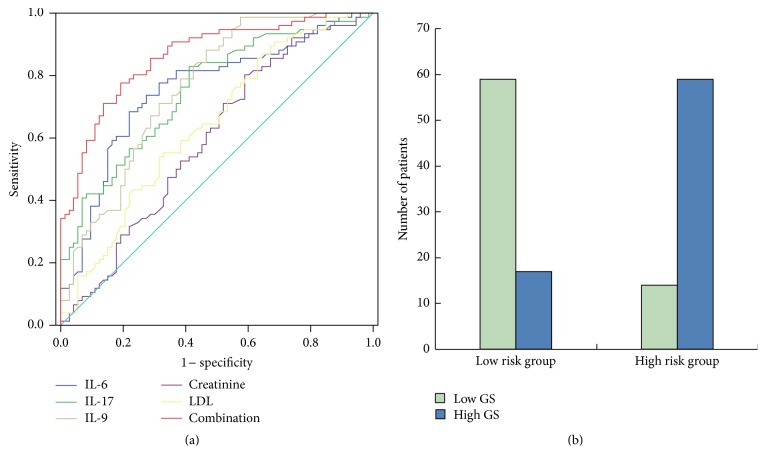
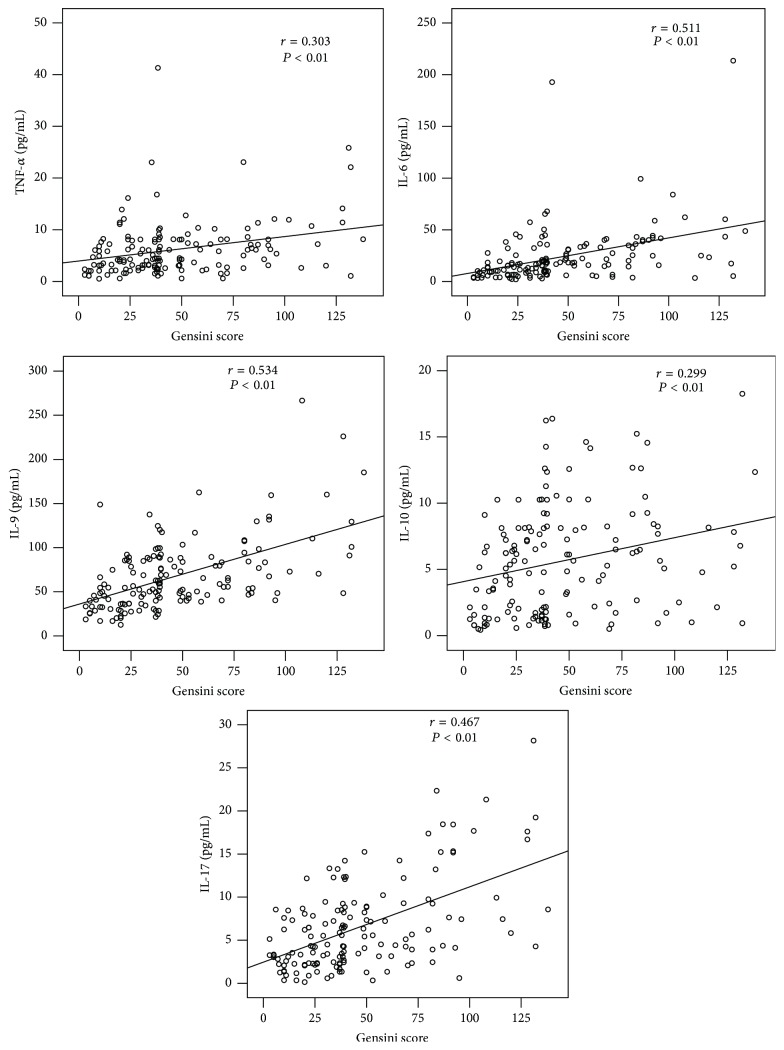
. To investigate the potential association of a set of serum cytokines with the severity of coronary artery disease (CAD). . A total of 201 patients who underwent coronary angiography for chest discomfort were enrolled. The concentrations of serum IFN-, TNF-, IL-2, IL-4, IL-6, IL-10, IL-9, and IL-17 were determined by xMAP multiplex technology. The CAD severity was assessed by Gensini score (GS). . The serum levels of TNF-, IL-6, IL-9, IL-10, and IL-17 were significantly higher in high GS group (GS ≥ 38.5) than those in low GS group (GS < 38.5). Positive correlations were also found between these cytokines and the severity of CAD. After adjustment for other associated factors, three serum cytokines (IL-6, IL-9, and IL-17) and two clinical risk factors (creatinine and LDL-C) were identified as the independent predictors of increased severity of CAD. ROC curve analysis revealed that the logistic regression risk prediction model had a good performance on predicting CAD severity. . Combinatorial analysis of serum cytokines (IL-6, IL-9, and IL-17) with clinical risk factors (creatinine and LDL-C) may contribute to the evaluation of the severity of CAD and may help guide the risk stratification of angina patients, especially in primary health facilities and in the catheter lab resource-limited settings.
. 探讨一组血清细胞因子与冠状动脉疾病(CAD)严重程度之间的潜在关联。. 共纳入201例因胸部不适接受冠状动脉造影的患者。采用xMAP多重技术测定血清IFN-、TNF-、IL-2、IL-4、IL-6、IL-10、IL-9和IL-17的浓度。通过Gensini评分(GS)评估CAD严重程度。. 高GS组(GS≥38.5)血清TNF-、IL-6、IL-9、IL-10和IL-17水平显著高于低GS组(GS<38.5)。这些细胞因子与CAD严重程度之间也存在正相关。在对其他相关因素进行校正后,三种血清细胞因子(IL-6、IL-9和IL-17)和两种临床危险因素(肌酐和低密度脂蛋白胆固醇)被确定为CAD严重程度增加的独立预测因素。ROC曲线分析显示,逻辑回归风险预测模型在预测CAD严重程度方面具有良好的性能。. 血清细胞因子(IL-6、IL-9和IL-17)与临床危险因素(肌酐和低密度脂蛋白胆固醇)的联合分析可能有助于评估CAD的严重程度,并可能有助于指导心绞痛患者的风险分层,尤其是在基层医疗机构和导管室资源有限的情况下。