Department of Industrial Engineering, Yonsei University, Seoul, South Korea.
Korean Foundation for Quality, Seoul, South Korea.
Int J Public Health. 2022 May 16;67:1604389. doi: 10.3389/ijph.2022.1604389. eCollection 2022.
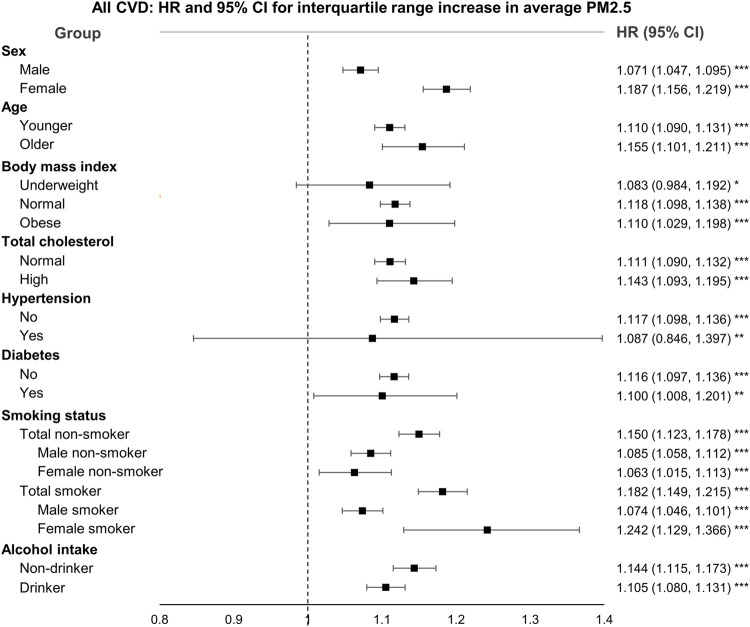
The primary purpose of this study is to analyze the relationship between the first occurrence of hospitalization for cardiovascular disease (CVD) and particulate matter less than 2.5 μm in diameter (PM2.5) exposure, considering average PM2.5 concentration and the frequency of high PM2.5 concentration simultaneously. We used large-scale cohort data from seven metropolitan cities in South Korea. We estimated hazard ratios (HRs) and 95% confidence intervals (CIs) using the Cox proportional-hazards model, including annual average PM2.5 and annual hours of PM2.5 concentration exceeding 55.5 μg/m (FH55). We found that the risk was elevated by 11.6% (95% CI, 9.7-13.6) for all CVD per 2.9 μg/m increase of average PM2.5. In addition, a 94-h increase in FH55 increased the risk of all CVD by 3.8% (95% CI, 2.8-4.7). Regarding stroke, we found that people who were older and had a history of hypertension were more vulnerable to PM2.5 exposure. Based on the findings, we conclude that accurate forecasting, information dissemination, and timely warning of high concentrations of PM2.5 at the national level may reduce the risk of CVD occurrence.
本研究的主要目的是分析首次因心血管疾病(CVD)住院与细颗粒物(PM2.5)暴露之间的关系,同时考虑平均 PM2.5 浓度和高 PM2.5 浓度的频率。我们使用了来自韩国七个大都市地区的大规模队列数据。我们使用 Cox 比例风险模型估计了危险比(HRs)和 95%置信区间(CIs),包括年平均 PM2.5 和 PM2.5 浓度超过 55.5μg/m 的年小时数(FH55)。我们发现,平均 PM2.5 每增加 2.9μg/m,所有 CVD 的风险增加 11.6%(95%CI,9.7-13.6)。此外,FH55 增加 94 小时会使所有 CVD 的风险增加 3.8%(95%CI,2.8-4.7)。对于中风,我们发现年龄较大和有高血压病史的人更容易受到 PM2.5 暴露的影响。基于这些发现,我们得出结论,在国家层面上准确预测、传播信息和及时警告 PM2.5 浓度升高可能会降低 CVD 发生的风险。