Departments of Neurosurgery (R.M., M.W.A., J.M.C.v.D.), University of Groningen, University Medical Center Groningen, the Netherlands.
Epidemiology (C.H.L.T., H.S.), University of Groningen, University Medical Center Groningen, the Netherlands.
Stroke. 2022 Sep;53(9):2870-2875. doi: 10.1161/STROKEAHA.121.038035. Epub 2022 Jun 2.
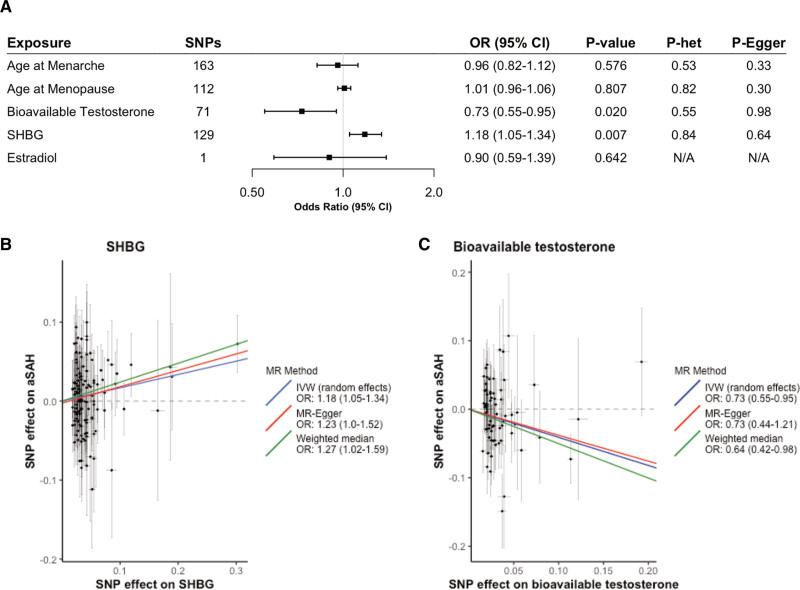
The risk of aneurysmal subarachnoid hemorrhage (aSAH) is increased in postmenopausal women compared with men of similar age, suggesting a role for sex hormones. We aimed to explore whether sex hormones, and age at menarche/menopause have a causal effect on aSAH risk by conducting a 2-sample MR study (Mendelian randomization).
We obtained sex-specific genetic instruments for serum estradiol, bioavailable testosterone (BioT), SHBG (sex hormone-binding globulin), and age at menarche/menopause from genome-wide association studies. The associated sex-specific aSAH risk was estimated with inverse-variance weighted MR analyses with various statistical sensitivity analyses. Multivariable and cluster MR analyses were performed for BioT and SHBG to account for a genetic and phenotypic correlation between the 2 exposures. The clusters represented (1) single-nucleotide polymorphisms primarily increasing SHBG, with secondary decreasing effects on BioT, and (2) single-nucleotide polymorphisms affecting BioT without affecting SHBG.
Univariable MR analyses showed an 18% increased aSAH risk among women per 1-SD increase in genetically determined SHBG levels (odds ratio, 1.18 [95% CI, 1.05-1.34]; =0.007). Suggestive evidence was identified for a 27% decreased risk of aSAH among women per 1-SD increase in BioT (odds ratio, 0.73 [95% CI, 0.55-0.95]; =0.02). The latter association disappeared in cluster analysis when only using SHBG-independent variants. MR analyses with variants from the cluster with primary SHBG effects and secondary (opposite) BioT-effects yielded a statistically significant association (odds ratio, 1.21 [95% CI, 1.05-1.40]; =0.008). No other causal associations were identified.
Genetic predisposition to elevated serum levels of SHBG, with secondary lower serum BioT levels, is associated with an increased aSAH risk among women, suggesting that SHBG and BioT causally elevate aSAH risk. Further studies are required to elucidate the underlying mechanisms and their potential as an interventional target to lower aSAH incidence.
与同龄男性相比,绝经后女性发生蛛网膜下腔出血(aSAH)的风险增加,这表明性激素起作用。我们旨在通过进行两样本 MR 研究(孟德尔随机化)来探讨性激素和初潮/绝经年龄是否对 aSAH 风险有因果影响。
我们从全基因组关联研究中获得了针对血清雌二醇、生物可利用睾酮(BioT)、性激素结合球蛋白(SHBG)和初潮/绝经年龄的性别特异性遗传工具。使用逆方差加权 MR 分析估计与性别特异性 aSAH 风险相关的关联,并进行了各种统计敏感性分析。对于 BioT 和 SHBG,进行了多变量和聚类 MR 分析,以解释这两种暴露之间的遗传和表型相关性。聚类代表了(1)主要增加 SHBG 而次要降低 BioT 的单核苷酸多态性,以及(2)影响 BioT 而不影响 SHBG 的单核苷酸多态性。
单变量 MR 分析显示,女性的 SHBG 水平每增加 1 个标准差,aSAH 的风险就会增加 18%(比值比,1.18 [95%置信区间,1.05-1.34];=0.007)。在女性中,每增加 1 个标准差的 BioT,aSAH 的风险降低 27%(比值比,0.73 [95%置信区间,0.55-0.95];=0.02),这一结果存在一定的证据支持。当仅使用与 SHBG 无关的变体时,聚类分析中该关联消失。使用来自主要 SHBG 效应和次要(相反)BioT 效应的聚类变体的 MR 分析得出了具有统计学意义的关联(比值比,1.21 [95%置信区间,1.05-1.40];=0.008)。未发现其他因果关联。
血清 SHBG 水平升高且继发 BioT 水平降低的遗传倾向与女性 aSAH 风险增加相关,表明 SHBG 和 BioT 因果上增加了 aSAH 风险。需要进一步研究来阐明潜在机制及其作为降低 aSAH 发病率的干预靶点的潜力。