Department of Clinical Medicine, Research Center for Emergency Medicine, Aarhus University and Aarhus University Hospital, Aarhus, Denmark.
Department of Emergency Medicine, Aarhus University Hospital, Aarhus, Denmark.
Acad Emerg Med. 2022 Oct;29(10):1172-1184. doi: 10.1111/acem.14546. Epub 2022 Aug 5.
Fluid treatment in sepsis is a challenge and clinical equipoise exists regarding intravenous (IV) volumes. We aimed to determine whether a 24-h protocol restricting IV fluid was feasible in adult patients with sepsis without shock presenting to the emergency department (ED).
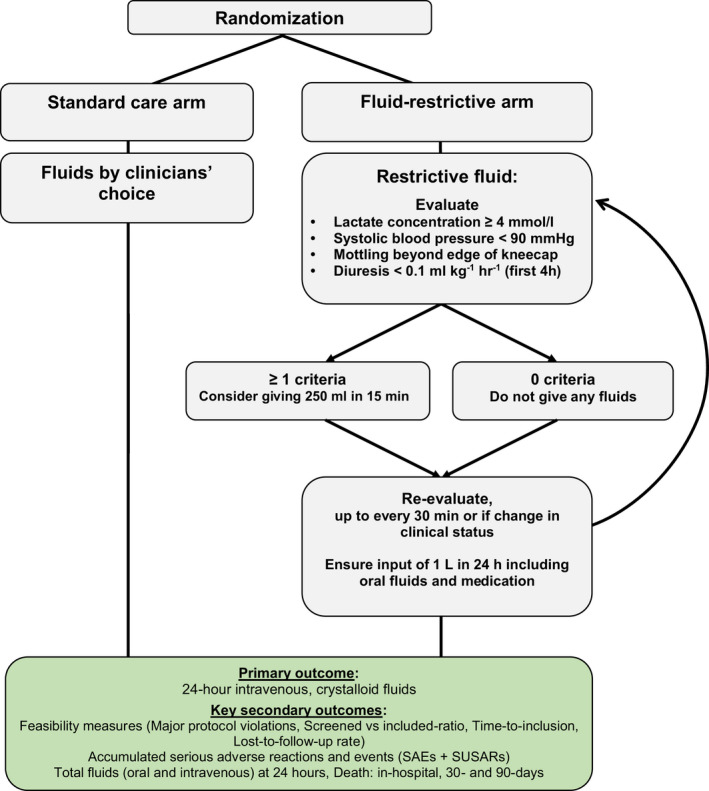
The REFACED Sepsis trial is an investigator-initiated, multicenter, randomized, open-label, feasibility trial, assigning sepsis patients without shock to 24 h of restrictive, crystal IV fluid administration or standard care. In the IV fluid restriction group fluid boluses were only permitted if predefined criteria for hypoperfusion occurred. Standard care was at the discretion of the treating team. The primary outcome was total IV crystalloid fluid volumes at 24 h after randomization. Secondary outcomes included total fluid volumes, feasibility measures, and patient-centered outcomes.
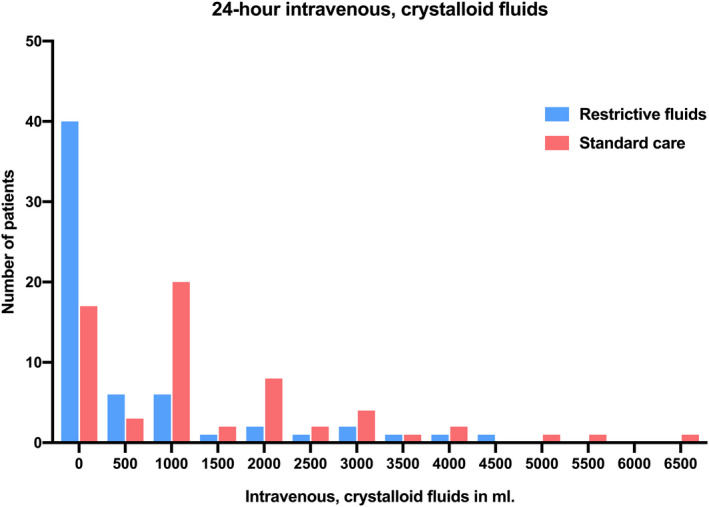
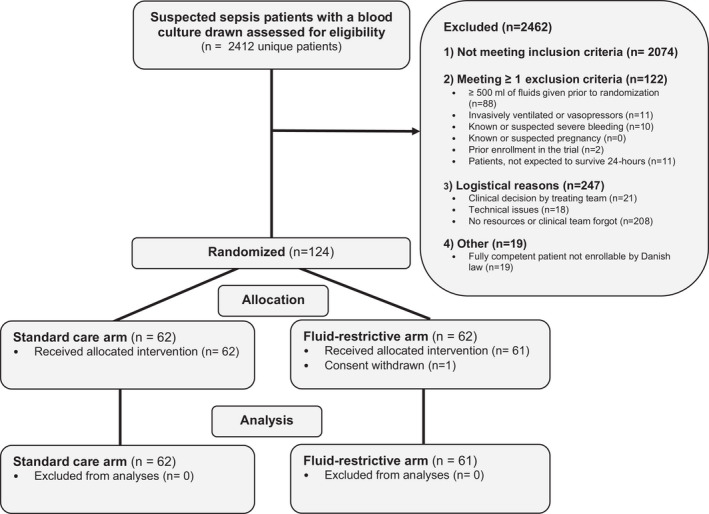
We included 123 patients (restrictive 61 patients and standard care 62 patients) in the primary analysis. A total of 32% (95% confidence interval [CI] 28%-37%) of eligible patients meeting all inclusion criteria and no exclusion criteria were included. At 24 h, the mean (±SD) IV crystalloid fluid volumes were 562 (±1076) ml versus 1370 (±1438) ml in the restrictive versus standard care group (mean difference -801 ml, 95% CI -1257 to -345 ml, p = 0.001). Protocol violations occurred in 21 (34%) patients in the fluid-restrictive group. There were no differences between groups in adverse events, use of mechanical ventilation or vasopressors, acute kidney failure, length of stay, or mortality.
A protocol restricting IV crystalloid fluids in ED patients with sepsis reduced 24-h fluid volumes compared to standard care. A future trial powered toward patient-centered outcomes appears feasible.
脓毒症患者的液体治疗是一个挑战,静脉(IV)输液量存在临床平衡。我们旨在确定在没有休克的脓毒症成年患者中,是否可以在急诊室(ED)实施限制 IV 液体的 24 小时方案。
REFACED 脓毒症试验是一项由研究者发起的、多中心、随机、开放标签、可行性试验,将无休克的脓毒症患者分为 24 小时限制晶体 IV 液体或标准治疗。在 IV 液体限制组中,只有在出现低灌注的预设标准时才允许进行液体冲击。标准治疗由治疗团队决定。主要结局是随机分组后 24 小时的总 IV 晶体液量。次要结局包括总液体量、可行性指标和以患者为中心的结局。
我们对 123 例患者(限制组 61 例,标准治疗组 62 例)进行了主要分析。符合所有纳入标准且无排除标准的合格患者中,仅 32%(95%置信区间 [CI] 28%-37%)的患者被纳入。在 24 小时时,限制组的平均(±SD)IV 晶体液量为 562(±1076)ml,而标准治疗组为 1370(±1438)ml(平均差异-801 ml,95%CI -1257 至-345 ml,p=0.001)。在液体限制组中,有 21 例(34%)患者违反了方案。两组之间在不良事件、机械通气或血管加压药的使用、急性肾衰、住院时间或死亡率方面无差异。
与标准治疗相比,ED 脓毒症患者的 IV 晶体液限制方案可减少 24 小时液体量。一项针对以患者为中心的结局的未来试验似乎是可行的。