Translational Research in Paediatric Specialities Area, Allergy Unit, Bambino Gesù Children's Hospital, IRCCS, Rome, Italy.
Allergy. 2022 Oct;77(10):3052-3060. doi: 10.1111/all.15397. Epub 2022 Jun 13.
The use of eliciting doses (EDs) for food allergens is necessary to inform individual dietary advice and food allergen risk-management. The Eliciting Dose 01 (ED01) for milk and egg, calculated from populations of allergic subjects undergoing oral food challenges (OFCs), are 0.2 mg total protein. The respective Eliciting Dose 05 (ED05) is 2.4 mg for milk and 2.3 mg for egg. As about 70% children allergic to such foods may tolerate them when baked, we sought to verify the EDs of that subpopulation of milk and egg-allergic children.
We retrospectively assessed consecutive OFC for fresh milk and egg between January 2018 and December 2020 in a population of baked food-tolerant children.
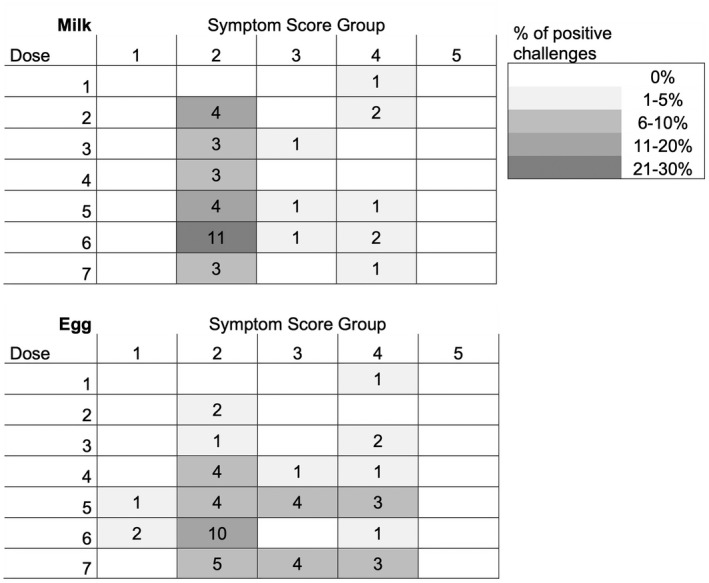
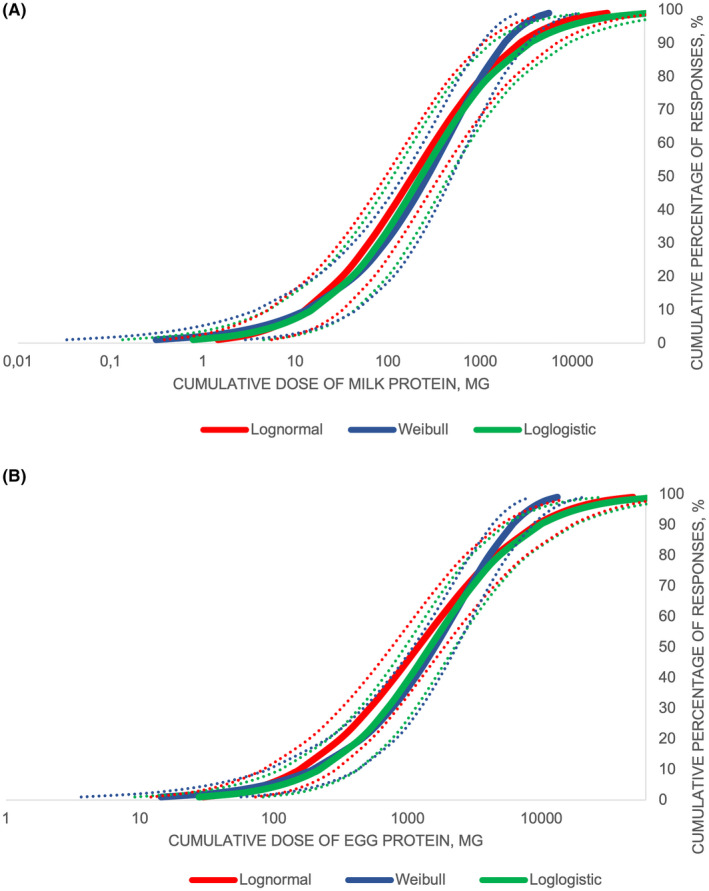
Among 288 children (median age 56 - IQR 36-92.5 months, 67.1% male) included, 87 (30.2%) returned positive OFC results, 38 with milk and 49 with egg. The most conservative ED01 was 0.3 mg total protein (IQR 0.03-2.9) for milk and 14.4 mg total protein (IQR 3.6-56.9) for egg. The respective ED05 was 4.2 (IQR 0.9-19.6) mg for milk and 87.7 (IQR 43-179) mg for egg. Such thresholds are, respectively, 1.5 (milk ED01), 1.75 (milk ED05), 72 (egg ED01), and 38.35 (egg ED05) times higher than the currently used thresholds.
The subpopulation of children allergic to milk and egg, but tolerant to baked proteins, displays higher reactivity thresholds than the general population of children allergic to milk and egg. Their risk stratification, in both individual and population terms, should consider this difference. In baked milk-tolerant children, milk causes reactions at lower doses than egg in our group of egg-tolerant children. This could be associated with the relative harmlessness of egg compared with milk in the determinism of fatal anaphylactic reactions in children.
为了提供个性化的饮食建议和管理食物过敏风险,有必要使用食物过敏原的激发剂量(EDs)。通过对接受口服食物挑战(OFC)的过敏受试者进行人群研究,计算出牛奶和鸡蛋的激发剂量 01(ED01)分别为 0.2 毫克总蛋白。相应的激发剂量 05(ED05)分别为 2.4 毫克牛奶和 2.3 毫克鸡蛋。由于大约 70%对这些食物过敏的儿童在烘焙后可以耐受它们,我们试图验证对这部分牛奶和鸡蛋过敏儿童的 EDs。
我们回顾性评估了 2018 年 1 月至 2020 年 12 月期间对一批可耐受烘焙食物的儿童进行的新鲜牛奶和鸡蛋的 OFC。
在 288 名儿童(中位年龄 56- IQR 36-92.5 个月,67.1%为男性)中,有 87 名(30.2%)返回阳性 OFC 结果,其中 38 名对牛奶过敏,49 名对鸡蛋过敏。最保守的牛奶 ED01 为 0.3 毫克总蛋白(IQR 0.03-2.9),鸡蛋 ED01 为 14.4 毫克总蛋白(IQR 3.6-56.9)。相应的 ED05 分别为 4.2 毫克(IQR 0.9-19.6)牛奶和 87.7 毫克(IQR 43-179)鸡蛋。这些阈值分别比目前使用的阈值高 1.5 倍(牛奶 ED01)、1.75 倍(牛奶 ED05)、72 倍(鸡蛋 ED01)和 38.35 倍(鸡蛋 ED05)。
对牛奶和鸡蛋过敏但可耐受烘焙蛋白的儿童亚群的反应性阈值高于对牛奶和鸡蛋过敏的一般儿童群体。在个体和人群层面上,对他们的风险分层应考虑到这种差异。在可耐受烘焙牛奶的儿童中,与我们组中可耐受鸡蛋的儿童相比,牛奶在较低剂量下引起反应。这可能与鸡蛋相对于牛奶在儿童致命性过敏反应中的相对无害性有关。