Department of Computer Science and Technology, University of Cambridge, Cambridge, United Kingdom.
Electronics and Computer Science, University of Southampton, Southampton, United Kingdom.
J Med Internet Res. 2022 Jun 21;24(6):e37004. doi: 10.2196/37004.
Recent work has shown the potential of using audio data (eg, cough, breathing, and voice) in the screening for COVID-19. However, these approaches only focus on one-off detection and detect the infection, given the current audio sample, but do not monitor disease progression in COVID-19. Limited exploration has been put forward to continuously monitor COVID-19 progression, especially recovery, through longitudinal audio data. Tracking disease progression characteristics and patterns of recovery could bring insights and lead to more timely treatment or treatment adjustment, as well as better resource management in health care systems.
The primary objective of this study is to explore the potential of longitudinal audio samples over time for COVID-19 progression prediction and, especially, recovery trend prediction using sequential deep learning techniques.
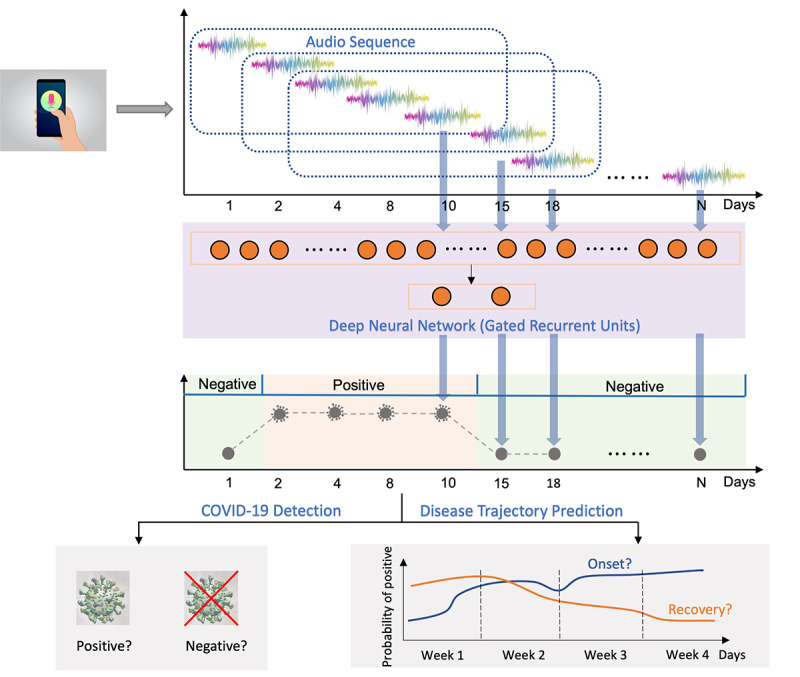
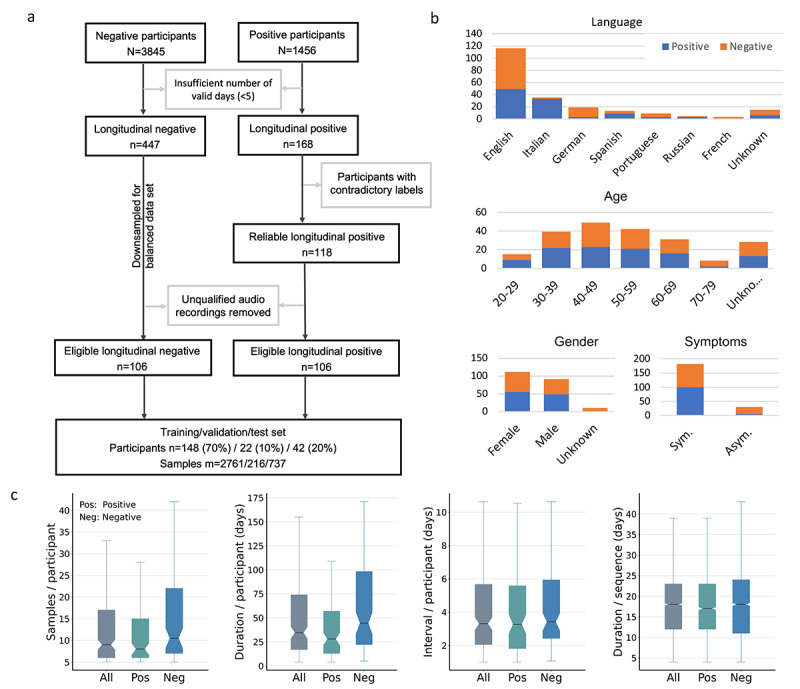
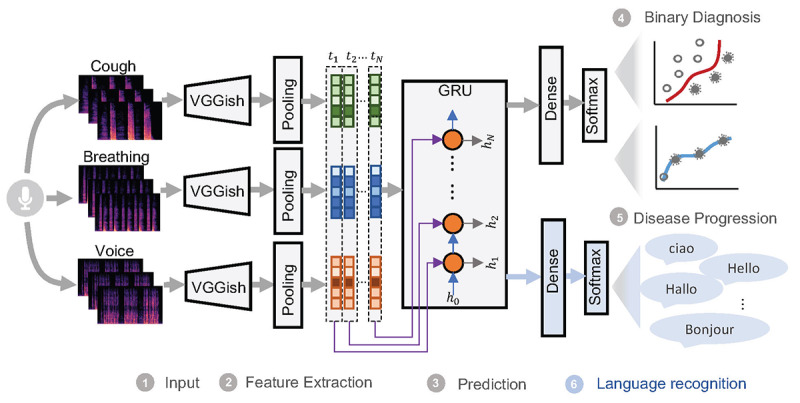
Crowdsourced respiratory audio data, including breathing, cough, and voice samples, from 212 individuals over 5-385 days were analyzed, alongside their self-reported COVID-19 test results. We developed and validated a deep learning-enabled tracking tool using gated recurrent units (GRUs) to detect COVID-19 progression by exploring the audio dynamics of the individuals' historical audio biomarkers. The investigation comprised 2 parts: (1) COVID-19 detection in terms of positive and negative (healthy) tests using sequential audio signals, which was primarily assessed in terms of the area under the receiver operating characteristic curve (AUROC), sensitivity, and specificity, with 95% CIs, and (2) longitudinal disease progression prediction over time in terms of probability of positive tests, which was evaluated using the correlation between the predicted probability trajectory and self-reported labels.
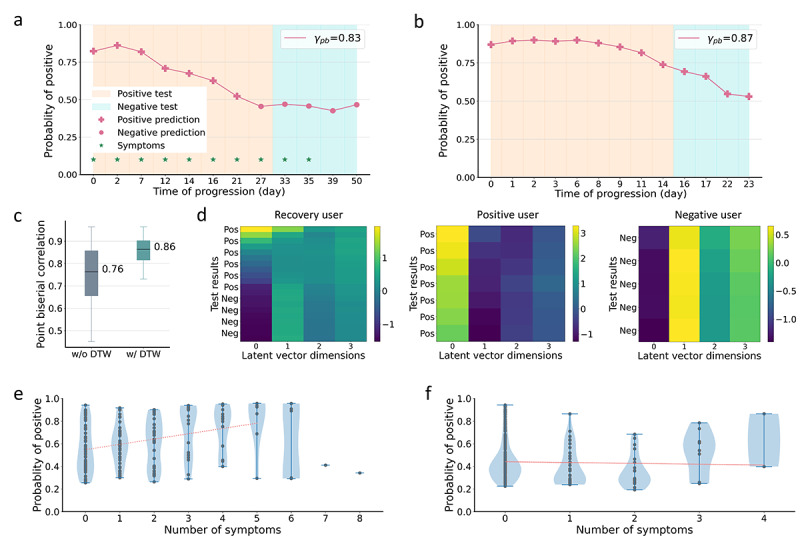
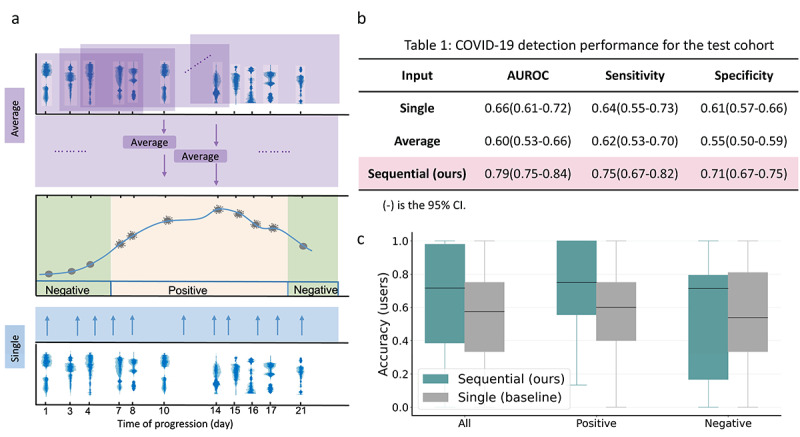
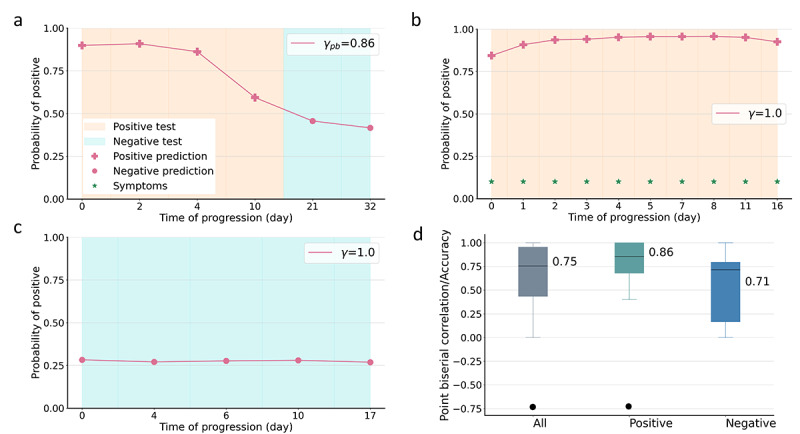
We first explored the benefits of capturing longitudinal dynamics of audio biomarkers for COVID-19 detection. The strong performance, yielding an AUROC of 0.79, a sensitivity of 0.75, and a specificity of 0.71 supported the effectiveness of the approach compared to methods that do not leverage longitudinal dynamics. We further examined the predicted disease progression trajectory, which displayed high consistency with longitudinal test results with a correlation of 0.75 in the test cohort and 0.86 in a subset of the test cohort with 12 (57.1%) of 21 COVID-19-positive participants who reported disease recovery. Our findings suggest that monitoring COVID-19 evolution via longitudinal audio data has potential in the tracking of individuals' disease progression and recovery.
An audio-based COVID-19 progression monitoring system was developed using deep learning techniques, with strong performance showing high consistency between the predicted trajectory and the test results over time, especially for recovery trend predictions. This has good potential in the postpeak and postpandemic era that can help guide medical treatment and optimize hospital resource allocations. The changes in longitudinal audio samples, referred to as audio dynamics, are associated with COVID-19 progression; thus, modeling the audio dynamics can potentially capture the underlying disease progression process and further aid COVID-19 progression prediction. This framework provides a flexible, affordable, and timely tool for COVID-19 tracking, and more importantly, it also provides a proof of concept of how telemonitoring could be applicable to respiratory diseases monitoring, in general.
最近的研究表明,使用音频数据(如咳嗽、呼吸和语音)进行 COVID-19 筛查具有潜力。然而,这些方法仅关注一次性检测,检测当前音频样本中的感染情况,但无法监测 COVID-19 的疾病进展。很少有研究提出通过纵向音频数据来连续监测 COVID-19 的进展,尤其是康复情况。跟踪疾病进展的特征和康复模式可以提供深入的见解,并导致更及时的治疗或治疗调整,以及更好的医疗保健系统资源管理。
本研究的主要目的是探索随着时间的推移,纵向音频样本在 COVID-19 进展预测方面的潜力,特别是使用序列深度学习技术预测康复趋势。
分析了 212 名个体超过 5-385 天的众包呼吸音频数据,包括呼吸、咳嗽和语音样本,以及他们自我报告的 COVID-19 检测结果。我们使用门控循环单元(GRU)开发并验证了一个深度学习支持的跟踪工具,通过探索个体历史音频生物标志物的音频动态来检测 COVID-19 的进展。该研究包括 2 部分:(1)使用顺序音频信号检测 COVID-19 的阳性和阴性(健康)测试,主要通过接收者操作特征曲线(AUROC)的面积、敏感性和特异性进行评估,置信区间为 95%,(2)使用自我报告标签和预测概率轨迹之间的相关性来评估随时间推移的纵向疾病进展预测。
我们首先探讨了捕捉音频生物标志物纵向动态对 COVID-19 检测的益处。该方法的表现非常出色,AUROC 为 0.79,敏感性为 0.75,特异性为 0.71,与不利用纵向动态的方法相比具有有效性。我们进一步研究了预测疾病进展的轨迹,该轨迹与纵向测试结果高度一致,在测试队列中的相关性为 0.75,在测试队列的一个子集(包含 12 名 COVID-19 阳性参与者中的 57.1%,他们报告了疾病康复)中的相关性为 0.86。我们的研究结果表明,通过纵向音频数据监测 COVID-19 的演变在跟踪个体疾病进展和康复方面具有潜力。
使用深度学习技术开发了一种基于音频的 COVID-19 进展监测系统,该系统具有出色的性能,在随时间推移的预测轨迹和测试结果之间具有高度一致性,特别是对于康复趋势预测。这在疫情后时代具有很好的潜力,可以帮助指导医疗和优化医院资源配置。纵向音频样本的变化,称为音频动态,与 COVID-19 的进展有关;因此,对音频动态进行建模可以潜在地捕获潜在的疾病进展过程,并进一步辅助 COVID-19 进展预测。该框架为 COVID-19 跟踪提供了一种灵活、经济实惠且及时的工具,更重要的是,它还提供了一个概念验证,证明远程监测如何适用于一般的呼吸疾病监测。