Department of Neurology, University of Ulm, Germany.
Department of Neurology, University of Ulm, Germany; German Center for Neurodegenerative Diseases (DZNE), Ulm, Germany.
Neuroimage Clin. 2022;35:103061. doi: 10.1016/j.nicl.2022.103061. Epub 2022 May 28.
Within the core neuroimaging signature of amyotrophic lateral sclerosis (ALS), the corpus callosum (CC) is increasingly recognized as a consistent feature. The aim of this study was to investigate the sensitivity and specificity of the microstructural segmental CC morphology, assessed by diffusion tensor imaging (DTI) and high-resolution T1-weighted (T1w) imaging, in a large cohort of ALS patients including different clinical phenotypes.
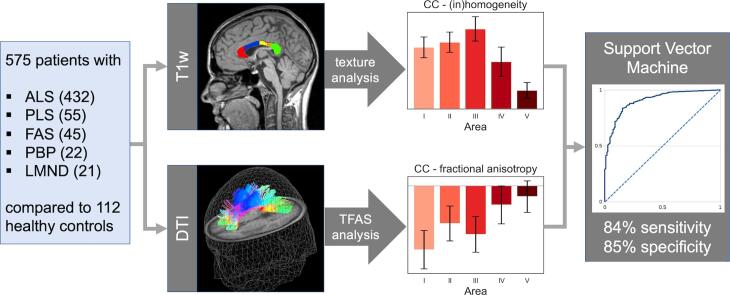
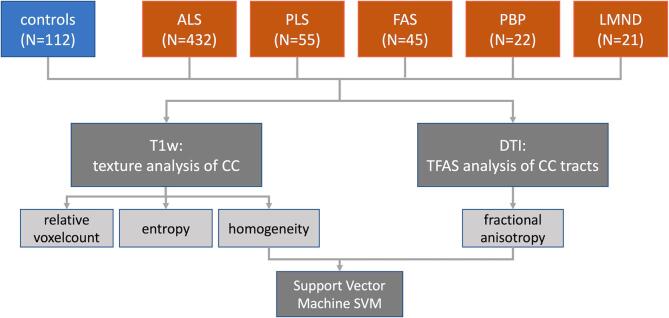
In a single-centre study, 575 patients with ALS (classical phenotype, N = 432; restricted phenotypes primary lateral sclerosis (PLS) N = 55, flail arm syndrome (FAS) N = 45, progressive bulbar palsy (PBP) N = 22, lower motor neuron disease (LMND) N = 21) and 112 healthy controls underwent multiparametric MRI, i.e. volume-rendering T1w scans and DTI. Tract-based fractional anisotropy statistics (TFAS) was applied to callosal tracts of CC areas I-V, identified from DTI data (tract-of-interest (TOI) analysis), and texture analysis was applied to T1w data. In order to further specify the callosal alterations, a support vector machine (SVM) algorithm was used to discriminate between motor neuron disease patients and controls.
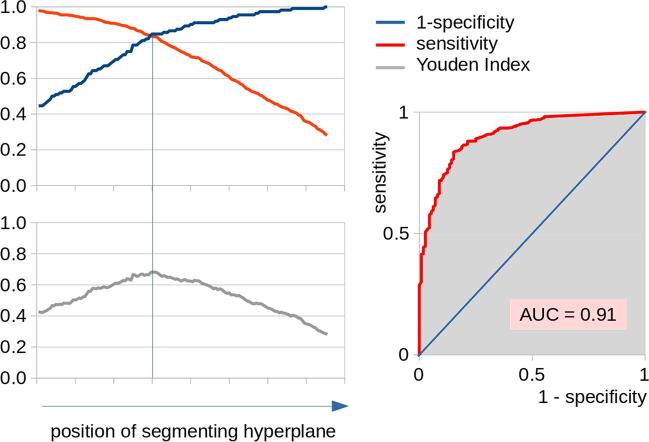
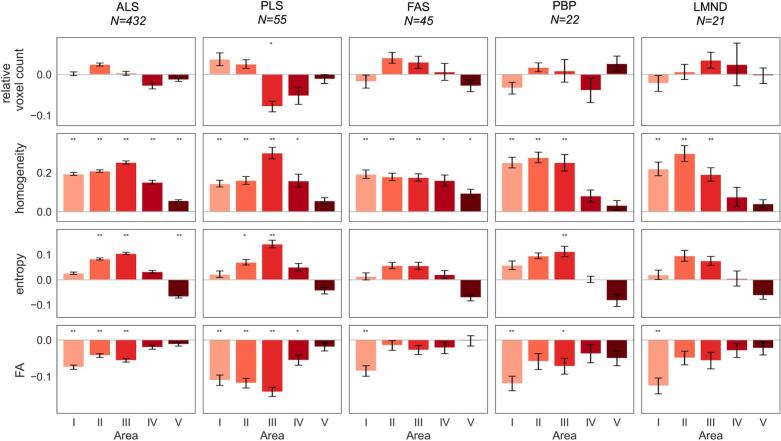
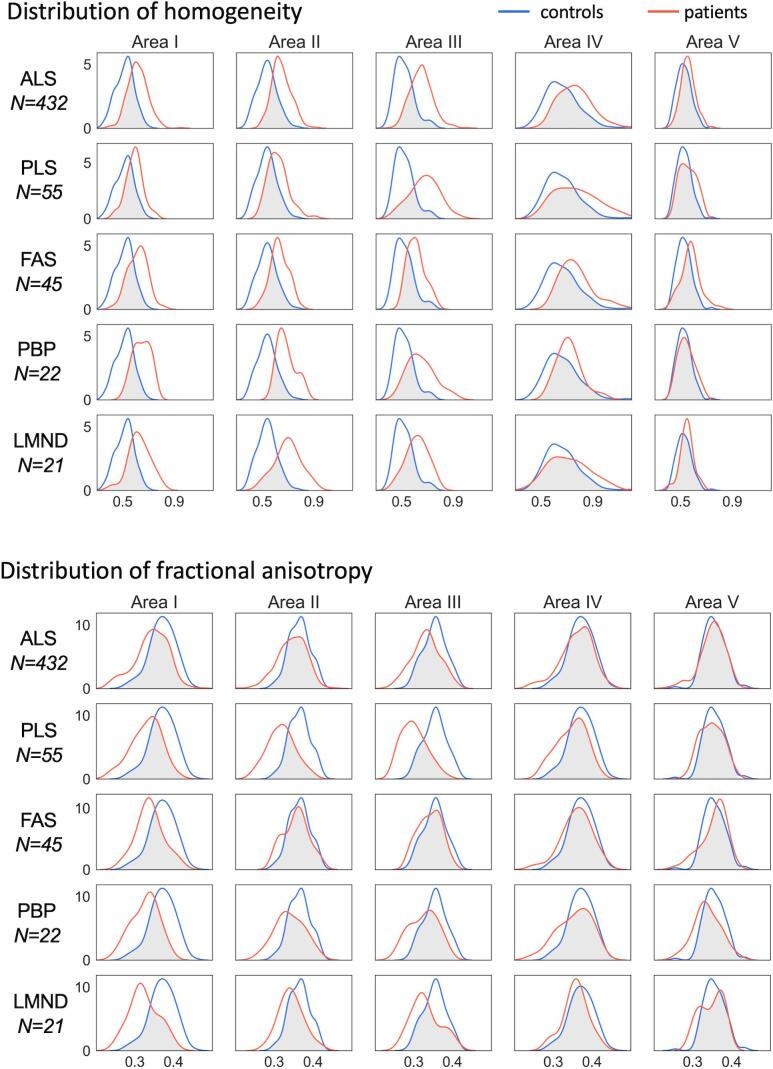
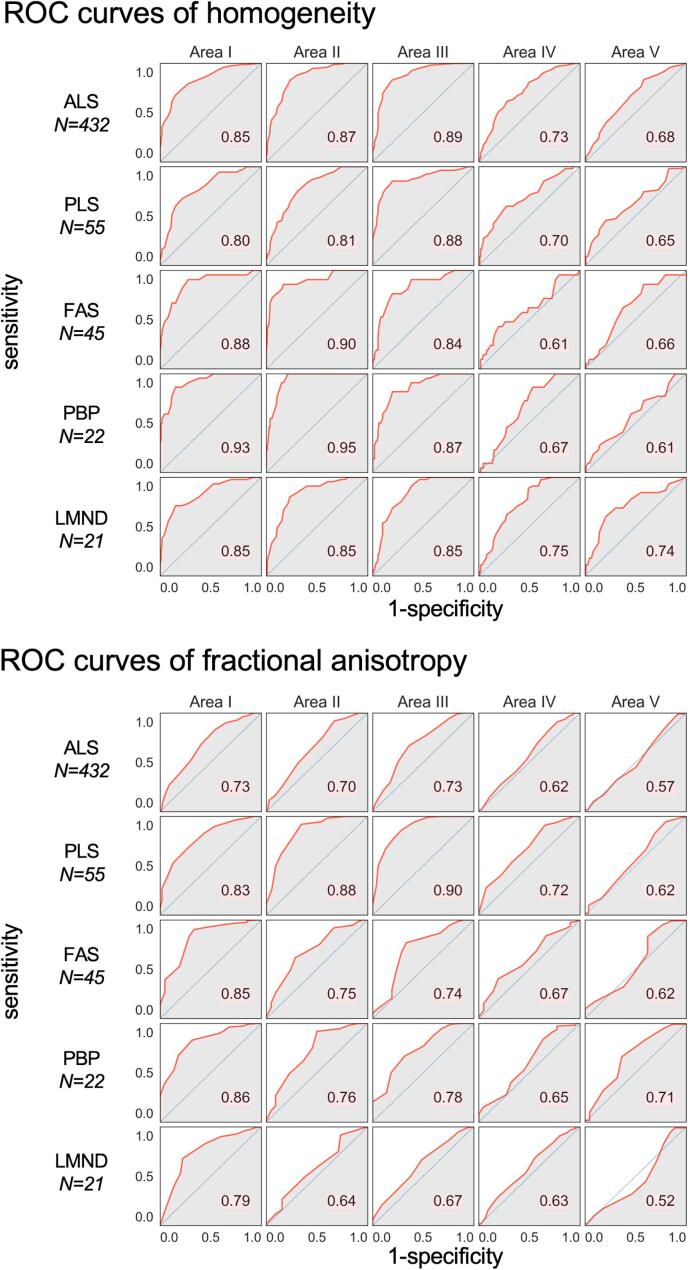
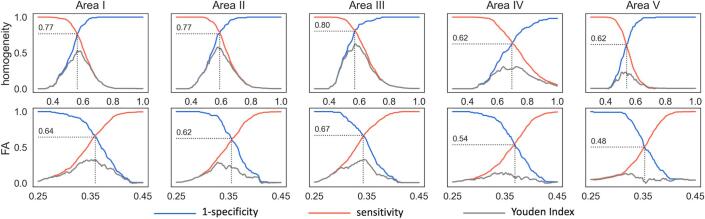
The analysis of white matter integrity revealed predominantly FA reductions for tracts of the callosal areas I, II, and III (with highest reductions in callosal area III) for all ALS patients and separately for each phenotype when compared to controls; texture analysis demonstrated significant alterations of the parameters entropy and homogeneity for ALS patients and all phenotypes for the CC areas I, II, and III (with again highest reductions in callosal area III) compared to controls. With SVM applied on multiparametric callosal parameters of area III, a separation of all ALS patients including phenotypes from controls with 72% sensitivity and 73% specificity was achieved. These results for callosal area III parameters could be improved by an SVM of six multiparametric callosal parameters of areas I, II, and III, achieving a separation of all ALS patients including phenotypes from controls with 84% sensitivity and 85% specificity.
The multiparametric MRI texture and DTI analysis demonstrated substantial alterations of the frontal and central CC with most significant alterations in callosal area III (motor segment) in ALS and separately in all investigated phenotypes (PLS, FAS, PBP, LMND) in comparison to controls, while no significant differences were observed between ALS and its phenotypes. The combination of the texture and the DTI parameters in an unbiased SVM-based approach might contribute as a neuroimaging marker for the assessment of the CC in ALS, including subtypes.
在肌萎缩侧索硬化症(ALS)的核心神经影像学特征中,胼胝体(CC)越来越被认为是一个一致的特征。本研究的目的是在包括不同临床表型的大量 ALS 患者中,通过弥散张量成像(DTI)和高分辨率 T1 加权(T1w)成像,研究 CC 微观结构节段形态的敏感性和特异性。
在一项单中心研究中,575 名 ALS 患者(经典表型,N=432;限局性表型原发性侧索硬化症(PLS),N=55;臂丛张力障碍综合征(FAS),N=45;进行性球麻痹(PBP),N=22;下运动神经元病(LMND),N=21)和 112 名健康对照者接受了多参数 MRI 检查,包括容积再现 T1w 扫描和 DTI。应用基于束的各向异性分数统计量(TFAS)对 DTI 数据中的 CC 区域 I-V 进行感兴趣区(TOI)分析,以评估胼胝体束的各向异性分数。为了进一步明确胼胝体的改变,应用支持向量机(SVM)算法对运动神经元病患者和对照组进行判别分析。
对脑白质完整性的分析显示,所有 ALS 患者和每个表型与对照组相比,CC 区域 I、II 和 III 的 FA 降低最为明显(CC 区域 III 的降低最明显);纹理分析显示,CC 区域 I、II 和 III 的熵和同质性参数在 ALS 患者和所有表型中均有显著改变(CC 区域 III 的降低最明显)。应用 SVM 对 CC 区域 III 的多参数进行分析,可实现对包括所有表型的 ALS 患者与对照组的区分,敏感性为 72%,特异性为 73%。通过对 CC 区域 I、II 和 III 的六个多参数进行 SVM 分析,可将包括所有表型的 ALS 患者与对照组区分开来,敏感性为 84%,特异性为 85%。
多参数 MRI 纹理和 DTI 分析显示,在 ALS 中,CC 的额极和中央部出现明显改变,以 CC 区域 III(运动节段)改变最明显,与对照组相比,在所有研究的表型(PLS、FAS、PBP、LMND)中也有明显改变,而 ALS 与其表型之间无显著差异。在基于 SVM 的无偏方法中,纹理和 DTI 参数的组合可能作为评估 ALS 包括亚型的 CC 的神经影像学标志物。