The African Computational Genomics (TACG) Research Group, MRC/UVRI and LSHTM, Entebbe, Uganda.
Malawi Epidemiology and Intervention Research Unit, Lilongwe, Karonga, Malawi.
Nat Med. 2022 Jun;28(6):1163-1166. doi: 10.1038/s41591-022-01835-x. Epub 2022 Jun 2.
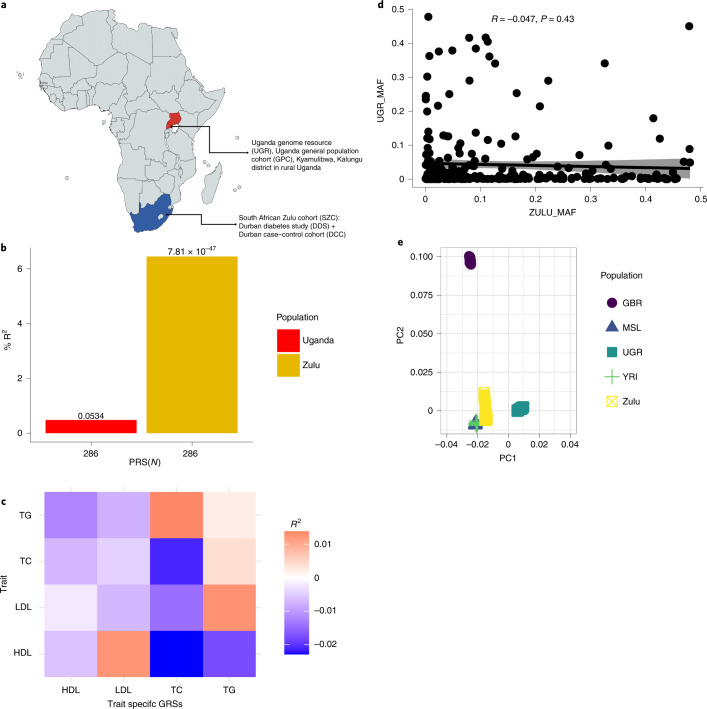
The poor transferability of genetic risk scores (GRSs) derived from European ancestry data in diverse populations is a cause of concern. We set out to evaluate whether GRSs derived from data of African American individuals and multiancestry data perform better in sub-Saharan Africa (SSA) compared to European ancestry-derived scores. Using summary statistics from the Million Veteran Program (MVP), we showed that GRSs derived from data of African American individuals enhance polygenic prediction of lipid traits in SSA compared to European and multiancestry scores. However, our GRS prediction varied greatly within SSA between the South African Zulu (low-density lipoprotein cholesterol (LDL-C), R = 8.14%) and Ugandan cohorts (LDL-C, R = 0.026%). We postulate that differences in the genetic and environmental factors between these population groups might lead to the poor transferability of GRSs within SSA. More effort is required to optimize polygenic prediction in Africa.
遗传风险评分(GRS)源自欧洲血统数据,在不同人群中的可转移性较差,这令人担忧。我们旨在评估源自非裔美国个体数据和多血统数据的 GRS 与源自欧洲血统数据的评分相比,在撒哈拉以南非洲(SSA)的表现是否更好。使用来自百万退伍军人计划(MVP)的汇总统计数据,我们表明,与欧洲和多血统评分相比,源自非裔美国个体数据的 GRS 增强了 SSA 中脂质特征的多基因预测。然而,我们的 GRS 预测在 SSA 内部的南非祖鲁(LDL-C,R=8.14%)和乌干达队列(LDL-C,R=0.026%)之间差异很大。我们推测,这些人群群体之间遗传和环境因素的差异可能导致 GRS 在 SSA 内部的可转移性较差。需要付出更多努力来优化非洲的多基因预测。