Bruyère Olivier, Reginster Jean-Yves, Honvo Germain
WHO Collaborating Centre for Public Health Aspects of Musculo-Skeletal Health and Ageing, Division of Public Health, Epidemiology and Health Economics, University of Liège, CHU-Sart Tilman, Quartier Hôpital, Avenue Hippocrate 13 (Bât. B23), 4000, Liège, Belgium.
Rheumatol Ther. 2022 Aug;9(4):1119-1128. doi: 10.1007/s40744-022-00466-5. Epub 2022 Jun 3.
In a recent randomized placebo-controlled trial, a single intra-articular injection of a high and low molecular weight hyaluronic acid formulation (HA-HL) was shown to be effective in providing a clinically meaningful reduction in pain and functional limitation up to 24 weeks in subjects with painful knee osteoarthritis (OA). The objective of this post hoc analyses is to assess the cost-effectiveness of HA-HL compared with placebo using individual patient data from this clinical trial in a Swiss health care perspective.
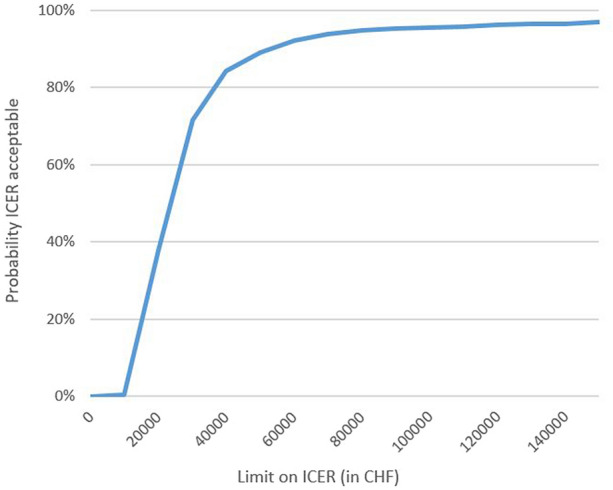
A total of 692 patients fulfilling the inclusion criteria were randomly allocated to HA-HL or placebo groups. Each patient received one intra-articular injection of HA-HL or placebo at baseline and was then followed-up for a total duration of 24 weeks with five follow-up visits (i.e., after weeks 1, 6, 12, 18, and 24). The EQ-5D-5L five-point verbal Likert scale was used to calculate the health utility and the related quality-adjusted life-years (QALYs) using the area-under-the-curve (AUC) method. For the costs, the price of HA-HL in Switzerland was used. The primary threshold for the incremental cost/effectiveness ratio (ICER) below which HA-HL was considered as cost-effective was 91,540 Swiss francs (CHF) per QALY (i.e., US $100,000).
No significant difference between the baseline characteristics of the HA-HL group and the placebo group was observed. With a mean ICER of 27,212 CHF per QALY (95% CI 20,135-34,289), HA-HL was considered as cost-effective compared to placebo. Sensitivity analyses (e.g., using lower or upper limit prices or using other threshold values) gave similar results, i.e., ICERs far below the threshold values of cost-effectiveness.
These results confirm the role of HA-HL as a cost-effective therapeutic option in the management of OA. However, more studies taking into account the utilization of other health care resources are needed.
在最近一项随机安慰剂对照试验中,对于患有疼痛性膝骨关节炎(OA)的受试者,单次关节内注射高分子量和低分子量透明质酸制剂(HA-HL)被证明在长达24周的时间内能够有效减轻疼痛并改善功能受限,具有临床意义。这项事后分析的目的是从瑞士医疗保健的角度,使用该临床试验的个体患者数据,评估HA-HL与安慰剂相比的成本效益。
共有692名符合纳入标准的患者被随机分配至HA-HL组或安慰剂组。每位患者在基线时接受一次关节内注射HA-HL或安慰剂,随后进行为期24周的随访,共进行五次随访(即第1、6、12、18和24周后)。使用EQ-5D-5L五点语言Likert量表,采用曲线下面积(AUC)方法计算健康效用和相关的质量调整生命年(QALY)。对于成本,使用了瑞士HA-HL的价格。增量成本/效益比(ICER)的主要阈值为每QALY 91,540瑞士法郎(CHF)(即100,000美元),低于该阈值则认为HA-HL具有成本效益。
HA-HL组和安慰剂组的基线特征未观察到显著差异。HA-HL的平均ICER为每QALY 27,212 CHF(95% CI 20,135 - 34,289),与安慰剂相比被认为具有成本效益。敏感性分析(例如,使用下限或上限价格或使用其他阈值)得出了类似的结果,即ICER远低于成本效益阈值。
这些结果证实了HA-HL作为OA管理中具有成本效益的治疗选择的作用。然而,需要更多考虑其他医疗保健资源利用情况的研究。