Lv Kangkang, Hu Bo, Xu Mingzhu, Wan Li, Jin Ziqi, Xu Mimi, Du Yuanyuan, Ma Kunpeng, Lv Quansheng, Xu Yang, Lei Lei, Gong Huanle, Liu Haiyan, Wu Depei, Liu Yuejun
National Clinical Research Center for Hematologic Diseases, Jiangsu Institute of Hematology, The First Affiliated Hospital of Soochow University, Shizi Street 188, Suzhou, 215006, China.
Institute of Blood and Marrow Transplantation, Collaborative Innovation Center of Hematology, Soochow University, Suzhou, China.
Exp Hematol Oncol. 2022 Jun 2;11(1):34. doi: 10.1186/s40164-022-00286-x.
Chronic graft-versus-host disease (cGVHD) remains a major complication during the late phase of allogeneic hematopoietic stem cell transplantation (allo-HSCT). IL-39, a newly described pro-inflammatory cytokine belonging to the IL-12 family, plays a role in lupus development. Recently, IL-39 has been identified as a pathogenic factor in acute GVHD (aGVHD). However, the role of IL-39 in the pathogenesis of cGVHD remains unclear.
We constructed a recombinant IL-39 plasmid and established scleroderma and lupus-like cGVHD models. Quantitative PCR and enzyme-linked immunosorbent assay (ELISA) were used to detect IL-39 expression in mice and patients post transplantation, respectively. Hydrodynamic gene transfer (HGT) was performed to achieve IL-39 overexpression in vivo. Multiparameter flow cytometry, western blotting, and assays in vitro were performed to investigate the effect of IL-39 on cGVHD.
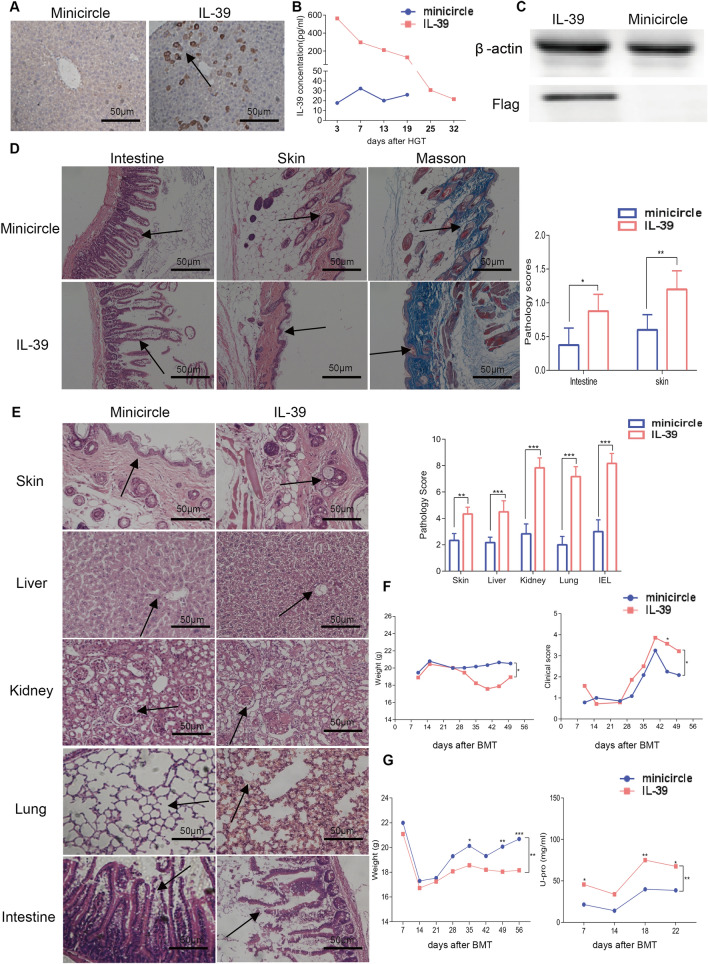
The relative expression of IL-23p19 and EBi3 was significantly increased in the intestine of cGVHD mice on day 40 post allo-HSCT, and IL-39 levels were significantly elevated in the serum of patients following allo-HSCT. Overexpression of IL-39 significantly aggravated the severity of cGVHD. Increased IL-39 levels promoted T-cell activation and germinal center responses, and may exacerbate thymic damage. Consistently, blocking IL-39 markedly ameliorated immune dysregulation in the cGVHD mice. Furthermore, we found that IL-39 was produced by B cells, CD11b cells, and CD8T cells after activation. Stimulation of IL-39 led to upregulation of the IL-39 receptor on CD4T cells and further caused activation of the STAT1/STAT3 pathway, through which IL-39 may exert its pro-inflammatory effects.
Our study reveals a critical role for IL-39 in cGVHD pathogenesis and indicates that IL-39 may serve as a potential therapeutic target for cGVHD prevention.
慢性移植物抗宿主病(cGVHD)仍是异基因造血干细胞移植(allo-HSCT)后期的主要并发症。白细胞介素-39(IL-39)是一种新发现的属于白细胞介素-12家族的促炎细胞因子,在狼疮发展中起作用。最近,IL-39已被确定为急性移植物抗宿主病(aGVHD)的致病因素。然而,IL-39在cGVHD发病机制中的作用仍不清楚。
我们构建了重组IL-39质粒,并建立了硬皮病和狼疮样cGVHD模型。分别采用定量聚合酶链反应(PCR)和酶联免疫吸附测定(ELISA)检测移植后小鼠和患者体内的IL-39表达。通过流体动力学基因转移(HGT)在体内实现IL-39的过表达。采用多参数流式细胞术、蛋白质免疫印迹法及体外实验研究IL-39对cGVHD的影响。
allo-HSCT后40天,cGVHD小鼠肠道中IL-23p19和EBi3的相对表达显著增加,allo-HSCT后患者血清中IL-39水平显著升高。IL-39过表达显著加重了cGVHD的严重程度。IL-39水平升高促进T细胞活化和生发中心反应,并可能加重胸腺损伤。同样,阻断IL-39可显著改善cGVHD小鼠的免疫失调。此外,我们发现活化后的B细胞、CD11b细胞和CD8T细胞可产生IL-39。IL-39刺激导致CD4T细胞上IL-39受体上调,并进一步引起信号转导和转录激活因子1/信号转导和转录激活因子3(STAT1/STAT3)通路的激活,IL-39可能通过该通路发挥其促炎作用。
我们的研究揭示了IL-39在cGVHD发病机制中的关键作用,并表明IL-39可能作为预防cGVHD的潜在治疗靶点。