Department of Entomology, Cornell University, Ithaca, NY, USA.
Cornell Institute of Host-Microbe Interactions and Disease, Cornell University, Ithaca, NY, USA.
BMC Biol. 2022 Jun 2;20(1):127. doi: 10.1186/s12915-022-01328-w.
Single tissues can have multiple functions, which can result in constraints, impaired function, and tradeoffs. The insect fat body performs remarkably diverse functions including metabolic control, reproductive provisioning, and systemic immune responses. How polyfunctional tissues simultaneously execute multiple distinct physiological functions is generally unknown. Immunity and reproduction are observed to trade off in many organisms but the mechanistic basis for this tradeoff is also typically not known. Here we investigate constraints and trade-offs in the polyfunctional insect fat body.
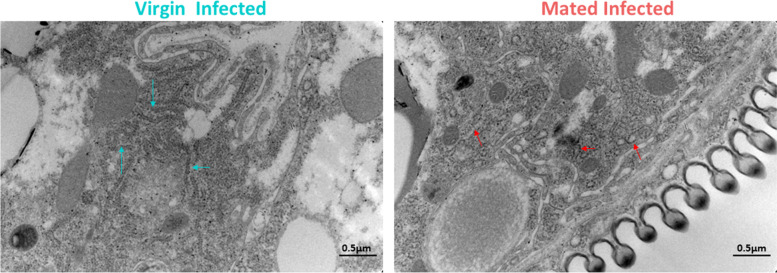
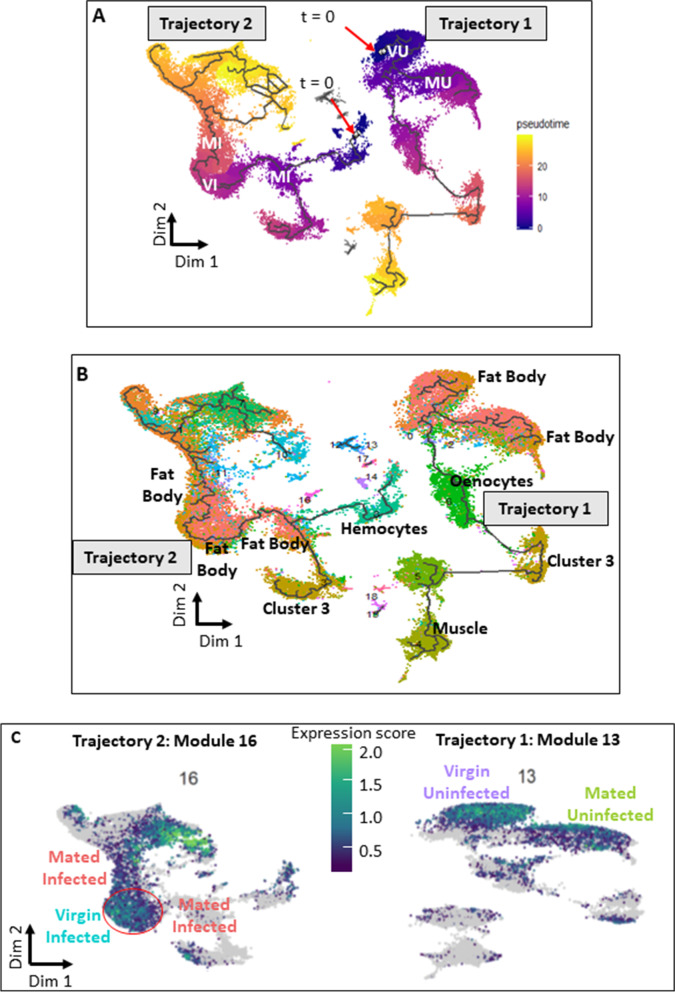
Using single-nucleus sequencing, we determined that the Drosophila melanogaster fat body executes diverse basal functions with heterogenous cellular subpopulations. The size and identity of these subpopulations are remarkably stable between virgin and mated flies, as well as before and after infection. However, as an emergency function, the immune response engages the entire tissue and all cellular subpopulations produce induce expression of defense genes. We found that reproductively active females who were given bacterial infection exhibited signatures of ER stress and impaired capacity to synthesize new protein in response to infection, including decreased capacity to produce antimicrobial peptides. Transient provision of a reversible translation inhibitor to mated females prior to infection rescued general protein synthesis, specific production of antimicrobial peptides, and survival of infection.
The commonly observed tradeoff between reproduction and immunity appears to be driven, in D. melanogaster, by a failure of the fat body to be able to handle simultaneous protein translation demands of reproductive provisioning and immune defense. We suggest that inherent cellular limitations in tissues that perform multiple functions may provide a general explanation for the wide prevalence of physiological and evolutionary tradeoffs.
单一组织可能具有多种功能,这可能会导致约束、功能受损和权衡。昆虫脂肪体具有显著多样的功能,包括代谢控制、生殖供应和全身免疫反应。多能组织如何同时执行多种不同的生理功能通常是未知的。在许多生物体中观察到免疫和生殖之间存在权衡,但这种权衡的机制基础通常也不清楚。在这里,我们研究了多功能昆虫脂肪体的约束和权衡。
使用单核测序,我们确定了黑腹果蝇脂肪体通过异质细胞亚群执行不同的基础功能。这些亚群的大小和身份在处女和交配的苍蝇之间以及感染前后都非常稳定。然而,作为一种紧急功能,免疫反应涉及整个组织,所有细胞亚群都会产生防御基因的诱导表达。我们发现,接受细菌感染的生殖活跃的雌性表现出内质网应激的特征,并表现出合成新蛋白质的能力受损,包括产生抗菌肽的能力降低。在感染前给交配的雌性短暂提供可逆的翻译抑制剂,可以挽救一般蛋白质合成、特定抗菌肽的产生和对感染的存活。
在 D. melanogaster 中,生殖和免疫之间常见的权衡似乎是由脂肪体无法同时满足生殖供应和免疫防御的蛋白质翻译需求所驱动。我们认为,执行多种功能的组织中固有的细胞限制可能为广泛存在的生理和进化权衡提供了一个普遍的解释。