Jiang Li-Ping, Yu Xiao-Hua, Chen Jin-Zhi, Hu Mi, Zhang Yang-Kai, Lin Hui-Ling, Tang Wan-Ying, He Ping-Ping, Ouyang Xin-Ping
1Department of Physiology, Institute of Neuroscience Research, Hengyang Key Laboratory of Neurodegeneration and Cognitive Impairment, Hunan Province Cooperative Innovation Center for Molecular Target New Drug Study, Hengyang Medical School, University of South China, Hunan, China.
2Institute of Clinical Medicine, the Second Affiliated Hospital of Hainan Medical University, Haikou, China.
Aging Dis. 2022 Jun 1;13(3):773-786. doi: 10.14336/AD.2021.1116. eCollection 2022 Jun.
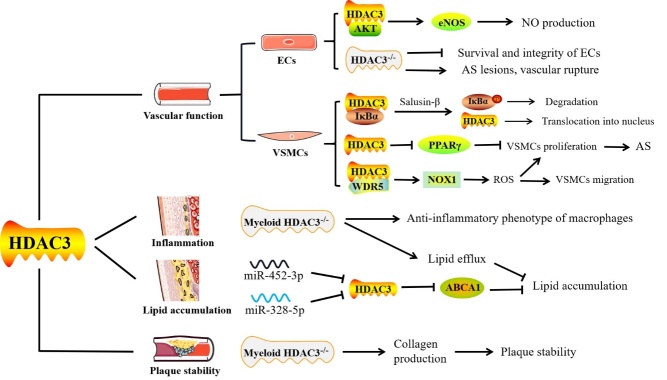
Atherosclerosis, the pathological basis of most cardiovascular disease, is characterized by plaque formation in the intima. Secondary lesions include intraplaque hemorrhage, plaque rupture, and local thrombosis. Vascular endothelial function impairment and smooth muscle cell migration lead to vascular dysfunction, which is conducive to the formation of macrophage-derived foam cells and aggravates inflammatory response and lipid accumulation that cause atherosclerosis. Histone deacetylase (HDAC) is an epigenetic modifying enzyme closely related to chromatin structure and gene transcriptional regulation. Emerging studies have demonstrated that the Class I member HDAC3 of the HDAC super family has cell-specific functions in atherosclerosis, including 1) maintenance of endothelial integrity and functions, 2) regulation of vascular smooth muscle cell proliferation and migration, 3) modulation of macrophage phenotype, and 4) influence on foam cell formation. Although several studies have shown that HDAC3 may be a promising therapeutic target, only a few HDAC3-selective inhibitors have been thoroughly researched and reported. Here, we specifically summarize the impact of HDAC3 and its inhibitors on vascular function, inflammation, lipid accumulation, and plaque stability in the development of atherosclerosis with the hopes of opening up new opportunities for the treatment of cardiovascular diseases.
动脉粥样硬化是大多数心血管疾病的病理基础,其特征是在内膜形成斑块。继发性病变包括斑块内出血、斑块破裂和局部血栓形成。血管内皮功能障碍和平滑肌细胞迁移导致血管功能障碍,这有利于巨噬细胞衍生的泡沫细胞形成,并加剧导致动脉粥样硬化的炎症反应和脂质积累。组蛋白去乙酰化酶(HDAC)是一种与染色质结构和基因转录调控密切相关的表观遗传修饰酶。新兴研究表明,HDAC超家族的I类成员HDAC3在动脉粥样硬化中具有细胞特异性功能,包括:1)维持内皮完整性和功能;2)调节血管平滑肌细胞增殖和迁移;3)调节巨噬细胞表型;4)影响泡沫细胞形成。尽管多项研究表明HDAC3可能是一个有前景的治疗靶点,但只有少数HDAC3选择性抑制剂得到了深入研究和报道。在此,我们特别总结了HDAC3及其抑制剂在动脉粥样硬化发展过程中对血管功能、炎症、脂质积累和斑块稳定性的影响,以期为心血管疾病的治疗开辟新的机会。