Bonello Matthew, Farrugia Philip, Buhagiar Nathalie, Mercieca Joseph
University of Malta, Malta.
J Rehabil Assist Technol Eng. 2022 May 25;9:20556683221103164. doi: 10.1177/20556683221103164. eCollection 2022 Jan-Dec.
This paper takes a multi-stakeholder approach to generate key requirements to design smart habilitation devices for children with Cerebral Palsy. Four groups of different relevant stakeholders of smart-habilitation devices were approached to participate in this study, including children with Cerebral Palsy, their parents, occupational therapists, as well as technical specialists.
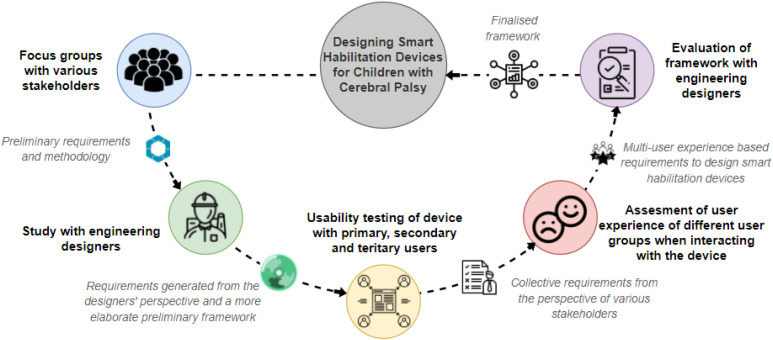
Profiles of children with Cerebral Palsy were generated to have a concrete idea of their needs and desires. Meanwhile, for the three stakeholders, focus groups were used to gather their insights and requirements on a prospective smart habilitation device for children. Successively, a thematic analysis was conducted to analyse the qualitative data obtained during the focus groups.
Eight design requirements were developed to generate designs which stimulate high quality user experiences in children and other users of smart habilitation devices. In addition, an initial framework of the process that design engineers would follow to design such devices for children was proposed.
Adopting this framework, and the respective requirements, will help design engineers to implement a multi-user approach and amend the design according to stakeholders' goals and desires. The resulted design should ensure a high quality user experience for both the active and potential passive users of smart habilitation devices.
本文采用多利益相关者方法来生成关键需求,以设计针对脑瘫儿童的智能康复设备。研究邀请了智能康复设备的四类不同相关利益者参与,包括脑瘫儿童、他们的父母、职业治疗师以及技术专家。
生成脑瘫儿童的概况,以便具体了解他们的需求和愿望。同时,针对三类利益相关者,使用焦点小组来收集他们对一款面向儿童的前瞻性智能康复设备的见解和需求。随后,进行了主题分析,以分析在焦点小组期间获得的定性数据。
制定了八项设计要求,以生成能够为智能康复设备的儿童及其他用户带来高质量用户体验的设计。此外,还提出了设计工程师为儿童设计此类设备时应遵循的流程的初步框架。
采用此框架及相应要求,将有助于设计工程师实施多用户方法,并根据利益相关者的目标和愿望修改设计。最终设计应确保智能康复设备的主动和潜在被动用户都能获得高质量的用户体验。