School of Health Sciences and Social Work, Griffith University, Gold Coast, QLD, Australia.
Griffith Centre of Biomedical and Rehabilitation Engineering (GCORE), Menzies Health Institute Queensland, Griffith University, Gold Coast, QLD, Australia.
Sports Med. 2022 Oct;52(10):2405-2429. doi: 10.1007/s40279-022-01695-y. Epub 2022 Jun 3.
Exposure to increased mechanical loading during physical training can lead to increased tendon stiffness. However, the loading regimen that maximises tendon adaptation and the extent to which adaptation is driven by changes in tendon material properties or tendon geometry is not fully understood.
To determine (1) the effect of mechanical loading on tendon stiffness, modulus and cross-sectional area (CSA); (2) whether adaptations in stiffness are driven primarily by changes in CSA or modulus; (3) the effect of training type and associated loading parameters (relative intensity; localised strain, load duration, load volume and contraction mode) on stiffness, modulus or CSA; and (4) whether the magnitude of adaptation in tendon properties differs between age groups.
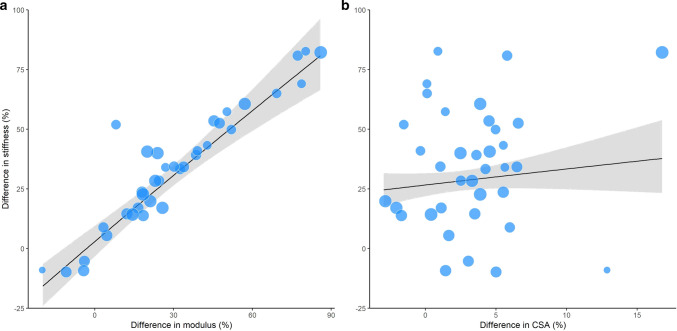
Five databases (PubMed, Scopus, CINAHL, SPORTDiscus, EMBASE) were searched for studies detailing load-induced adaptations in tendon morphological, material or mechanical properties. Standardised mean differences (SMDs) with 95% confidence intervals (CIs) were calculated and data were pooled using a random effects model to estimate variance. Meta regression was used to examine the moderating effects of changes in tendon CSA and modulus on tendon stiffness.
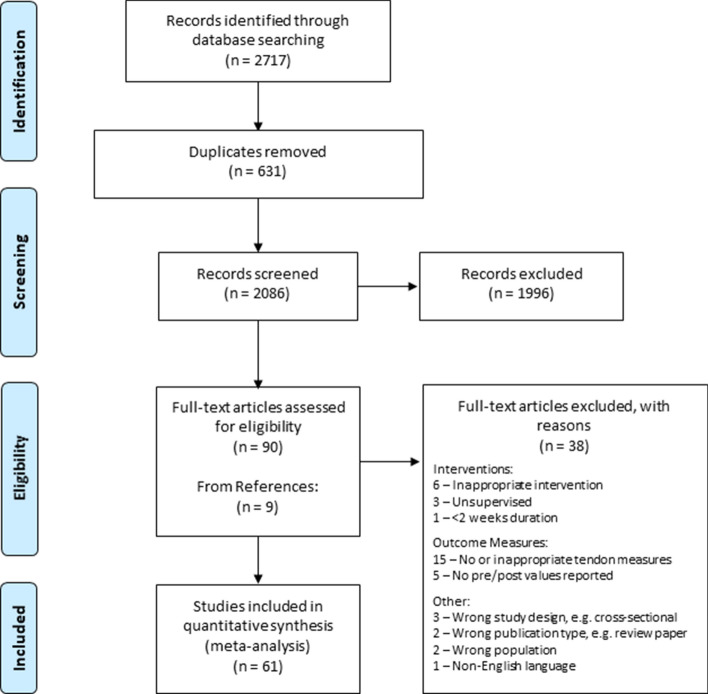
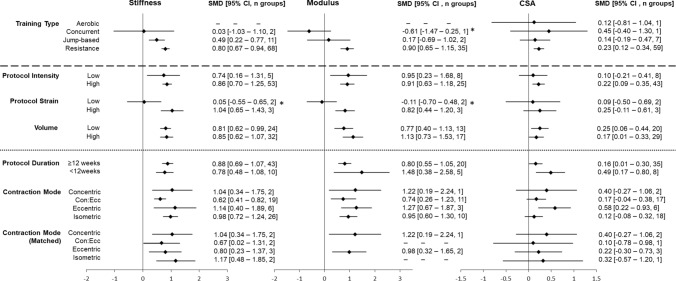
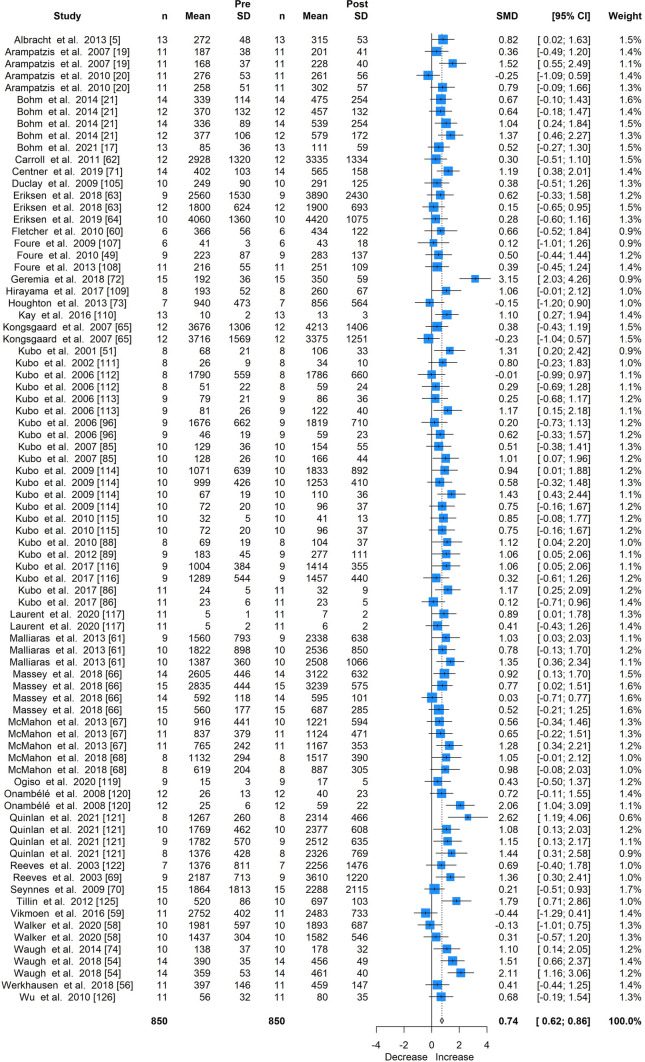
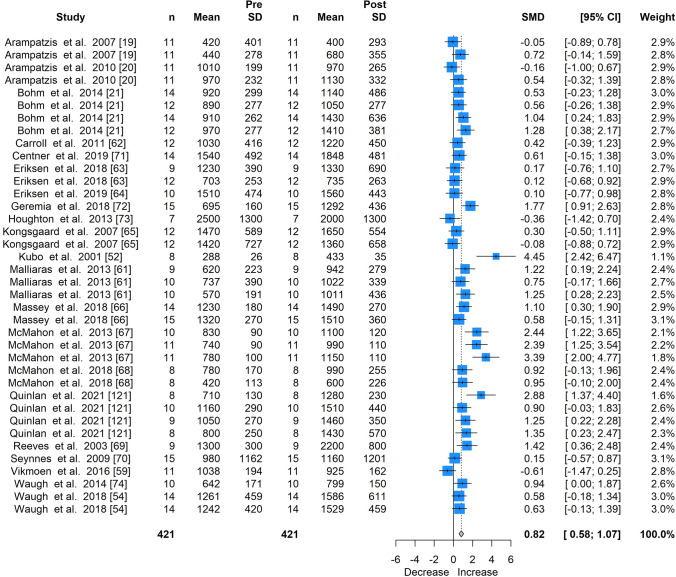
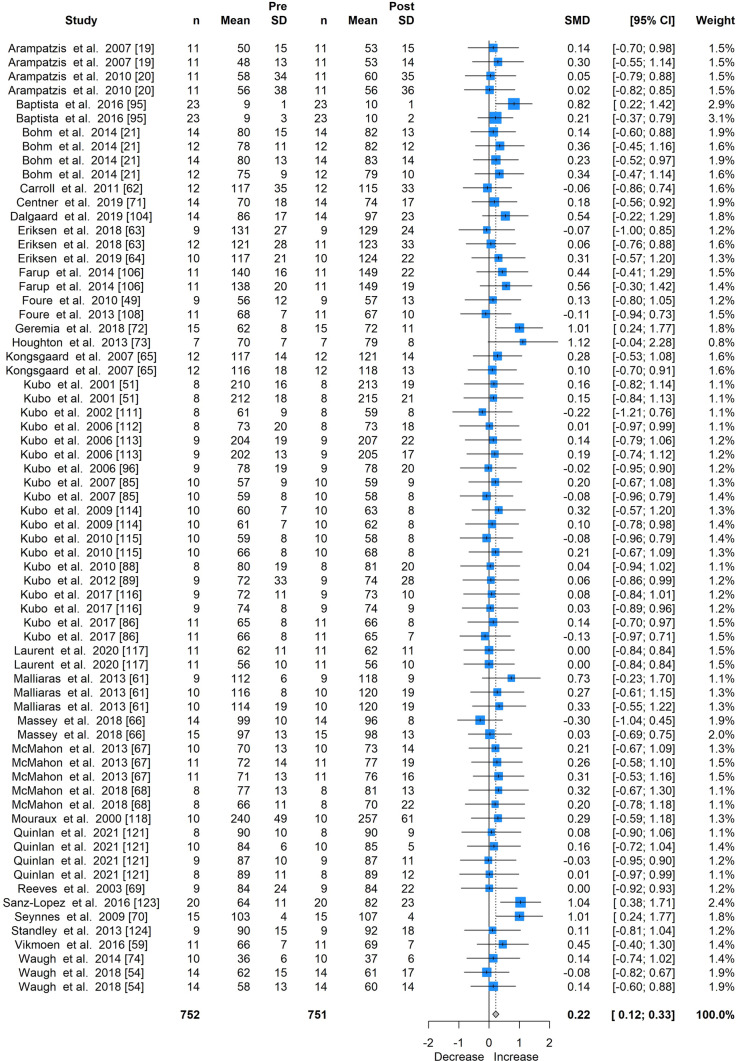
Sixty-one articles met the inclusion criteria. The total number of participants in the included studies was 763. The Achilles tendon (33 studies) and the patella tendon (24 studies) were the most commonly studied regions. Resistance training was the main type of intervention (49 studies). Mechanical loading produced moderate increases in stiffness (standardised mean difference (SMD) 0.74; 95% confidence interval (CI) 0.62-0.86), large increases in modulus (SMD 0.82; 95% CI 0.58-1.07), and small increases in CSA (SMD 0.22; 95% CI 0.12-0.33). Meta-regression revealed that the main moderator of increased stiffness was modulus. Resistance training interventions induced greater increases in modulus than other training types (SMD 0.90; 95% CI 0.65-1.15) and higher strain resistance training protocols induced greater increases in modulus (SMD 0.82; 95% CI 0.44-1.20; p = 0.009) and stiffness (SMD 1.04; 95% CI 0.65-1.43; p = 0.007) than low-strain protocols. The magnitude of stiffness and modulus differences were greater in adult participants.
Mechanical loading leads to positive adaptation in lower limb tendon stiffness, modulus and CSA. Studies to date indicate that the main mechanism of increased tendon stiffness due to physical training is increased tendon modulus, and that resistance training performed at high compared to low localised tendon strains is associated with the greatest positive tendon adaptation. PROSPERO registration no.: CRD42019141299.
在体育训练中,增加机械负荷会导致肌腱硬度增加。然而,最大限度地提高肌腱适应能力的负荷方案以及适应能力主要是由肌腱材料特性还是肌腱几何形状的变化驱动的,目前还不完全清楚。
确定(1)机械负荷对肌腱硬度、模量和横截面积(CSA)的影响;(2)硬度的适应性变化是否主要由 CSA 或模量的变化驱动;(3)训练类型和相关负荷参数(相对强度;局部应变、负荷持续时间、负荷量和收缩模式)对硬度、模量或 CSA 的影响;以及(4)肌腱性质的适应程度是否因年龄组而异。
在五个数据库(PubMed、Scopus、CINAHL、SPORTDiscus 和 EMBASE)中搜索详细描述肌腱形态、材料或机械性能的负荷诱导适应性的研究。使用随机效应模型计算标准化均数差(SMD)和 95%置信区间(CI),并对数据进行汇总以估计方差。Meta 回归用于研究肌腱 CSA 和模量变化对肌腱硬度的调节作用。
61 篇文章符合纳入标准。纳入研究的总参与者人数为 763 人。跟腱(33 项研究)和髌腱(24 项研究)是最常研究的部位。阻力训练是主要的干预类型(49 项研究)。机械负荷会导致硬度适度增加(SMD 0.74;95%CI 0.62-0.86)、模量大幅增加(SMD 0.82;95%CI 0.58-1.07)和 CSA 适度增加(SMD 0.22;95%CI 0.12-0.33)。Meta 回归显示,增加硬度的主要调节因素是模量。阻力训练干预引起的模量增加大于其他训练类型(SMD 0.90;95%CI 0.65-1.15),而较高应变的阻力训练方案引起的模量增加(SMD 0.82;95%CI 0.44-1.20;p=0.009)和硬度(SMD 1.04;95%CI 0.65-1.43;p=0.007)比低应变方案更大。成人参与者的硬度和模量差异幅度更大。
机械负荷会导致下肢肌腱硬度、模量和 CSA 产生积极的适应性变化。目前的研究表明,由于体育训练导致肌腱硬度增加的主要机制是肌腱模量增加,与低局部肌腱应变相比,高局部肌腱应变的阻力训练与最大的正肌腱适应性相关。PROSPERO 注册号:CRD42019141299。