Walker Simon, Trezise Joanne, Haff Guy Gregory, Newton Robert U, Häkkinen Keijo, Blazevich Anthony J
NeuroMuscular Research Center, Faculty of Sport and Health Sciences, University of Jyväskylä, Room VIV223, 40014, Jyväskylä, Finland.
School of Medical and Health Sciences, Centre for Exercise and Sports Science Research, Edith Cowan University, Joondalup, WA, Australia.
Eur J Appl Physiol. 2020 Nov;120(11):2371-2382. doi: 10.1007/s00421-020-04462-x. Epub 2020 Aug 9.
This study examined whether additional external load during the eccentric phase of lower limb strength training exercises led to greater adaptations in knee extensor strength, muscle architecture, and patellar tendon properties than traditional concentric-eccentric training in already-trained men.
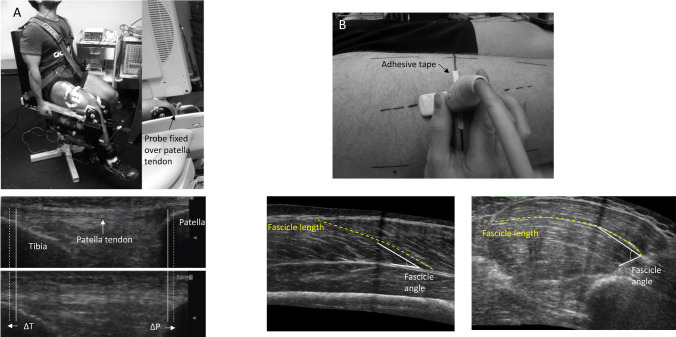
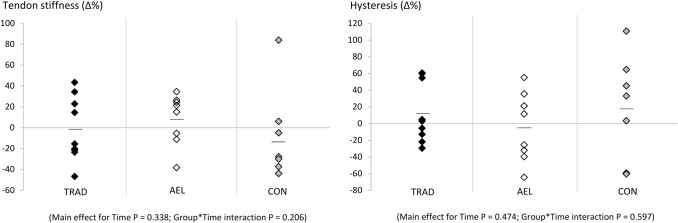
Twenty-eight men accustomed to strength training were randomized to undertake 10 weeks of supervised traditional (TRAD) or accentuated eccentric loading (AEL) or continue their habitual unsupervised (CON) strength training. TRAD and AEL trained 2∙week with a six-repetition maximum (RM) session and a ten-RM session. TRAD used the same external load in both concentric and eccentric phases, while AEL used 40% greater load during the eccentric than concentric phase. Tests were performed at pre- and post-training, including: maximum unilateral isokinetic (30°·s) concentric, eccentric and isometric torques by isokinetic dynamometry, unilateral isometric ramp contractions with muscle-tendon ultrasound imaging to measure tendon stiffness and hysteresis, and resting vastus lateralis and medialis fascicle angle and length measured by extended-field-of-view ultrasound.
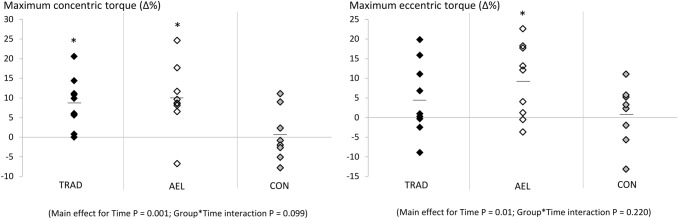
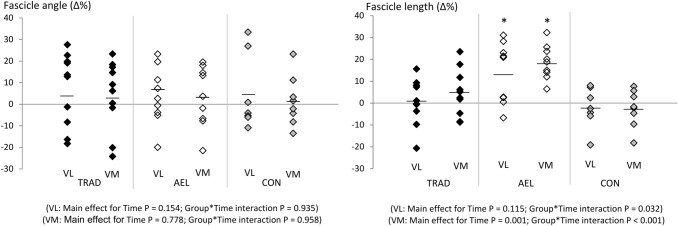
After training, both TRAD and AEL significantly increased maximum concentric and isometric torque (p < 0.05), but only AEL increased eccentric torque (AEL: + 10 ± 9%, TRAD: + 4 ± 9%) and vastus lateralis (AEL: + 14 ± 14%, TRAD: + 1 ± 10%) and medialis (AEL: + 19 ± 8%, TRAD: + 5 ± 11%) fascicle length.
Both TRAD and AEL increased maximum knee extensor strength but only AEL increased VL and VM fascicle length. Neither training program promoted changes in fascicle angle or changes in patellar tendon properties in our already-trained men.
本研究旨在探讨在已接受训练的男性中,下肢力量训练练习的离心阶段增加额外外部负荷是否比传统的向心-离心训练能带来更大的膝关节伸肌力量、肌肉结构和髌腱特性的适应性变化。
28名习惯力量训练的男性被随机分为三组,分别进行为期10周的有监督的传统训练(TRAD)、强化离心负荷训练(AEL)或继续其习惯的无监督力量训练(CON)。TRAD组和AEL组每周训练2次,每次进行一组6次重复最大值(RM)训练和一组10次RM训练。TRAD组在向心和离心阶段使用相同的外部负荷,而AEL组在离心阶段使用比向心阶段大40%的负荷。在训练前和训练后进行测试,包括:通过等速测力法测量最大单侧等速(30°·s)向心、离心和等长扭矩;通过肌肉-肌腱超声成像进行单侧等长斜坡收缩以测量肌腱刚度和滞后;以及通过扩展视野超声测量静息状态下股外侧肌和股内侧肌的肌束角度和长度。
训练后,TRAD组和AEL组的最大向心和等长扭矩均显著增加(p < 0.05),但只有AEL组增加了离心扭矩(AEL组:+10±9%,TRAD组:+4±9%)以及股外侧肌(AEL组:+14±14%,TRAD组:+1±10%)和股内侧肌(AEL组:+19±8%,TRAD组:+5±11%)的肌束长度。
TRAD组和AEL组均增加了最大膝关节伸肌力量,但只有AEL组增加了股外侧肌和股内侧肌的肌束长度。在我们已接受训练的男性中,两种训练方案均未促进肌束角度的变化或髌腱特性的变化。