Naz-McLean Sarah, Kim Andy, Zimmer Andrew, Laibinis Hannah, Lapan Jen, Tyman Paul, Hung Jessica, Kelly Christina, Nagireddy Himaja, Narayanan-Pandit Surya, McCarthy Margaret, Ratnaparkhi Saee, Rutherford Henry, Patel Rajesh, Dryden-Peterson Scott, Hung Deborah T, Woolley Ann E, Cosimi Lisa A
Division of Infectious Diseases, Brigham and Women's Hospital, Boston, MA, United States of America.
Division of Epidemiology, University of Toronto Dalla Lana School of Public Health, Toronto, Canada.
PLoS One. 2022 Jun 3;17(6):e0269127. doi: 10.1371/journal.pone.0269127. eCollection 2022.
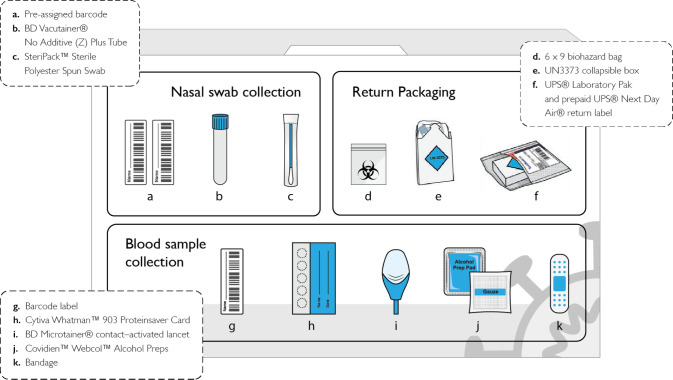
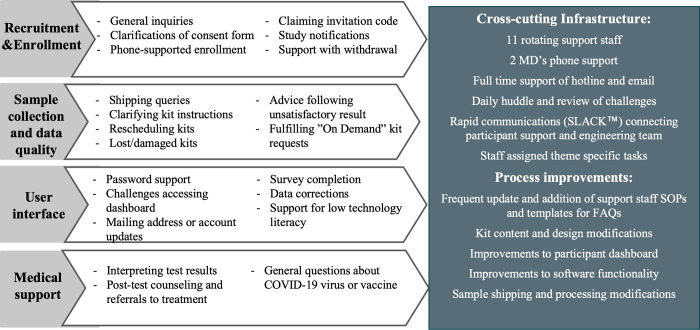
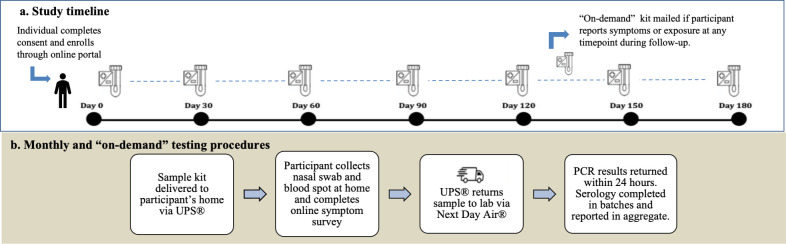
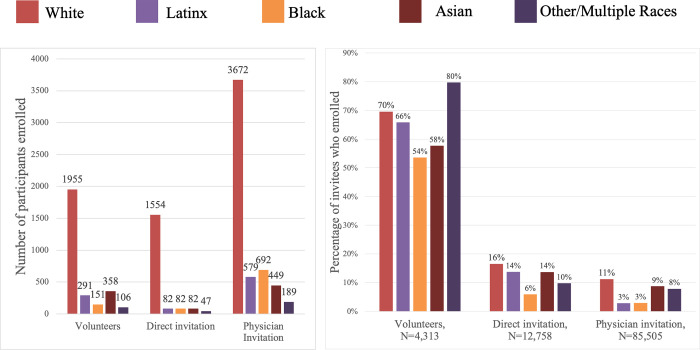
Longitudinal clinical studies traditionally require in-person study visits which are well documented to pose barriers to participation and contribute challenges to enrolling representative samples. Remote trial models may reduce barriers to research engagement, improve retention, and reach a more representative cohort. As remote trials become more common following the COVID-19 pandemic, a critical evaluation of this approach is imperative to optimize this paradigm shift in research. The TestBoston study was launched to understand prevalence and risk factors for COVID-19 infection in the greater Boston area through a fully remote home-testing model. Participants (adults, within 45 miles of Boston, MA) were recruited remotely from patient registries at Brigham and Women's Hospital and the general public. Participants were provided with monthly and "on-demand" at-home SARS-CoV-2 RT-PCR and antibody testing using nasal swab and dried blood spot self-collection kits and electronic surveys to assess symptoms and risk factors for COVID-19 via an online dashboard. Between October 2020 and January 2021, we enrolled 10,289 participants reflective of Massachusetts census data. Mean age was 47 years (range 18-93), 5855 (56.9%) were assigned female sex at birth, 7181(69.8%) reported being White non-Hispanic, 952 (9.3%) Hispanic/Latinx, 925 (9.0%) Black, 889 (8.6%) Asian, and 342 (3.3%) other and/or more than one race. Lower initial enrollment among Black and Hispanic/Latinx individuals required an adaptive approach to recruitment, leveraging connections to the medical system, coupled with community partnerships to ensure a representative cohort. Longitudinal retention was higher among participants who were White non-Hispanic, older, working remotely, and with lower socioeconomic vulnerability. Implementation highlighted key differences in remote trial models as participants independently navigate study milestones, requiring a dedicated participant support team and robust technology platforms, to reduce barriers to enrollment, promote retention, and ensure scientific rigor and data quality. Remote clinical trial models offer tremendous potential to engage representative cohorts, scale biomedical research, and promote accessibility by reducing barriers common in traditional trial design. Barriers and burdens within remote trials may be experienced disproportionately across demographic groups. To maximize engagement and retention, researchers should prioritize intensive participant support, investment in technologic infrastructure and an adaptive approach to maximize engagement and retention.
传统的纵向临床研究需要进行面对面的研究访视,有充分记录表明这种访视对参与构成障碍,并给招募具有代表性的样本带来挑战。远程试验模式可能会减少研究参与的障碍,提高留存率,并覆盖更具代表性的队列。随着远程试验在新冠疫情后变得越来越普遍,对这种方法进行批判性评估对于优化这一研究范式转变至关重要。“波士顿测试”研究旨在通过完全远程的家庭测试模式了解大波士顿地区新冠病毒感染的患病率和风险因素。参与者(年龄在马萨诸塞州波士顿45英里范围内的成年人)从布莱根妇女医院的患者登记处和普通公众中远程招募。通过在线仪表板,为参与者提供每月一次和“按需”的居家严重急性呼吸综合征冠状病毒2逆转录聚合酶链反应(SARS-CoV-2 RT-PCR)和抗体检测,使用鼻拭子和干血斑自我采集试剂盒,以及电子调查问卷来评估新冠病毒感染的症状和风险因素。在2020年10月至2021年1月期间,我们招募了10289名反映马萨诸塞州人口普查数据的参与者。平均年龄为47岁(范围18 - 93岁),5855名(56.9%)出生时被指定为女性,7181名(69.8%)报告为非西班牙裔白人,952名(9.3%)西班牙裔/拉丁裔,925名(9.0%)黑人,889名(8.6%)亚洲人,342名(3.3%)其他种族和/或不止一个种族。黑人和西班牙裔/拉丁裔个体最初的入组率较低,这需要一种适应性的招募方法,利用与医疗系统的联系,并结合社区伙伴关系来确保有代表性的队列。非西班牙裔白人、年龄较大、远程工作且社会经济脆弱性较低的参与者的纵向留存率较高。实施过程突出了远程试验模式的关键差异,因为参与者要独立完成研究里程碑,这需要一个专门的参与者支持团队和强大的技术平台,以减少入组障碍,提高留存率,并确保科学严谨性和数据质量。远程临床试验模式具有巨大潜力,通过减少传统试验设计中常见的障碍来吸引具有代表性的队列、扩大生物医学研究规模并提高可及性。远程试验中的障碍和负担在不同人口群体中可能存在不成比例的情况。为了最大限度地提高参与度和留存率,研究人员应优先提供密集的参与者支持、投资技术基础设施,并采用适应性方法来最大限度地提高参与度和留存率。