Alvarez Julio, Nielsen Søren Saxmose, Robardet Emmanuelle, Stegeman Arjan, Van Gucht Steven, Vuta Vlad, Antoniou Sotiria-Eleni, Aznar Inma, Papanikolaou Alexandra, Roberts Helen Clare
EFSA J. 2022 Jun 2;20(6):e07350. doi: 10.2903/j.efsa.2022.7350. eCollection 2022 Jun.
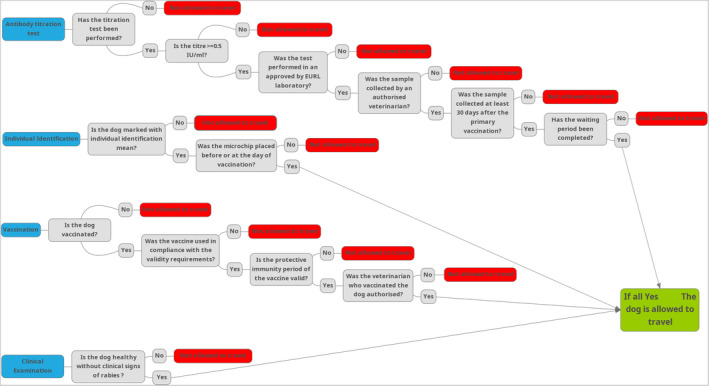
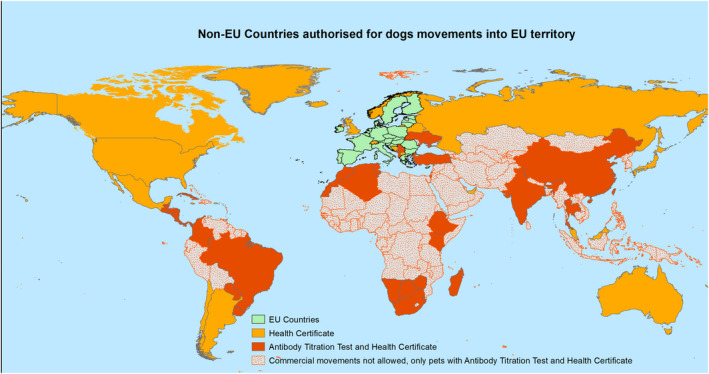
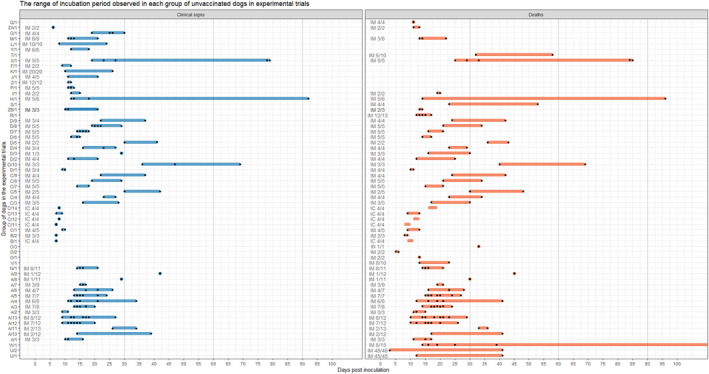
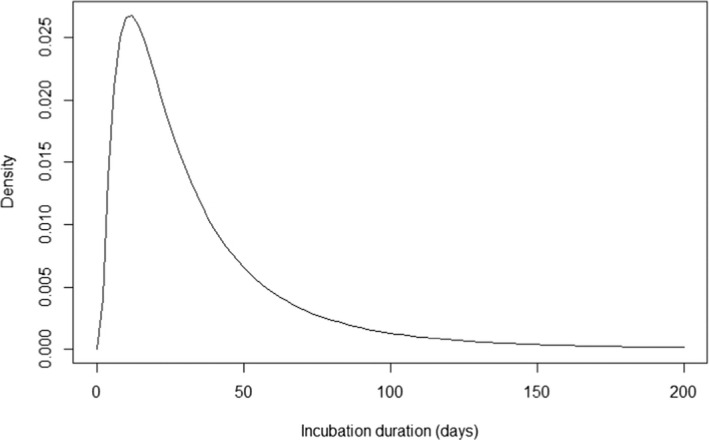
EFSA received a mandate from the European Commission to assess the risks related to a possible reduction of the waiting period after rabies antibody titration test to 30 days compared with 90 days of the current EU legislation, for dogs moving from certain non-EU countries to the EU. This Scientific Report assessed the probability of introduction of rabies into the EU through commercial and non-commercial movements of vaccinated dogs with a positive titration test (≥ 0.5 IU/mL) if the waiting period decreases from 90 to 30 days. Assuming that all the legal requirements are complied with, the risk of transmission of rabies through the movement of a vaccinated dog is related to the risk of introducing an animal incubating rabies that was infected before the day of vaccination or shortly after vaccination but before the development of immunity (21 days post-vaccination). Using published data on the incubation period for experimental and field cases in dogs and considering the rabies incidence data in certain countries, the aggregated probability for the annual introduction of rabies through dogs was assessed. Considering the uncertainty related to the duration of the incubation period, the number of imported dogs, and the disease incidence in some countries it was concluded with a 95% certainty that the maximum number of rabies-infected imported dogs complying with the regulations in a 20-year period could increase from 5 to 20 when decreasing the waiting period from 90 to 30 days. Nevertheless, the potential impact of even a small increase in probability means the risk is increased for a region like the EU where rabies has long been a focus for eradication, to protect human and animal health.
欧洲食品安全局(EFSA)接到欧盟委员会的一项任务,即评估对于从某些非欧盟国家进入欧盟的犬只,将狂犬病抗体滴定试验后的等待期从现行欧盟法规规定的90天减至30天可能带来的相关风险。本科学报告评估了如果等待期从90天减至30天,通过商业和非商业途径运输且抗体滴定试验呈阳性(≥ 0.5 IU/mL)的已接种疫苗犬只将狂犬病传入欧盟的可能性。假设所有法律要求均得到遵守,通过已接种疫苗犬只运输传播狂犬病的风险与引入在接种日之前或接种后不久但在免疫形成(接种后21天)之前感染狂犬病的潜伏动物的风险相关。利用已发表的关于犬类实验和实际病例潜伏期的数据,并考虑某些国家的狂犬病发病率数据,评估了每年通过犬只引入狂犬病的总体可能性。考虑到潜伏期时长、进口犬只数量以及某些国家疾病发病率的不确定性,得出结论:在95%的置信度下,当等待期从90天减至30天时,20年内符合规定的狂犬病感染进口犬只的最大数量可能从5只增至20只。然而,即使概率的小幅增加,其潜在影响对于长期以来一直将狂犬病根除作为重点以保护人类和动物健康的欧盟这样的地区而言,意味着风险增加。