Lynch Erica Nicola, Campani Claudia, Innocenti Tommaso, Dragoni Gabriele, Forte Paolo, Galli Andrea
Gastroenterology Research Unit, Department of Experimental and Clinical Biomedical Sciences "Mario Serio", University of Florence, Florence 50134, Italy.
Division of Gastroenterology, University Hospital "Careggi", Florence 50134, Italy.
World J Clin Cases. 2022 May 16;10(14):4334-4347. doi: 10.12998/wjcc.v10.i14.4334.
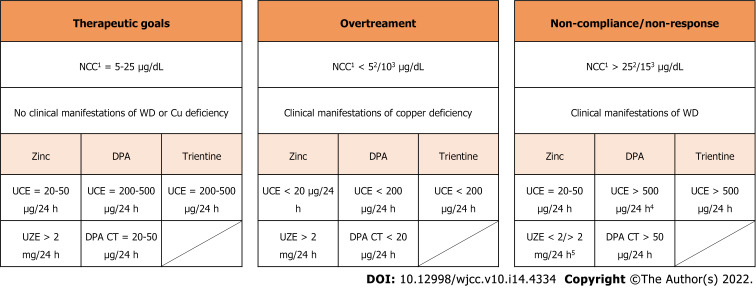
Wilson's disease (WD) is a rare inherited disorder of human copper metabolism, with an estimated prevalence of 1:30000-1:50000 and a broad spectrum of hepatic and neuropsychiatric manifestations. In healthy individuals, the bile is the main route of elimination of copper. In WD patients, copper accumulates in the liver, it is released into the bloodstream, and is excreted in urine. Copper can also be accumulated in the brain, kidneys, heart, and osseous matter and causes damage due to direct toxicity or oxidative stress. Hepatic WD is commonly but not exclusively diagnosed in childhood or young adulthood. Adherent, non-cirrhotic WD patients seem to have a normal life expectancy. Nevertheless, chronic management of patients with Wilson's disease is challenging, as available biochemical tests have many limitations and do not allow a clear identification of non-compliance, overtreatment, or treatment goals. To provide optimal care, clinicians should have a complete understanding of these limitations and counterbalance them with a thorough clinical assessment. The aim of this review is to provide clinicians with practical tools and suggestions which may answer doubts that can arise during chronic management of patients with hepatic WD. In particular, it summarises current knowledge on Wilson's disease clinical and biochemical monitoring and treatment. It also analyses available evidence on pregnancy and the role of low-copper diet in WD. Future research should focus on trying to provide new copper metabolism tests which could help to guide treatment adjustments.
威尔逊病(WD)是一种罕见的人类铜代谢遗传性疾病,估计患病率为1:30000至1:50000,具有广泛的肝脏和神经精神表现。在健康个体中,胆汁是铜排泄的主要途径。在WD患者中,铜在肝脏中蓄积,释放到血液中,并通过尿液排出。铜也可在脑、肾、心脏和骨质中蓄积,并由于直接毒性或氧化应激而造成损害。肝性WD通常但并非仅在儿童期或青年期被诊断出来。依从性好、无肝硬化的WD患者似乎预期寿命正常。然而,威尔逊病患者的长期管理具有挑战性,因为现有的生化检测有许多局限性,无法明确识别不依从、过度治疗或治疗目标。为了提供最佳护理,临床医生应全面了解这些局限性,并通过全面的临床评估来加以权衡。本综述的目的是为临床医生提供实用的工具和建议,以解答肝性WD患者长期管理过程中可能出现的疑问。特别是,它总结了目前关于威尔逊病临床和生化监测及治疗的知识。它还分析了关于妊娠以及低铜饮食在WD中的作用的现有证据。未来的研究应致力于提供新的铜代谢检测方法,以帮助指导治疗调整。