Hanna Joseph, David Luke Ajay, Touahri Yacine, Fleming Taylor, Screaton Robert A, Schuurmans Carol
Sunnybrook Research Institute, Biological Sciences, Toronto, ON, Canada.
Department of Laboratory Medicine and Pathobiology, University of Toronto, Toronto, ON, Canada.
Front Cell Dev Biol. 2022 May 18;10:887764. doi: 10.3389/fcell.2022.887764. eCollection 2022.
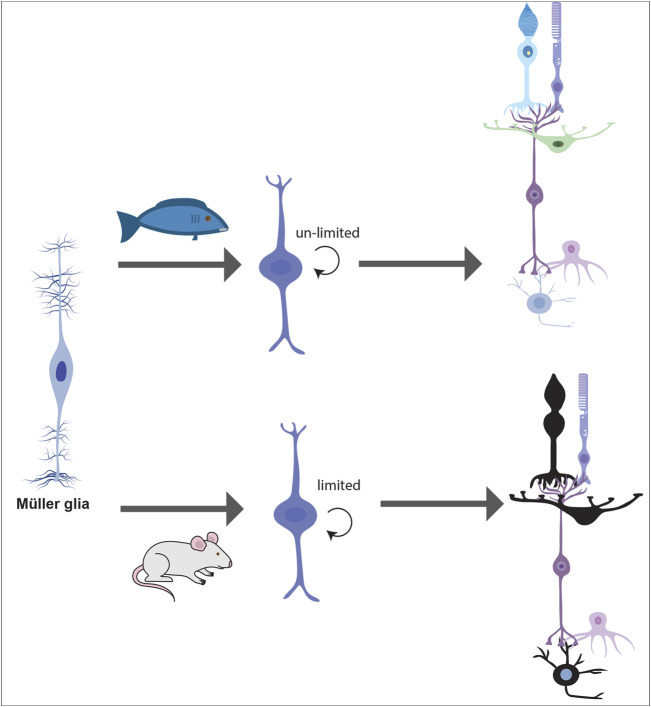
Vision commences in the retina with rod and cone photoreceptors that detect and convert light to electrical signals. The irreversible loss of photoreceptors due to neurodegenerative disease leads to visual impairment and blindness. Interventions now in development include transplanting photoreceptors, committed photoreceptor precursors, or retinal pigment epithelial (RPE) cells, with the latter protecting photoreceptors from dying. However, introducing exogenous human cells in a clinical setting faces both regulatory and supply chain hurdles. Recent work has shown that abnormalities in central cell metabolism pathways are an underlying feature of most neurodegenerative disorders, including those in the retina. Reversal of key metabolic alterations to drive retinal repair thus represents a novel strategy to treat vision loss based on cell regeneration. Here, we review the connection between photoreceptor degeneration and alterations in cell metabolism, along with new insights into how metabolic reprogramming drives both retinal development and repair following damage. The potential impact of metabolic reprogramming on retinal regeneration is also discussed, specifically in the context of how metabolic switches drive both retinal development and the activation of retinal glial cells known as Müller glia. Müller glia display latent regenerative properties in teleost fish, however, their capacity to regenerate new photoreceptors has been lost in mammals. Thus, re-activating the regenerative properties of Müller glia in mammals represents an exciting new area that integrates research into developmental cues, central metabolism, disease mechanisms, and glial cell biology. In addition, we discuss this work in relation to the latest insights gleaned from other tissues (brain, muscle) and regenerative species (zebrafish).
视觉始于视网膜中的视杆和视锥光感受器,它们能检测光并将其转化为电信号。神经退行性疾病导致的光感受器不可逆丧失会导致视力障碍和失明。目前正在研发的干预措施包括移植光感受器、定向光感受器前体或视网膜色素上皮(RPE)细胞,后者可保护光感受器免于死亡。然而,在临床环境中引入外源人类细胞面临监管和供应链方面的障碍。最近的研究表明,中枢细胞代谢途径异常是包括视网膜疾病在内的大多数神经退行性疾病的一个基本特征。因此,逆转关键的代谢改变以驱动视网膜修复代表了一种基于细胞再生治疗视力丧失的新策略。在这里,我们回顾了光感受器退化与细胞代谢改变之间的联系,以及对代谢重编程如何驱动视网膜发育和损伤后修复的新见解。还讨论了代谢重编程对视网膜再生的潜在影响,特别是在代谢开关如何驱动视网膜发育和激活称为穆勒胶质细胞的视网膜神经胶质细胞的背景下。穆勒胶质细胞在硬骨鱼中具有潜在的再生特性,然而,它们在哺乳动物中再生新光感受器的能力已经丧失。因此,重新激活哺乳动物中穆勒胶质细胞的再生特性代表了一个令人兴奋的新领域,它将发育线索、中枢代谢、疾病机制和神经胶质细胞生物学的研究整合在一起。此外,我们将这项工作与从其他组织(大脑、肌肉)和再生物种(斑马鱼)中获得的最新见解联系起来进行讨论。