Glei Dana A, Weinstein Maxine
Center for Population and Health, Georgetown University.
medRxiv. 2022 May 25:2022.05.24.22275508. doi: 10.1101/2022.05.24.22275508.
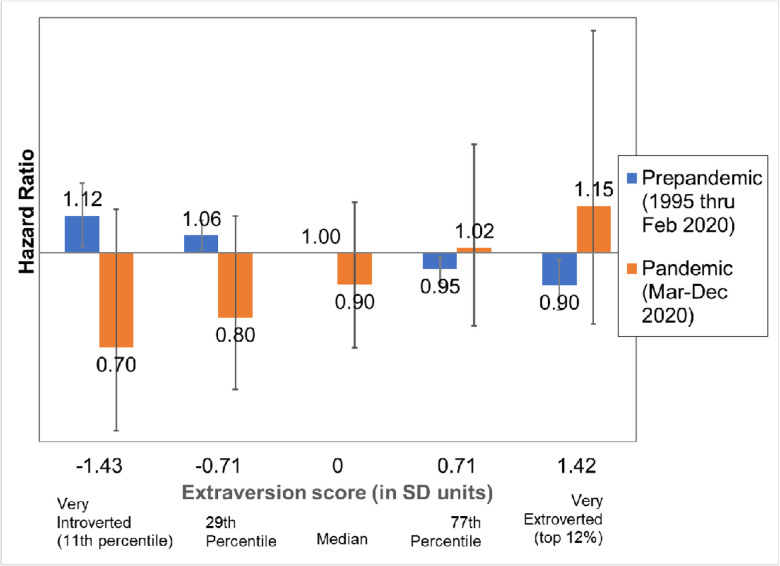
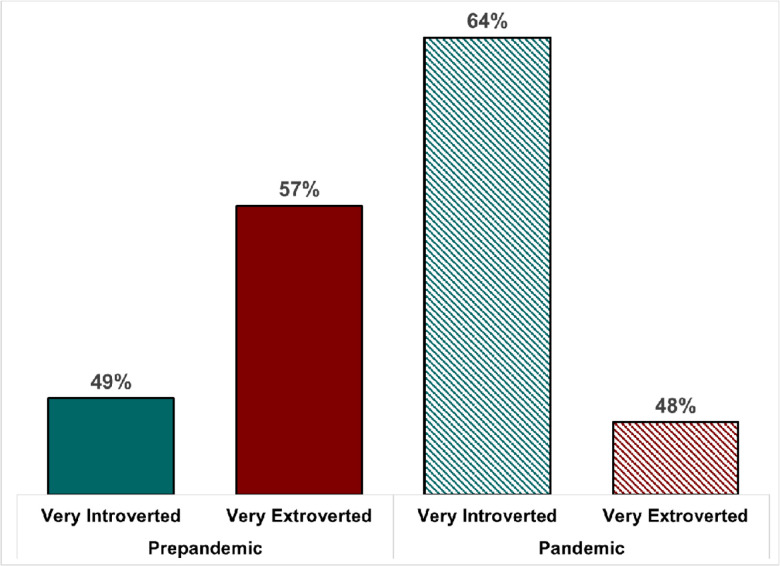
Extroverts may enjoy lower mortality than introverts under normal circumstances, but the relationship may be different during an airborne pandemic when social contact can be deadly. We used data for midlife Americans surveyed in 1995-96 with mortality follow-up through December 31, 2020 to investigate whether the association between extroversion and mortality changed during the COVID-19 pandemic. We hypothesized that excess mortality during the pandemic will be greater for extroverts than for introverts. Results were based on a Cox model estimating age-specific mortality controlling for sex, race/ethnicity, the period trend in mortality, and an additional indicator for the pandemic period (Mar-Dec 2020). We interacted extroversion with the pandemic indicator to test whether the relationship differed between prepandemic and pandemic periods. Prior to the pandemic, extroversion was associated with somewhat lower mortality (HR=0.93 per SD, 95% CI 0.88-0.97), but the relationship reversed during the pandemic: extroverted individuals appeared to suffer higher mortality than their introverted counterparts, although the effect was not significant (HR=1.20 per SD, 95% CI 0.93-1.54). Extroversion was associated with greater pandemic-related excess mortality (HR=1.20/0.93=1.29 per SD, 95% CI 1.00-1.67). Compared with someone who scored at the mean level of extroversion, mortality rates prior to the pandemic were 10% lower for a person who was very extroverted (i.e., top 12% of the sample at Wave 1), while they were 12% higher for someone who was very introverted (i.e., 11 percentile). In contrast, mortality rates during the pandemic appeared to be r for very extroverted individuals (HR=1.15, 95% CI 0.77-1.71) and l for those who were very introverted (HR=0.70, 95% CI 0.43-1.14) although the difference was not significant because of limited statistical power. In sum, the slight mortality advantage enjoyed by extroverts prior to the pandemic disappeared during the first 10 months of the COVID-19 pandemic. It remains to be seen whether that pattern continued into 2021-22. We suspect that the mortality benefit of introversion during the pandemic is largely a result of reduced exposure to the risk of infection, but it may also derive in part from the ability of introverts to adapt more easily to reduced social interaction without engaging in self-destructive behavior (e.g., drug and alcohol abuse). Introverts have been training for a pandemic their whole lives.
在正常情况下,外向者的死亡率可能低于内向者,但在空气传播的大流行期间,这种关系可能会有所不同,因为社交接触可能是致命的。我们使用了1995 - 1996年对美国中年人的调查数据,并对其进行了直至2020年12月31日的死亡率随访,以研究在新冠疫情期间外向性与死亡率之间的关联是否发生了变化。我们假设,在大流行期间,外向者的超额死亡率将高于内向者。结果基于一个Cox模型,该模型估计了特定年龄的死亡率,并控制了性别、种族/族裔、死亡率的时间趋势以及大流行时期(2020年3月至12月)的一个额外指标。我们将外向性与大流行指标进行交互,以测试大流行前和大流行期间的关系是否不同。在大流行之前,外向性与略低的死亡率相关(每标准差的风险比=0.93,95%置信区间0.88 - 0.97),但在大流行期间这种关系发生了逆转:外向的个体似乎比内向的个体死亡率更高,尽管这种影响并不显著(每标准差的风险比=1.20,95%置信区间0.93 - 1.54)。外向性与更大的与大流行相关的超额死亡率相关(每标准差的风险比=1.20/0.93 = 1.29,95%置信区间1.00 - 1.67)。与外向性得分处于平均水平的人相比,在大流行之前,非常外向的人(即第一波调查中样本的前12%)的死亡率低10%,而非常内向的人(即第11百分位数)的死亡率高12%。相比之下,在大流行期间,非常外向的个体的死亡率似乎是[此处原文缺失部分内容](风险比=1.15,95%置信区间0.77 - 1.71),而非常内向的个体的死亡率是[此处原文缺失部分内容](风险比=0.70,95%置信区间0.43 - 1.14),尽管由于统计效力有限,差异并不显著。总之,外向者在大流行之前享有的轻微死亡率优势在新冠疫情的前10个月消失了。这种模式是否会持续到2021 - 2022年还有待观察。我们怀疑,在大流行期间内向性的死亡率优势很大程度上是由于接触感染风险的降低,但也可能部分源于内向者能够更轻松地适应社交互动减少,而不从事自我毁灭行为(如药物和酒精滥用)。内向者一生都在为大流行做准备。