Debono Samuel, Nash Jennifer, Fletcher Alexander J, Syed Maaz B J, Semple Scott I, van Beek Edwin J R, Fletcher Alison, Cadet Sebastien, Williams Michelle C, Dey Damini, Slomka Piotr J, Forsythe Rachael O, Dweck Marc R, Newby David E
The University of Edinburgh Centre for Cardiovascular Science, Chancellor's Building, University of Edinburgh, 49 Little France Crescent, Edinburgh, EH16 4SB, UK.
Edinburgh Imaging Facility, Queen's Medical Research Institute, University of Edinburgh, Edinburgh, UK.
EJNMMI Res. 2022 Jun 6;12(1):33. doi: 10.1186/s13550-022-00904-z.
Aortic microcalcification activity is a recently described method of measuring aortic sodium [F]fluoride uptake in the thoracic aorta on positron emission tomography. In this study, we aimed to compare and to modify this method for use within the infrarenal aorta of patients with abdominal aortic aneurysms.
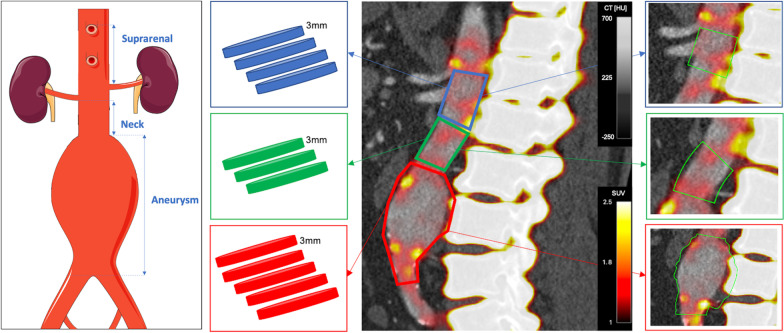
Twenty-five patients with abdominal aortic aneurysms underwent an sodium [F]fluoride positron emission tomography and computed tomography scan. Maximum and mean tissue-to-background ratios (TBR) and abdominal aortic microcalcification activity were determined following application of a thresholding and variable radius method to correct for vertebral sodium [F]fluoride signal spill-over and the nonlinear changes in aortic diameter, respectively. Agreement between the methods, and repeatability of these approaches were assessed.
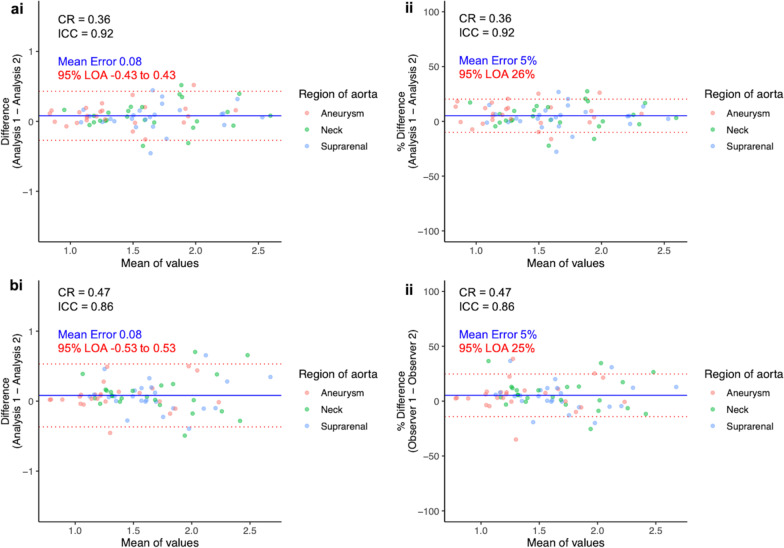
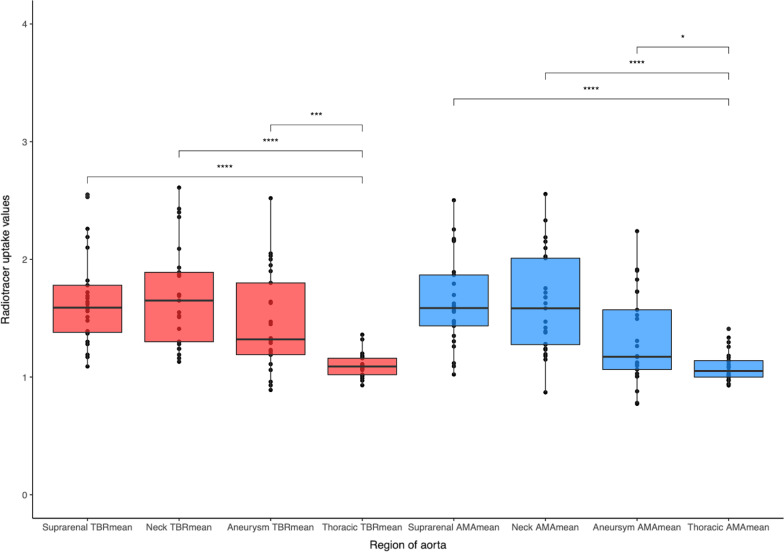
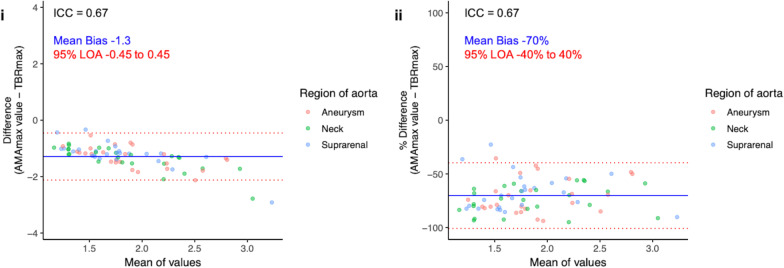
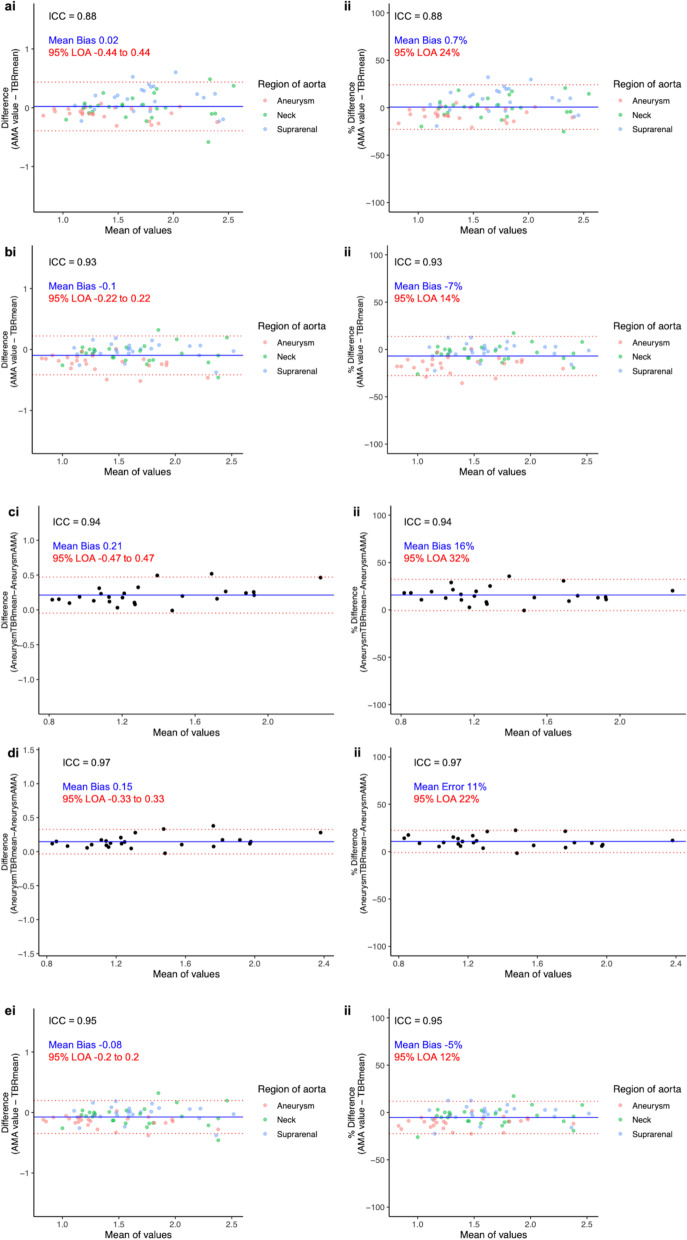
The aortic microcalcification activity method was much quicker to perform than the TBR method (14 versus 40 min, p < 0.001). There was moderate-to-good agreement between TBR and aortic microcalcification activity measurements for maximum (interclass correlation co-efficient, 0.67) and mean (interclass correlation co-efficient, 0.88) values. These correlations sequentially improved with the application of thresholding (intraclass correlation coefficient 0.93, 95% confidence interval 0.89-0.95) and variable diameter (intraclass correlation coefficient 0.97, 95% confidence interval 0.94-0.99) techniques. The optimised method had good intra-observer (mean 1.57 ± 0.42, bias 0.08, co-efficient of repeatability 0.36 and limits of agreement - 0.43 to 0.43) and inter-observer (mean 1.57 ± 0.42, bias 0.08, co-efficient of repeatability 0.47 and limits of agreement - 0.53 to 0.53) repeatability.
Aortic microcalcification activity is a quick and simple method which demonstrates good intra-observer and inter-observer repeatabilities and provides measures of sodium [F]fluoride uptake that are comparable to established methods.
主动脉微钙化活性是一种最近描述的在正电子发射断层扫描中测量胸主动脉[F]氟化钠摄取量的方法。在本研究中,我们旨在比较并改进该方法,以用于腹主动脉瘤患者的肾下腹主动脉。
25例腹主动脉瘤患者接受了[F]氟化钠正电子发射断层扫描和计算机断层扫描。应用阈值法和可变半径法分别校正椎体[F]氟化钠信号溢出和主动脉直径的非线性变化后,确定最大和平均组织与本底比值(TBR)以及腹主动脉微钙化活性。评估了这些方法之间的一致性以及这些方法的可重复性。
主动脉微钙化活性法的操作比TBR法快得多(14分钟对40分钟,p<0.001)。TBR与主动脉微钙化活性测量的最大值(组间相关系数,0.67)和平均值(组间相关系数,0.88)之间存在中度至良好的一致性。随着阈值法(组内相关系数0.93,95%置信区间0.89 - 0.95)和可变直径法(组内相关系数0.97,95%置信区间0.94 - 0.99)技术的应用,这些相关性依次提高。优化后的方法具有良好的观察者内(平均值1.57±0.42,偏差0.08,重复性系数0.36,一致性界限-0.43至0.43)和观察者间(平均值1.57±0.42,偏差0.08,重复性系数0.47,一致性界限-0.53至0.53)重复性。
主动脉微钙化活性是一种快速简便的方法,具有良好的观察者内和观察者间重复性,并且提供了与现有方法相当的[F]氟化钠摄取量测量值。