Severe Brain Injury Rehabilitation Unit, Department of Neuroscience and Rehabilitation, S. Anna University Hospital, Ferrara, Italy.
Rehabilitation Medicine Department, AULSS 3 Serenissima, Venice, Italy.
Eur J Phys Rehabil Med. 2022 Aug;58(4):584-591. doi: 10.23736/S1973-9087.22.07451-2. Epub 2022 Jun 6.
The assessment of patients with severe Acquired Brain Injury (sABI) is mandatory in every phase and setting of care, and requires a multidimensional and interdisciplinary approach, to develop the individual rehabilitation project, and monitor long-term functional outcomes. In 2001 the Italian Society of Physical and Rehabilitation Medicine (SIMFER) published the minimal assessment protocol for traumatic sABI, providing a comprehensive, standardized functional assessment based on the International Classification of Functioning, Disability and Health (ICF), 2001. In 2007, a new protocol was published, extended to all sABI patients (PMGCA). In 2019, the SIMFER appointed a working group to provide a revised, updated version: the PMGCA2020.
The purpose of this study was to describe the minimal assessment protocol to be applied at every stage and setting of the care process of patients with sABI.
The working group, including one neurologist and 11 physiatrists experts in sABI rehabilitation, performed a review of the international recommendations for sABI assessment focusing on the following key words: "sABI assessment," "sABI rehabilitation," "sABI prognostic factors," "sABI rehabilitation assessment," "sABI outcome," in MEDLINE. Revision and integration proposals by each member were written and motivated, discussed and voted.
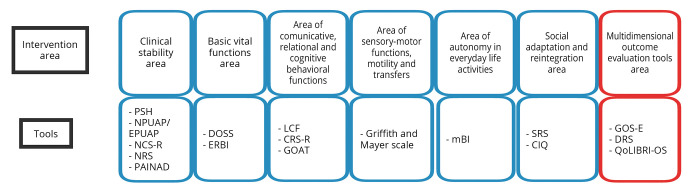
The PMGCA2020 is addressed to sABI adult patients. It investigates the main clinical problems of sABI at any time of the rehabilitation pathway. It includes a demographic/anamnestic section, a clinical/functional assessment section and an outcome measures section following the ICF model of functioning and the model of the construction of the rehabilitation project.
The PMGCA2020 provides an updated tool for the multidimensional rehabilitation assessment of sABI patients, at any stage of the rehabilitation pathway. Further studies will allow the validation of this minimum set of variables paving the way to an assessment standardization of patients with sABI in the rehabilitation settings.
This minimum set of variables, defining patient's functioning and clinical status and outcomes, at every stage and setting of the care process to provide a framework for the standardization of the clinical evaluation of patients with sABI in rehabilitation settings.
对严重获得性脑损伤(sABI)患者的评估是每个治疗阶段和环境所必需的,需要采用多维度和跨学科的方法来制定个体化康复计划,并监测长期功能结局。2001 年,意大利物理医学与康复医学学会(SIMFER)发表了创伤性 sABI 的最低评估方案,提供了基于 2001 年国际功能、残疾和健康分类(ICF)的全面、标准化功能评估。2007 年,发表了扩展至所有 sABI 患者的新方案(PMGCA)。2019 年,SIMFER 任命一个工作组提供修订更新版:PMGCA2020。
本研究旨在描述适用于 sABI 患者治疗过程中各个阶段和环境的最低评估方案。
该工作组由 1 名神经科医生和 11 名 sABI 康复专家组成,重点关注以下关键词,对 sABI 评估的国际建议进行了回顾:“sABI 评估”、“sABI 康复”、“sABI 预后因素”、“sABI 康复评估”、“sABI 结局”,在 MEDLINE 中进行检索。每位成员都编写并提出了修订和整合建议,并进行了讨论和投票。
PMGCA2020 适用于成年 sABI 患者。它在康复路径的任何时间调查 sABI 的主要临床问题。它包括一个人口统计学/病史部分、一个临床/功能评估部分和一个按照 ICF 功能模型和康复项目构建模型的结局测量部分。
PMGCA2020 为 sABI 患者的多维康复评估提供了一个更新的工具,适用于康复路径的任何阶段。进一步的研究将允许对这组最小变量进行验证,为康复环境中 sABI 患者的评估标准化铺平道路。
这组最小变量定义了患者在治疗过程中的每个阶段和环境中的功能和临床状况及结局,为康复环境中 sABI 患者的临床评估标准化提供了框架。