Center for Thrombosis and Hemorrhagic Diseases, IRCCS Humanitas Research Hospital, Rozzano, Milan, Italy.
Bayer SA, São Paulo, Brazil.
Haemophilia. 2022 Sep;28(5):702-712. doi: 10.1111/hae.14595. Epub 2022 Jun 6.
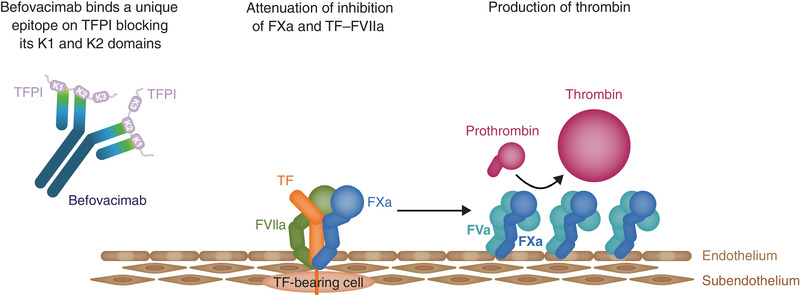
Befovacimab (formerly BAY 1093884) is a fully human monoclonal antibody able to bind to tissue factor pathway inhibitor (TFPI) and developed as a non-replacement therapy for individuals with haemophilia A/B, with or without inhibitors.
To assess the safety of multiple escalating doses of befovacimab in individuals with severe haemophilia A/B with or without inhibitors.
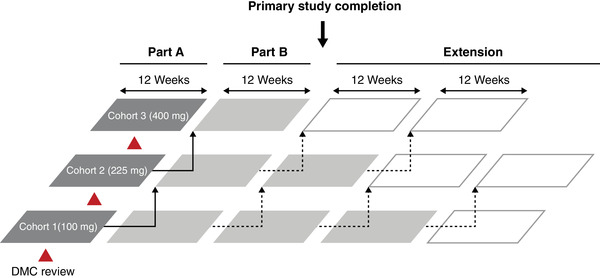
In this non-randomised, open-label Phase 2 study (NCT03597022), adult males with <1% factor VIII or <2% factor IX and ≥4 bleeds in the previous six months were enrolled in three dose cohorts (100/225/400 mg). Participants received befovacimab subcutaneously once weekly. The primary endpoint was safety; secondary endpoints included annualised bleeding rate (ABR) and pharmacokinetics/pharmacodynamics (PK/PD) of befovacimab.
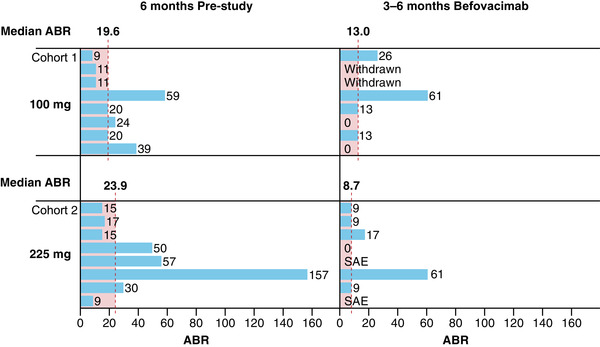
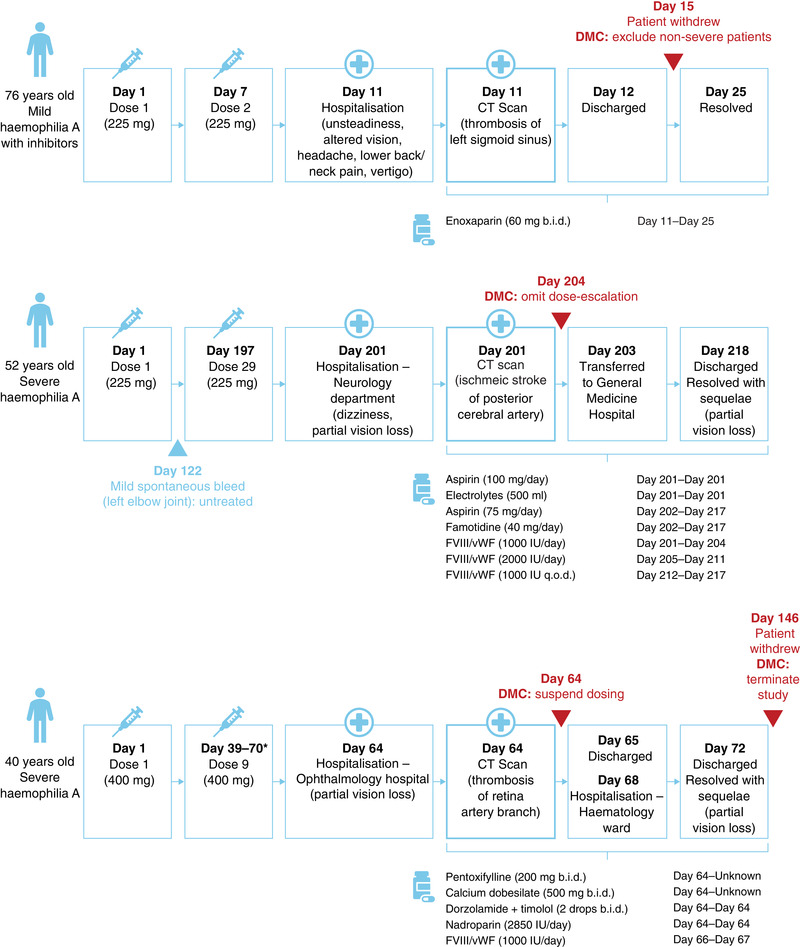
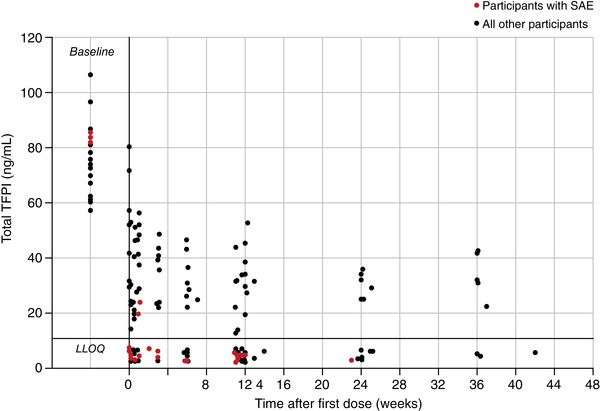
A total of 24 participants (n = 8 in each dose cohort) were treated for 2-47 weeks. Patients treated with 100 mg and 225 mg doses of befovacimab demonstrated improved bleeding control compared with pre-study bleeding rates, with a dose-dependent effect. Dosing was suspended and the study prematurely terminated following three drug-related thrombotic serious adverse events (SAEs): two at the 225 mg dose and one at the 400 mg dose. These occurred in the absence of bleeding episodes or concomitant use of replacement/bypass therapies. No laboratory abnormalities were observed, and PK/PD data did not show correlation between SAE occurrence and levels of circulating befovacimab or free TFPI.
Despite favourable initial results from preclinical and clinical studies, a positive safety profile of befovacimab was not confirmed. The lack of SAE-related laboratory abnormalities or differentiating PK/PD characteristics in participants experiencing SAEs raises concerns about the predictability of thrombosis following befovacimab treatment and emphasises the need for further investigation into the therapeutic window of anti-TFPI treatment.
Befovacimab(前称 BAY 1093884)是一种能够结合组织因子途径抑制剂(TFPI)的全人源单克隆抗体,作为一种非替代疗法,用于有或无抑制剂的甲型/乙型血友病患者。
评估多次递增剂量 befovacimab 在有或无抑制剂的严重甲型/乙型血友病患者中的安全性。
在这项非随机、开放性 2 期研究(NCT03597022)中,纳入了 <1% 因子 VIII 或 <2% 因子 IX 且在前六个月有≥4 次出血的成年男性患者,他们被分为三个剂量组(100/225/400mg)。参与者每周接受一次皮下 befovacimab 治疗。主要终点是安全性;次要终点包括 befovacimab 的年化出血率(ABR)和药代动力学/药效学(PK/PD)。
共有 24 名参与者(每个剂量组 8 名)接受了 2-47 周的治疗。接受 100mg 和 225mg 剂量 befovacimab 治疗的患者与研究前出血率相比,出血控制得到改善,且具有剂量依赖性效应。在 3 例与药物相关的血栓性严重不良事件(SAE)后,暂停给药并提前终止研究:2 例发生在 225mg 剂量组,1 例发生在 400mg 剂量组。这些事件发生在没有出血发作或同时使用替代/旁路治疗的情况下。未观察到实验室异常,PK/PD 数据显示 SAE 发生与循环 befovacimab 或游离 TFPI 水平之间无相关性。
尽管临床前和临床研究中取得了有利的初步结果,但 befovacimab 的安全性特征并未得到证实。在发生 SAE 的参与者中,没有与 SAE 相关的实验室异常或 PK/PD 特征的差异,这引发了对 befovacimab 治疗后血栓形成的可预测性的担忧,并强调需要进一步研究抗 TFPI 治疗的治疗窗。