Wang Yuanyuan, Dong Lirong, Pan Da, Xu Dengfeng, Lu Yifei, Yin Shiyu, Wang Shaokang, Xia Hui, Liao Wang, Sun Guiju
Key Laboratory of Environmental Medicine and Engineering of Ministry of Education, Department of Nutrition and Food Hygiene, School of Public Health, Southeast University, Nanjing, China.
Department of Integrated Service and Management, Jiangsu Provincial Center for Disease Control and Prevention, Nanjing, China.
Front Nutr. 2022 May 19;9:889576. doi: 10.3389/fnut.2022.889576. eCollection 2022.
The aim of this systematic review and meta-analysis was to examine the association between high ratio of n-6/n-3 polyunsaturated fatty acids (PUFAs) and depression.
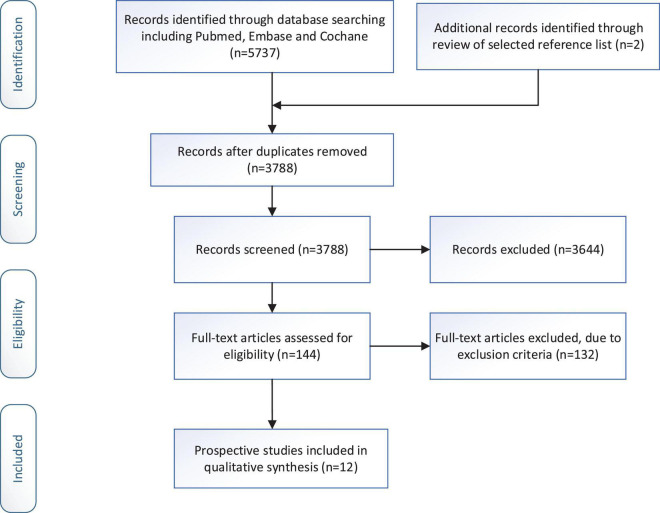
The authors conducted a meta-analysis of research articles on the association of high ratio of n-6/n-3 PUFAs with the risk of depression published in the online article database on PubMed, Embase, Cochrane library as of December 2021. Pooled odds ratios (OR) were calculated using random effects models. Publication bias was assessed visually by funnel plots and statistically by the Egger's and Begg's tests.
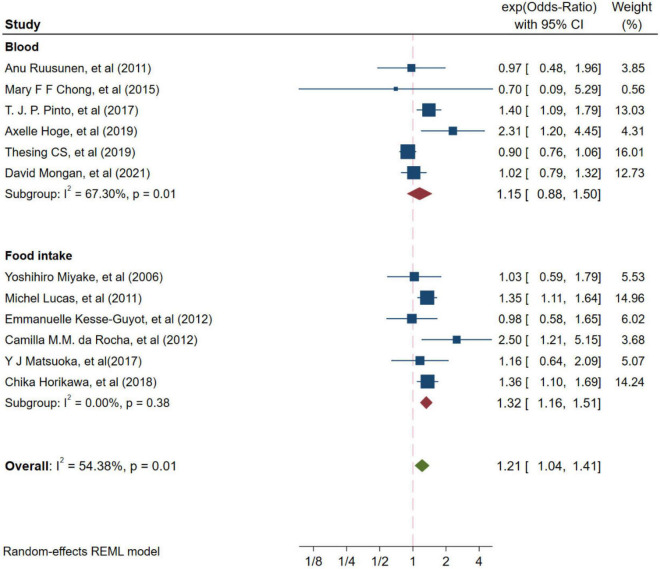
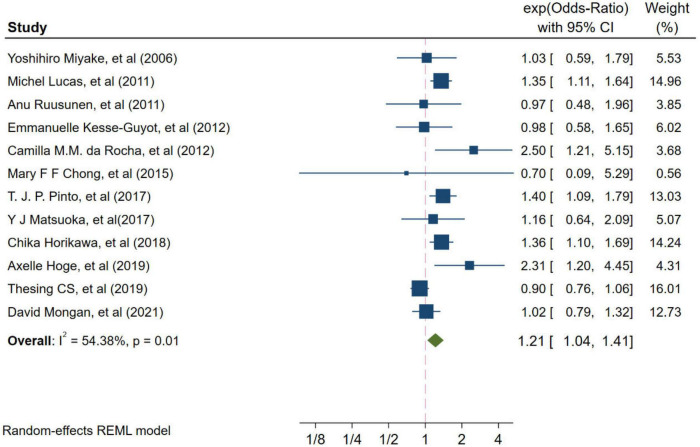
Finally, 12 studies included in this systematic review and meta-analysis with a total of 66,317 participants (including 4,173 individuals with depression condition). The pooled results showed that high ratio of n-6/n-3 PUFAs might be positively associated with depression [OR = 1.21, 95% confidence intervals (CIs): 1.04∼1.41]. The I test indicated that there was a substantial statistical heterogeneity across the included studies ( = 54.38%, = 0.01). Subgroup analysis showed that high ratio of n-6/n-3 PUFAs in blood had no significant association with depression (OR = 1.15, 95%CI: 0.88∼1.50), while high ratio of n-6/n-3 PUFAs in dietary supplements was positively associated with depression (OR = 1.32, 95%CI: 1.16∼1.51).
This meta-analysis confirmed the association between high ratio of n-6/n-3 PUFAs and the risk of depression. High ratio of n-6/n-3 PUFAs in dietary supplementation was positively associated with depression, but had no significant association in the blood. This study suggested that lowering the dietary intake of the ratio of n-6/n-3 PUFAs would be beneficial in the prevention of depression.
本系统评价和荟萃分析旨在研究n-6/n-3多不饱和脂肪酸(PUFAs)高比例与抑郁症之间的关联。
作者对截至2021年12月在PubMed、Embase、Cochrane图书馆在线文章数据库中发表的关于n-6/n-3 PUFAs高比例与抑郁症风险关联的研究文章进行了荟萃分析。采用随机效应模型计算合并比值比(OR)。通过漏斗图直观评估发表偏倚,并通过Egger检验和Begg检验进行统计学评估。
最终,本系统评价和荟萃分析纳入了12项研究,共66317名参与者(包括4173名抑郁症患者)。合并结果显示,n-6/n-3 PUFAs高比例可能与抑郁症呈正相关[OR = 1.21,95%置信区间(CIs):1.04∼1.41]。I²检验表明,纳入的研究之间存在显著的统计学异质性(I² = 54.38%,P = 0.01)。亚组分析显示,血液中n-6/n-3 PUFAs高比例与抑郁症无显著关联(OR = 1.15,95%CI:0.88∼1.50),而膳食补充剂中n-6/n-3 PUFAs高比例与抑郁症呈正相关(OR = 1.32,95%CI:1.16∼1.51)。
本荟萃分析证实了n-6/n-3 PUFAs高比例与抑郁症风险之间的关联。膳食补充中n-6/n-3 PUFAs高比例与抑郁症呈正相关,但在血液中无显著关联。本研究表明,降低膳食中n-6/n-3 PUFAs的摄入比例可能有助于预防抑郁症。