Environmental Science Graduate Program, The Ohio State University, Columbus, OH, USA.
Department of Food Science and Technology, The Ohio State University, Columbus, OH, USA.
Environ Res. 2022 Sep;212(Pt E):113580. doi: 10.1016/j.envres.2022.113580. Epub 2022 Jun 6.
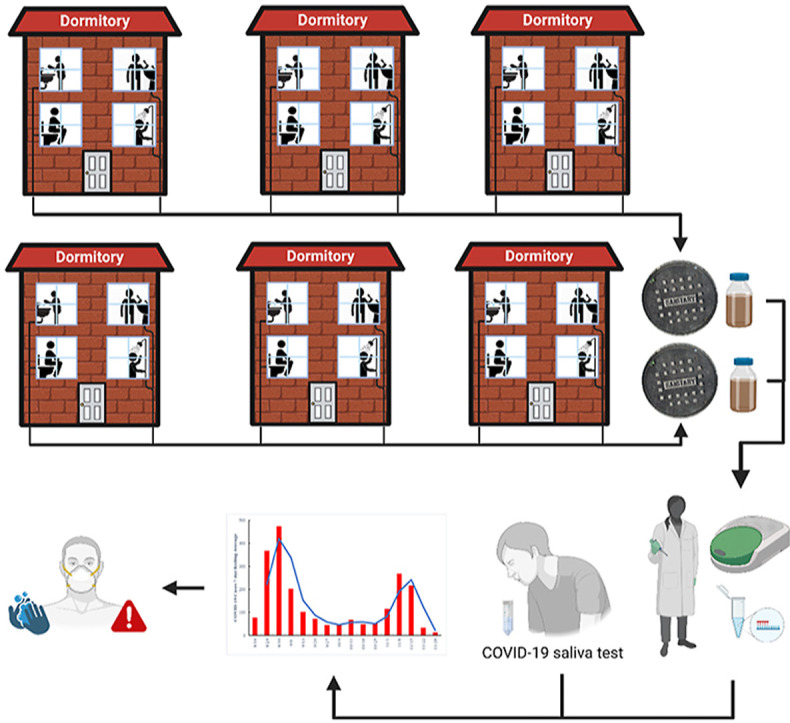
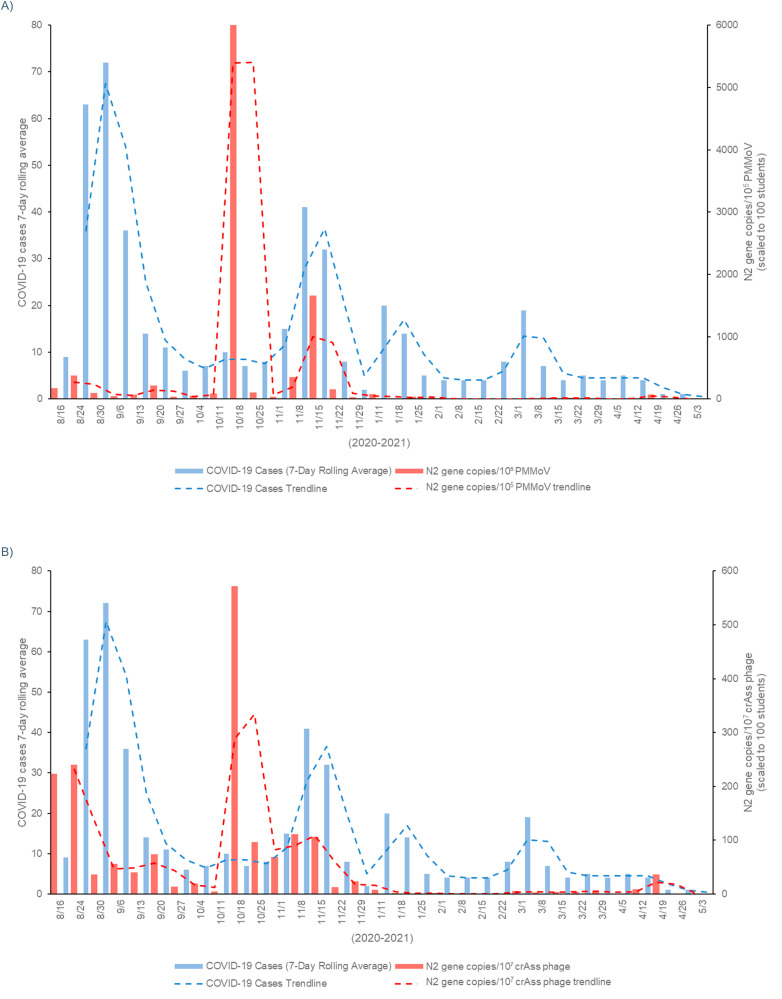
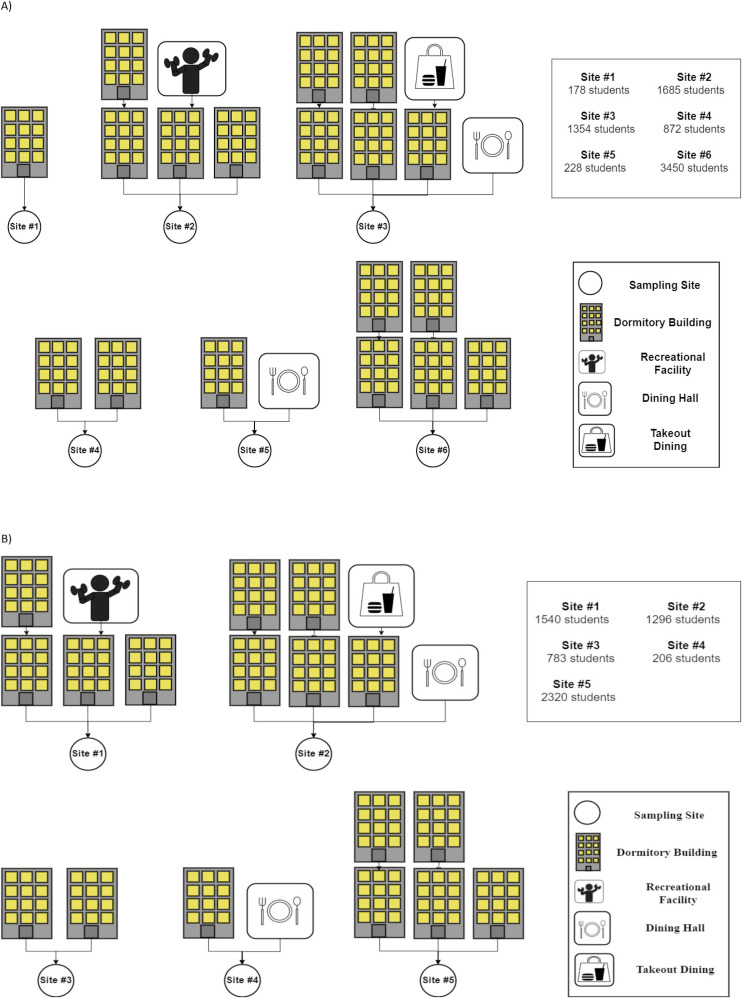
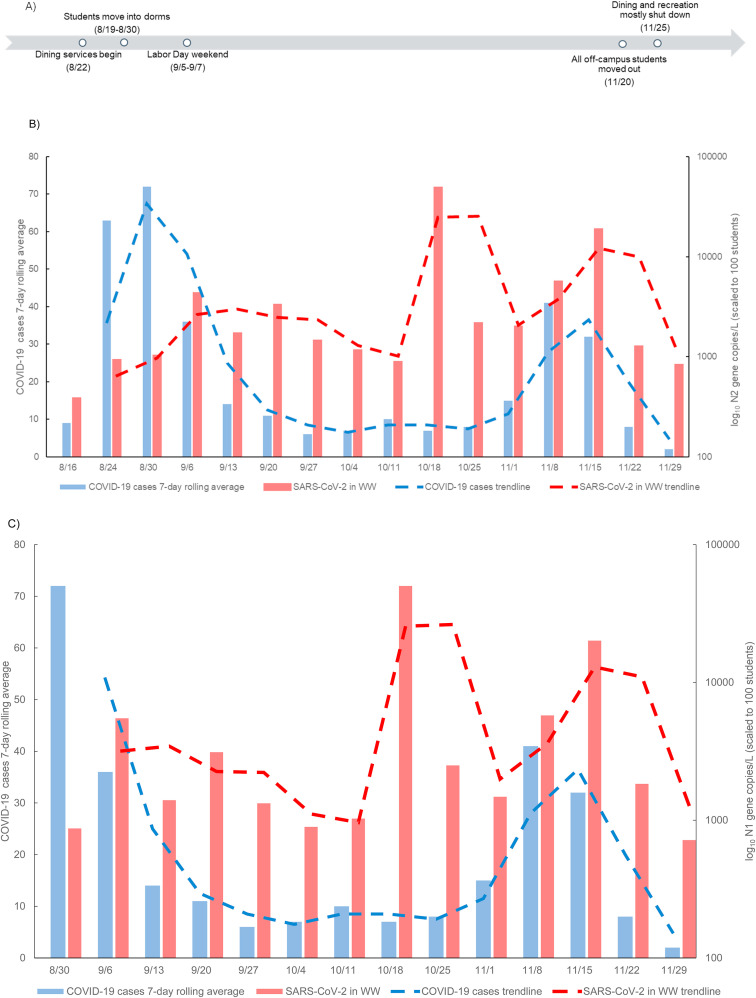
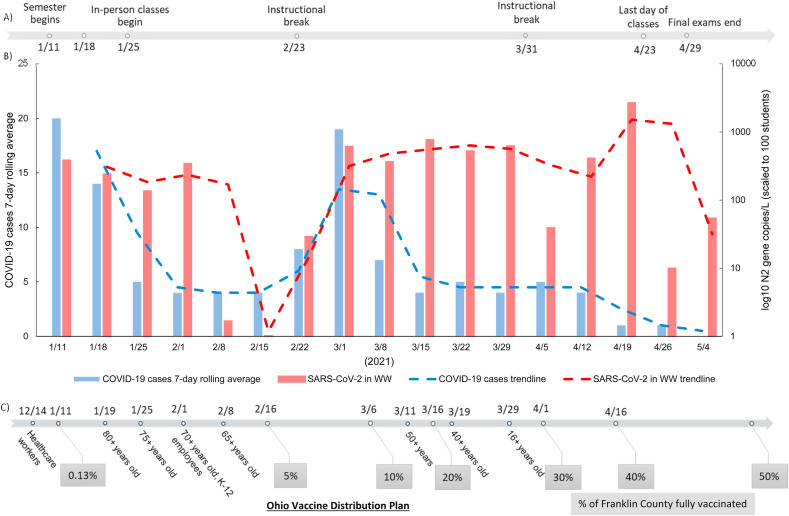
Wastewater-based epidemiology is an effective tool for monitoring infectious disease spread or illicit drug use within communities. At the Ohio State University, we conducted a SARS-CoV-2 wastewater surveillance program in the 2020-2021 academic year and compared results with the university-required weekly COVID-19 saliva testing to monitor COVID-19 infection prevalence in the on-campus residential communities. The objectives of the study were to rapidly track trends in the wastewater SARS-CoV-2 gene concentrations, analyze the relationship between case numbers and wastewater signals when adjusted using human fecal viral indicator concentrations (PMMoV, crAssphage) in wastewater, and investigate the relationship of the SARS-CoV-2 gene concentrations with wastewater parameters. SARS-CoV-2 nucleocapsid and envelope (N1, N2, and E) gene concentrations, determined with reverse transcription droplet digital PCR, were used to track SARS-CoV-2 viral loads in dormitory wastewater once a week at 6 sampling sites across the campus during the fall semester in 2020. During the following spring semester, research was focused on SARS-CoV2 N2 gene concentrations at 5 sites sampled twice a week. Spearman correlations both with and without adjusting using human fecal viral indicators showed a significant correlation (p < 0.05) between human COVID-19 positive case counts and wastewater SARS-CoV-2 gene concentrations. Spearman correlations showed significant relationships between N1 gene concentrations and both TSS and turbidity, and between E gene concentrations and both pH and turbidity. These results suggest that wastewater signal increases with the census of infected individuals, in which the majority are asymptomatic, with a statistically significant (p-value <0.05) temporal correlation. The study design can be utilized as a platform for rapid trend tracking of SARS-CoV-2 variants and other diseases circulating in various communities.
污水流行病学是一种监测社区内传染病传播或非法药物使用的有效工具。在俄亥俄州立大学,我们在 2020-2021 学年进行了 SARS-CoV-2 污水监测计划,并将结果与大学要求的每周 COVID-19 唾液检测进行了比较,以监测校园住宿社区的 COVID-19 感染流行率。该研究的目的是快速跟踪污水中 SARS-CoV-2 基因浓度的趋势,分析病例数量与污水信号之间的关系,当使用污水中人粪便病毒指示物浓度(PMMoV、crAssphage)进行调整时,以及研究 SARS-CoV-2 基因浓度与污水参数之间的关系。使用逆转录液滴数字 PCR 测定的 SARS-CoV-2 核衣壳和包膜(N1、N2 和 E)基因浓度,用于在 2020 年秋季学期每周一次在校园的 6 个采样点追踪宿舍污水中的 SARS-CoV-2 病毒载量。在接下来的春季学期,研究重点是每周两次在 5 个采样点采集的 SARS-CoV2 N2 基因浓度。使用和不使用人粪便病毒指示物进行调整的 Spearman 相关性均显示,人类 COVID-19 阳性病例数与污水 SARS-CoV-2 基因浓度之间存在显著相关性(p<0.05)。Spearman 相关性显示,N1 基因浓度与 TSS 和浊度之间存在显著关系,E 基因浓度与 pH 和浊度之间存在显著关系。这些结果表明,污水信号随着受感染个体的数量增加而增加,其中大多数是无症状的,具有统计学意义(p 值<0.05)的时间相关性。该研究设计可作为一种平台,用于快速跟踪各种社区中流行的 SARS-CoV-2 变体和其他疾病的趋势。