Department of Biology, University of Waterloo, Waterloo, ON, Canada.
Regional Municipality of York, Newmarket, ON, Canada.
Front Public Health. 2023 Aug 30;11:1186525. doi: 10.3389/fpubh.2023.1186525. eCollection 2023.
Wastewater-based surveillance is at the forefront of monitoring for community prevalence of COVID-19, however, continued uncertainty exists regarding the use of fecal indicators for normalization of the SARS-CoV-2 virus in wastewater. Using three communities in Ontario, sampled from 2021-2023, the seasonality of a viral fecal indicator (pepper mild mottle virus, PMMoV) and the utility of normalization of data to improve correlations with clinical cases was examined.
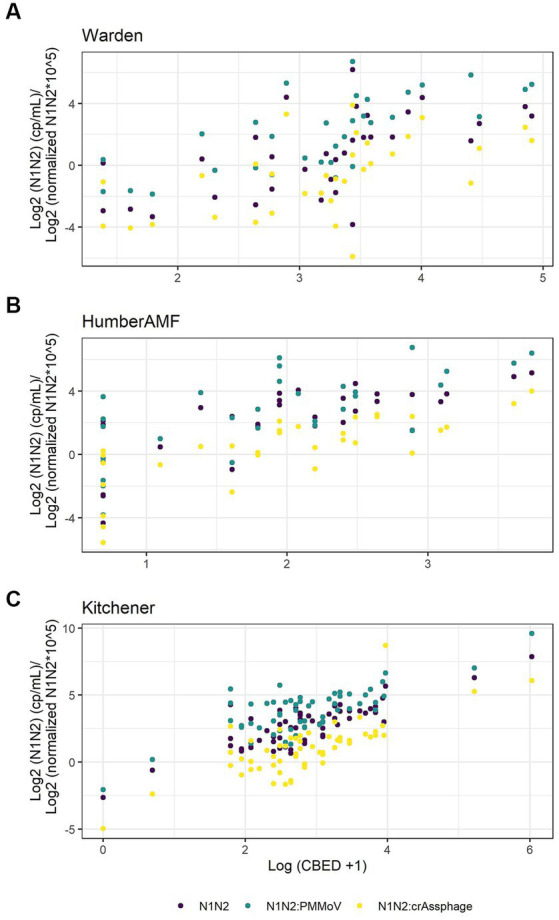
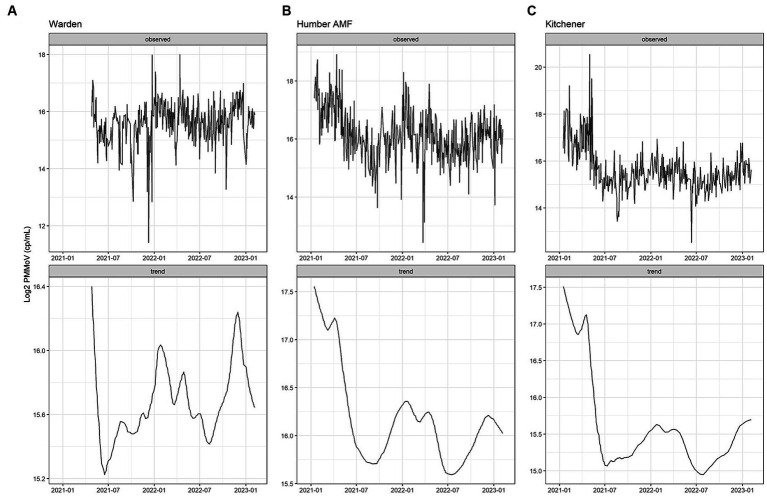
Wastewater samples from Warden, the Humber Air Management Facility (AMF), and Kitchener were analyzed for SARS-CoV-2, PMMoV, and crAssphage. The seasonality of PMMoV and flow rates were examined and compared by Season-Trend-Loess decomposition analysis. The effects of normalization using PMMoV, crAssphage, and flow rates were analyzed by comparing the correlations to clinical cases by episode date (CBED) during 2021.
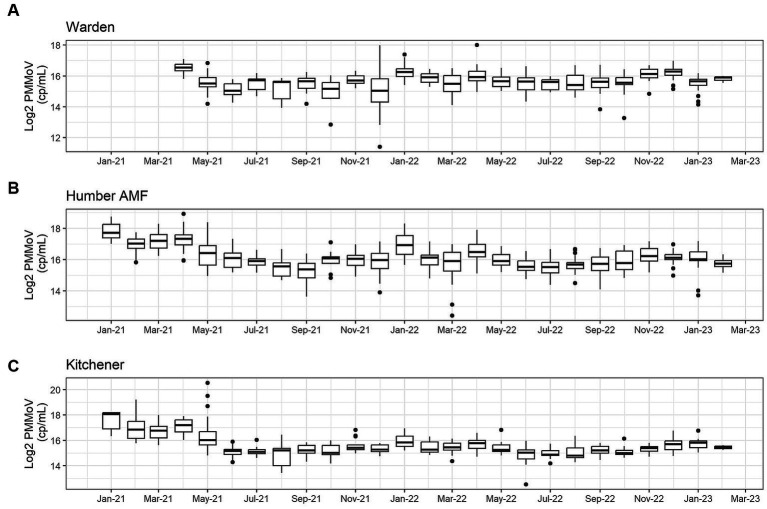
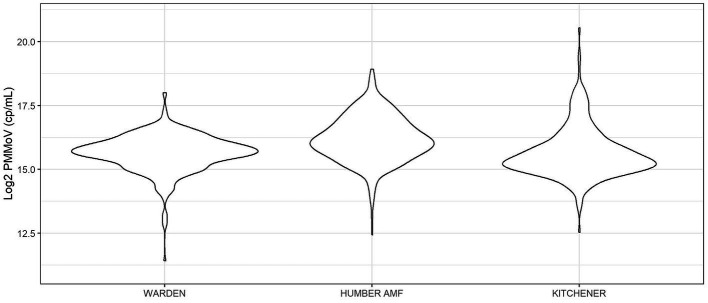
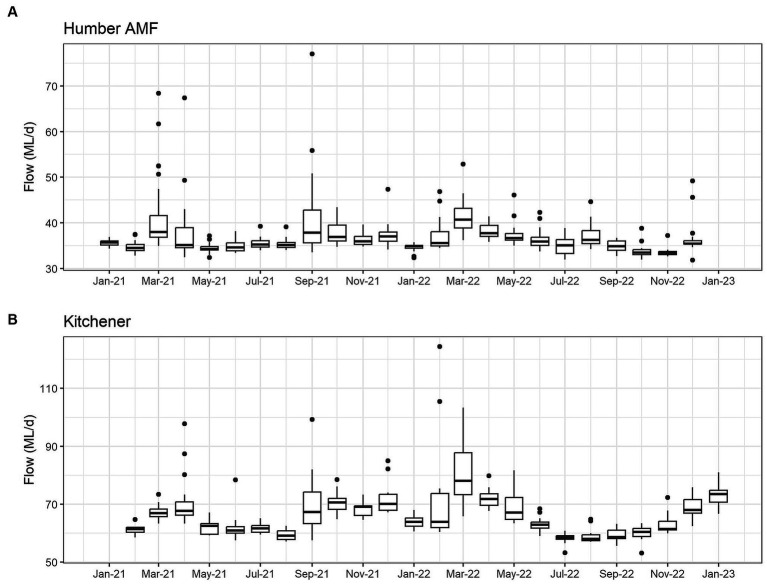
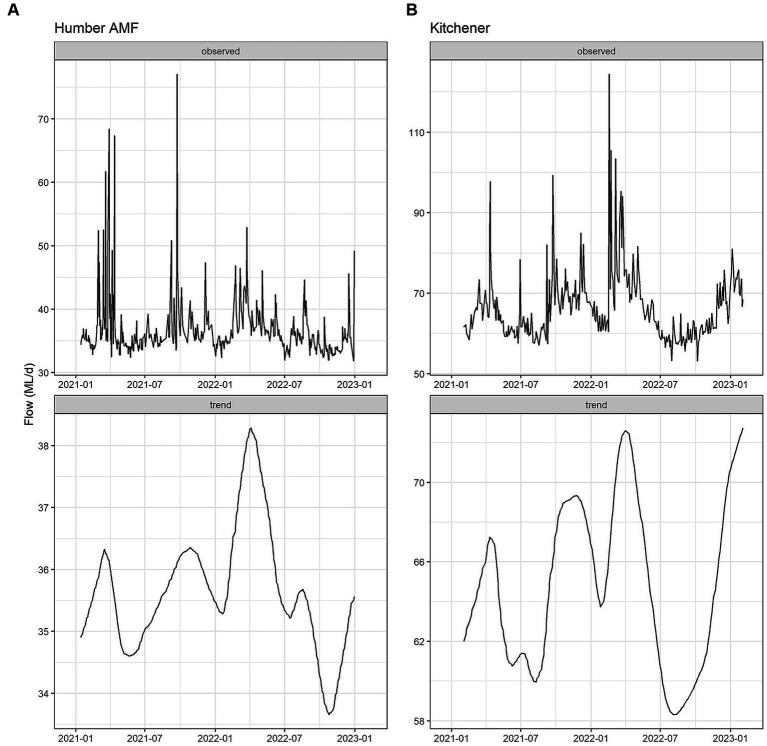
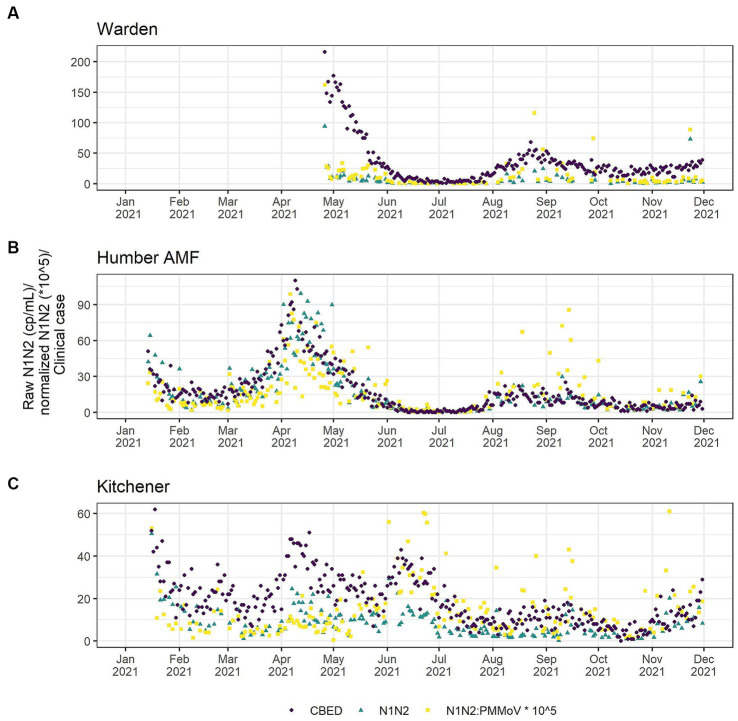
Seasonal analysis demonstrated that PMMoV had similar trends at Humber AMF and Kitchener with peaks in January and April 2022 and low concentrations (troughs) in the summer months. Warden had similar trends but was more sporadic between the peaks and troughs for PMMoV concentrations. Flow demonstrated similar trends but was not correlated to PMMoV concentrations at Humber AMF and was very weak at Kitchener ( = 0.12). Despite the differences among the sewersheds, unnormalized SARS-CoV-2 (raw N1-N2) concentration in wastewater ( = 99-191) was strongly correlated to the CBED in the communities ( = 0.620-0.854) during 2021. Additionally, normalization with PMMoV did not improve the correlations at Warden and significantly reduced the correlations at Humber AMF and Kitchener. Flow normalization ( = 99-191) at Humber AMF and Kitchener and crAssphage normalization ( = 29-57) correlations at all three sites were not significantly different from raw N1-N2 correlations with CBED.
Differences in seasonal trends in viral biomarkers caused by differences in sewershed characteristics (flow, input, etc.) may play a role in determining how effective normalization may be for improving correlations (or not). This study highlights the importance of assessing the influence of viral fecal indicators on normalized SARS-CoV-2 or other viruses of concern. Fecal indicators used to normalize the target of interest may help or hinder establishing trends with clinical outcomes of interest in wastewater-based surveillance and needs to be considered carefully across seasons and sites.
基于废水的监测是监测 COVID-19 社区流行情况的前沿方法,然而,对于使用粪便指标来规范废水中 SARS-CoV-2 病毒仍然存在持续的不确定性。本研究使用安大略省 2021-2023 年期间三个社区的样本,检查了病毒粪便指标(辣椒轻斑驳病毒,PMMoV)的季节性以及数据标准化以提高与临床病例相关性的实用性。
对 Warden、Humber 空气管理设施(AMF)和 Kitchener 的废水样本进行了 SARS-CoV-2、PMMoV 和 crAssphage 的分析。使用季节趋势洛伦兹分解分析比较了 PMMoV 和流量的季节性,并进行了比较。通过比较 2021 年期间按发病日期(CBED)的临床病例相关性,分析了使用 PMMoV、crAssphage 和流量进行标准化的效果。
季节性分析表明,PMMoV 在 Humber AMF 和 Kitchener 具有相似的趋势,2022 年 1 月和 4 月达到峰值,夏季浓度较低(低谷)。Warden 也有类似的趋势,但 PMMoV 浓度的峰值和低谷之间更为分散。流量显示出相似的趋势,但在 Humber AMF 与 PMMoV 浓度不相关,在 Kitchener 相关性很弱( = 0.12)。尽管下水道系统存在差异,但 2021 年未标准化的 SARS-CoV-2(原始 N1-N2)浓度与社区中的 CBED 呈强相关性( = 0.620-0.854)。此外,在 Warden 进行 PMMoV 标准化并没有提高相关性,反而显著降低了 Humber AMF 和 Kitchener 的相关性。Humber AMF 和 Kitchener 的流量标准化( = 99-191)以及所有三个地点的 crAssphage 标准化( = 29-57)与 CBED 的原始 N1-N2 相关性没有显著差异。
由于下水道系统特征(流量、输入等)的差异导致病毒生物标志物的季节性趋势差异,可能会影响标准化对提高相关性的有效性(或无效性)。本研究强调了评估粪便指示物对目标 SARS-CoV-2 或其他关注病毒的影响的重要性。用于标准化目标的粪便指示物可能有助于或阻碍建立与废水监测中临床结果相关的趋势,需要在不同季节和地点仔细考虑。