Violence Prevention Research Program, Department of Emergency Medicine, University of California Davis School of Medicine, 2315 Stockton Boulevard, Sacramento, CA, 95817, USA.
Department of Sociology & Criminology, Gonzaga University, Spokane, WA, USA.
J Urban Health. 2022 Aug;99(4):610-625. doi: 10.1007/s11524-022-00656-0. Epub 2022 Jun 7.
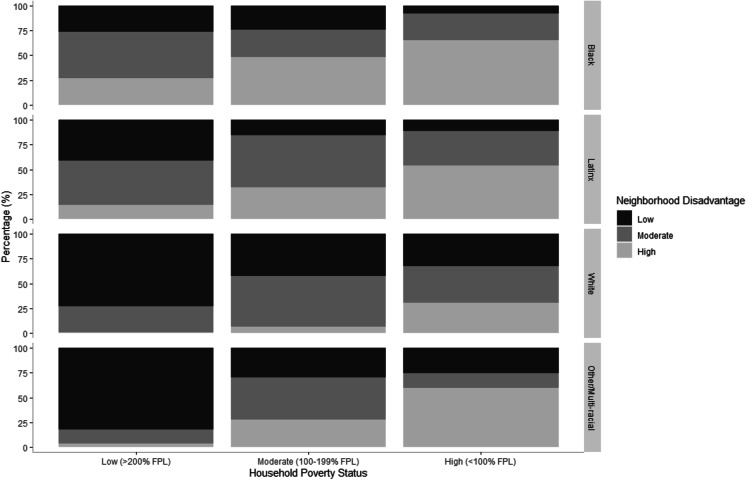
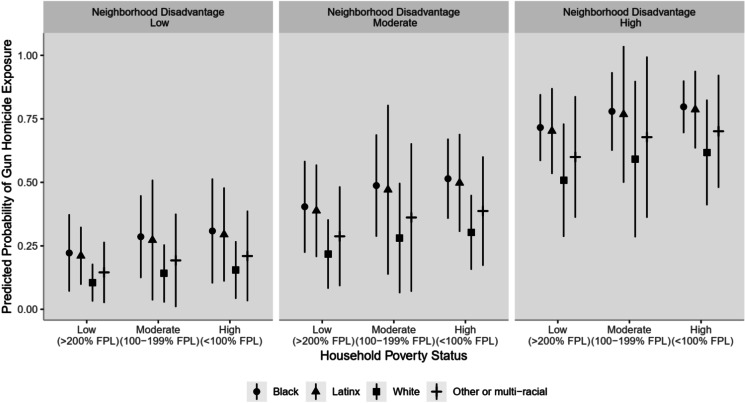
Understanding the burden of gun violence among youth is a public health imperative. While most estimates are based on direct and witnessed victimization, living nearby gun violence incidents may be consequential too. Yet detailed information about these broader experiences of violence is lacking. We use data on a population-based cohort of youth merged with incident-level data on deadly gun violence to assess the prevalence and intensity of community exposure to gun homicides across cross-classified categories of exposure distance and recency, overall and by race/ethnicity, household poverty, and neighborhood disadvantage. In total, 2-18% of youth resided within 600 m of a gun homicide occurring in the past 14-365 days. These percentages were 3-25% for incidents within 800 m and 5-37% for those within a 1300-m radius. Black and Latinx youth were 3-7 times more likely, depending on the exposure radius, to experience a past-year gun homicide than white youth and on average experienced incidents more recently and closer to home. Household poverty contributed to exposure inequities, but disproportionate residence in disadvantaged neighborhoods was especially consequential: for all racial/ethnic groups, the difference in the probability of exposure between youth in low vs high poverty households was approximately 5-10 percentage points, while the difference between youth residing in low vs high disadvantage neighborhoods was approximately 50 percentage points. Given well-documented consequences of gun violence exposure on health, these more comprehensive estimates underscore the importance of supportive strategies not only for individual victims but entire communities in the aftermath of gun violence.
了解青少年枪支暴力的负担是公共卫生的当务之急。虽然大多数估计数都是基于直接和目击的受害情况,但生活在枪支暴力事件附近也可能产生后果。然而,关于这些更广泛的暴力经历的详细信息却很缺乏。我们使用了一个基于人群的青年队列的数据,并与致命枪支暴力的事件级数据相合并,以评估在交叉分类的暴露距离和最近时间范围内,社区整体以及按种族/族裔、家庭贫困和邻里劣势暴露于枪支凶杀案的普遍性和强度。总共有 2-18%的青年居住在过去 14-365 天内发生的枪支凶杀案的 600 米范围内。对于距离 800 米以内的事件,这一百分比为 3-25%,对于距离 1300 米以内的事件,这一百分比为 5-37%。具体而言,取决于暴露半径,黑人青年和拉丁裔青年经历过去一年枪支凶杀案的可能性比白人青年高 3-7 倍,而且平均来说,他们遭遇的事件更近且发生在家附近。家庭贫困导致了暴露的不平等,但在劣势社区的不成比例居住尤为重要:对于所有种族/族裔群体,处于低贫困家庭和高贫困家庭的青年之间的暴露概率差异约为 5-10 个百分点,而居住在低劣势社区和高劣势社区的青年之间的差异约为 50 个百分点。鉴于枪支暴力暴露对健康的后果有据可查,这些更全面的估计突显了不仅为个别受害者,而且为枪支暴力事件发生后整个社区提供支持性策略的重要性。