Biotechnology Innovation Centre, Rhodes University, P.O. Box 94, Grahamstown, 6140, Eastern Cape, South Africa.
Department of Biochemistry and Microbiology, Rhodes University, P.O. Box 94, Grahamstown, 6140, Eastern Cape, South Africa.
Malar J. 2022 Jun 7;21(1):174. doi: 10.1186/s12936-022-04187-6.
The prevalence and death rate arising from malaria infection, and emergence of other diseases showing similar symptoms to malaria require the development of malaria-specific and sensitive devices for its diagnosis. To address this, the design and fabrication of low-cost, rapid, paper-based analytical devices (µPAD) using surface-immobilized aptamers to detect the presence of a recombinant malarial biomarker-Plasmodium falciparum lactate dehydrogenase (rPfLDH)-is reported in this study.
Test zones on paper surfaces were created by covalently immobilizing streptavidin to the paper, subsequently attaching biotinylated aptamers to streptavidin. Aptamers selectively bound rPfLDH. The measurement of captured rPfLDH enzyme activity served as the means of detecting this biomarker. Enzyme activity across three replicate sensors was digitally quantified using the colorimetric Malstat assay.
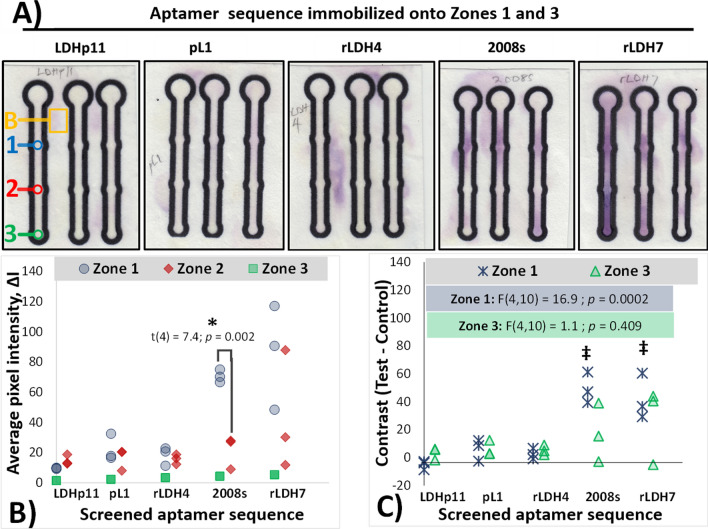
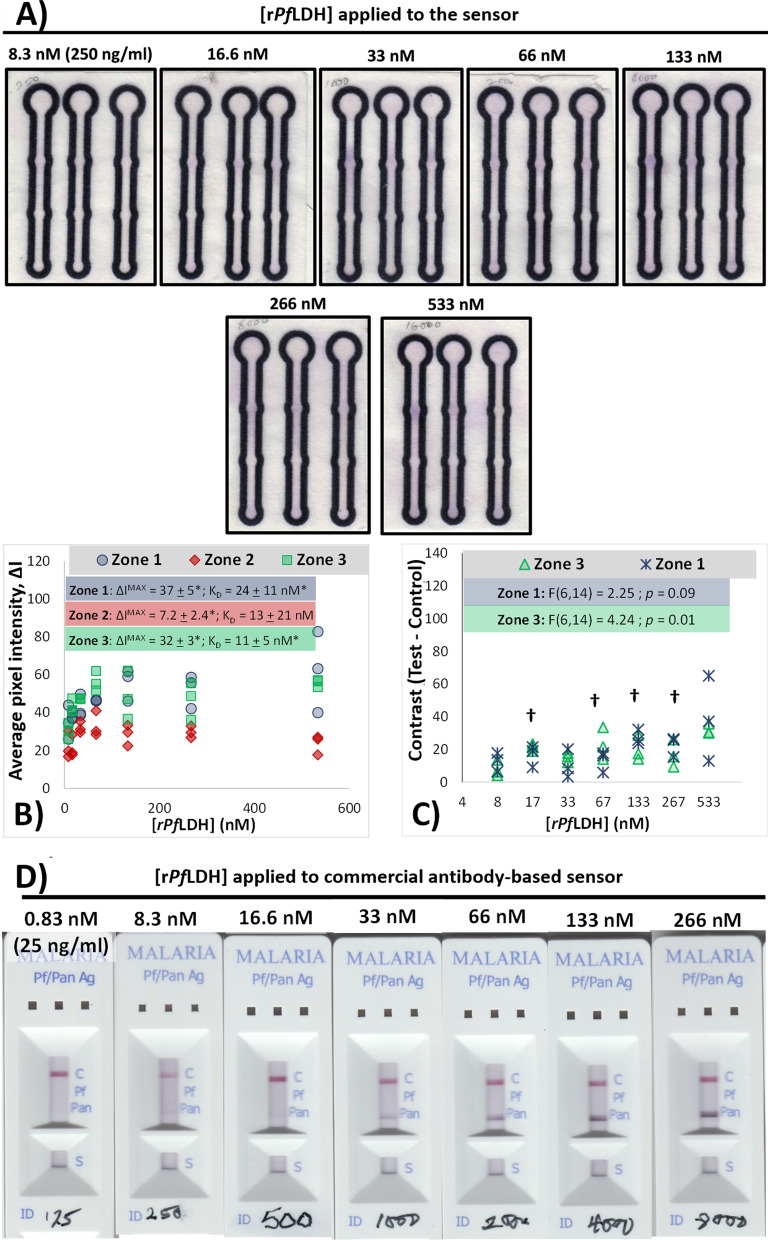
Screening of several different aptamers reported in the literature showed that aptamers rLDH7 and 2008s immobilized in this manner specifically recognised and captured PfLDH. Using rLDH7, the sensitivity of the µPAD sensor was evaluated and the µPAD sensor was applied for preferential detection of rPfLDH, both in buffered solutions of the protein and in spiked serum and red blood cell lysate samples. In buffered solutions, the test zone of the µPAD sensor exhibited a K of 24 ± 11 nM and an empirical limit of detection of 17 nM, respectively, a limit similar to commercial antibody-based sensors exposed to rPfLDH. The specific recognition of 133 nM rPfLDH in undiluted serum and blood samples was demonstrated by the µPAD.
The reported µPAD demonstrates the potential of integrating aptamers into paper-based malarial rapid diagnostic tests. The assembly of µPAD sensors using APTEC assay principles for the detection the malarial biomarker, lactate dehydrogenase enzymes from Plasmodium falciparum (PfLDH). The aptamers immobilized at the test zones capture the PfLDH in samples. After washing the unbound sample components from the zones, Malstat assay reagents are added for colour development, proportional to the amount of captured PfLDH.
疟疾感染的流行率和死亡率以及其他表现出类似疟疾症状的疾病的出现,需要开发专门针对疟疾的灵敏诊断设备。为了解决这个问题,本研究报告了使用表面固定的适体设计和制造低成本、快速、基于纸张的分析设备(µPAD),以检测重组疟原生物标志物-恶性疟原虫乳酸脱氢酶(rPfLDH)的存在。
通过将链霉亲和素共价固定在纸张上,在纸张表面的测试区域创建,随后将生物素化的适体连接到链霉亲和素上。适体选择性地与 rPfLDH 结合。通过使用比色 Malstat 测定法对捕获的 rPfLDH 酶活性进行数字化定量,作为检测这种生物标志物的手段。使用 Malstat 测定法对三个重复传感器的酶活性进行数字化定量。
筛选了文献中报道的几种不同的适体,结果表明,以这种方式固定的适体 rLDH7 和 2008s 特异性地识别和捕获 PfLDH。使用 rLDH7 评估了 µPAD 传感器的灵敏度,并将 µPAD 传感器应用于在缓冲溶液中的蛋白质和在掺入血清和红细胞裂解液样品中对 rPfLDH 的优先检测。在缓冲溶液中,µPAD 传感器的测试区显示出 24±11 nM 的 K 值和 17 nM 的经验检测限,这一检测限与暴露于 rPfLDH 的商业抗体传感器相似。µPAD 显示了对未稀释血清和血液样品中 133 nM rPfLDH 的特异性识别。
报告的 µPAD 证明了将适体整合到基于纸张的疟疾快速诊断测试中的潜力。µPAD 传感器的组装使用 APTEC 测定原理检测疟原生物标志物,即恶性疟原虫的乳酸脱氢酶(PfLDH)。在测试区域固定的适体捕获样品中的 PfLDH。在从区域中洗涤掉未结合的样品成分后,加入 Malstat 测定试剂进行显色,显色程度与捕获的 PfLDH 成正比。