Composting Research Group (GICOM), Department of Chemical, Biological and Environmental Engineering, Escola d'Enginyeria, Universitat Autònoma de Barcelona, Cerdanyola del Vallès, Spain.
Bioengineered. 2022 May;13(5):12365-12391. doi: 10.1080/21655979.2022.2074621.
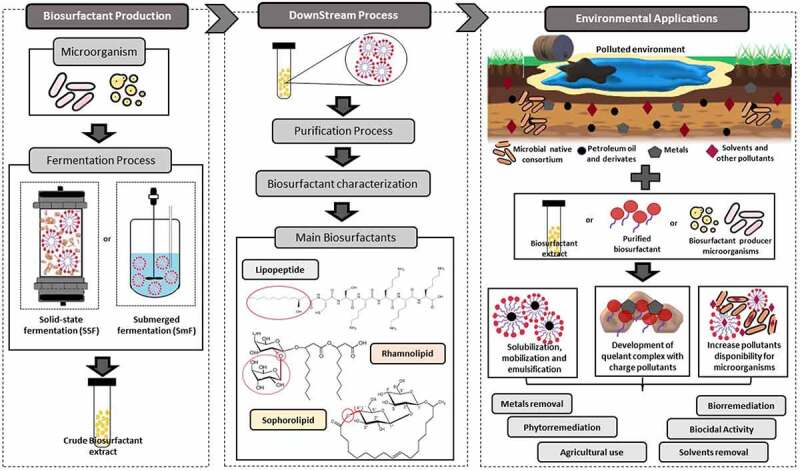
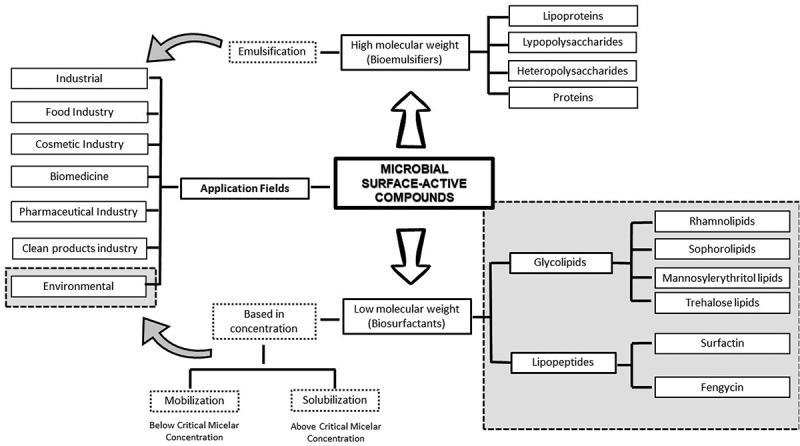
Microbial biosurfactants are low-molecular-weight surface-active compounds of high industrial interest owing to their chemical properties and stability under several environmental conditions. The chemistry of a biosurfactant and its production cost are defined by the selection of the producer microorganism, type of substrate, and purification strategy. Recently, biosurfactants have been applied to solve or contribute to solving some environmental problems, with this being their main field of application. The most referenced studies are based on the bioremediation of contaminated soils with recalcitrant pollutants, such as hydrocarbons or heavy metals. In the case of heavy metals, biosurfactants function as chelating agents owing to their binding capacity. However, the mechanism by which biosurfactants typically act in an environmental field is focused on their ability to reduce the surface tension, thus facilitating the emulsification and solubilization of certain pollutants ( biostimulation and/or bioaugmentation). Moreover, despite the low toxicity of biosurfactants, they can also act as biocidal agents at certain doses, mainly at higher concentrations than their critical micellar concentration. More recently, biosurfactant production using alternative substrates, such as several types of organic waste and solid-state fermentation, has increased its applicability and research interest in a circular economy context. In this review, the most recent research publications on the use of biosurfactants in environmental applications as an alternative to conventional chemical surfactants are summarized and analyzed. Novel strategies using biosurfactants as agricultural and biocidal agents are also presented in this paper.
微生物生物表面活性剂是具有高分子量和高工业价值的低分子量表面活性化合物,其化学性质和在多种环境条件下的稳定性使其具有广泛的应用前景。生物表面活性剂的化学性质和生产成本取决于生产微生物、底物类型和纯化策略的选择。最近,生物表面活性剂已被应用于解决或有助于解决一些环境问题,这是它们的主要应用领域。最常被引用的研究是基于生物修复受难降解污染物(如碳氢化合物或重金属)污染的土壤。在重金属的情况下,生物表面活性剂作为螯合剂发挥作用,因为它们具有结合能力。然而,生物表面活性剂在环境领域中的作用机制通常集中在它们降低表面张力的能力上,从而促进某些污染物的乳化和溶解(生物刺激和/或生物增强)。此外,尽管生物表面活性剂的毒性较低,但在某些剂量下也可以作为杀菌剂,主要是在高于其临界胶束浓度的浓度下。最近,使用替代底物(如多种有机废物和固态发酵)生产生物表面活性剂增加了其在循环经济背景下的适用性和研究兴趣。在这篇综述中,总结和分析了最近关于生物表面活性剂在环境应用中替代传统化学表面活性剂的研究出版物。本文还介绍了将生物表面活性剂用作农业和杀菌剂的新策略。