INSERM, BPH, U1219, Team Pharmacoepidemiology, University of Bordeaux, Bordeaux, France.
Department of Medical Science, Surgery and Neuroscience, University of Siena, Siena, Italy.
PLoS One. 2022 Jun 8;17(6):e0269232. doi: 10.1371/journal.pone.0269232. eCollection 2022.
To develop and validate a case-finding algorithm for the identification of Non-Small Cell Lung Cancer (NSCLC) cases in a region-wide Italian pathology registry (PR).
Data collected between 2009 and 2017 in the PR and the Pharmacy Database of the University Hospital of Siena and the PR of Tuscany region were used. A NSCLC-identification algorithm based on free-text keywords and SNOMED morphology and topography codes was designed and tested on data from Siena: indication for drug use (i.e. NSCLC) was the reference standard for sensitivity (SE); positive predictive value (PPV) was estimated through manual review. Algorithm modifications were then tested to improve algorithm performance: PPV was calculated against validated dataset from PR of Siena; a range of SE [min-max] was estimated in PR of Tuscany using analytical formulae that assumed NSCLC incidence equal either to 80% or 90% of overall lung cancer incidence recorded in Tuscany. The algorithm modification with the best performance was chosen as the final version of the algorithm. A random sample of 200 cases was extracted from the PR of Tuscany for manual review.
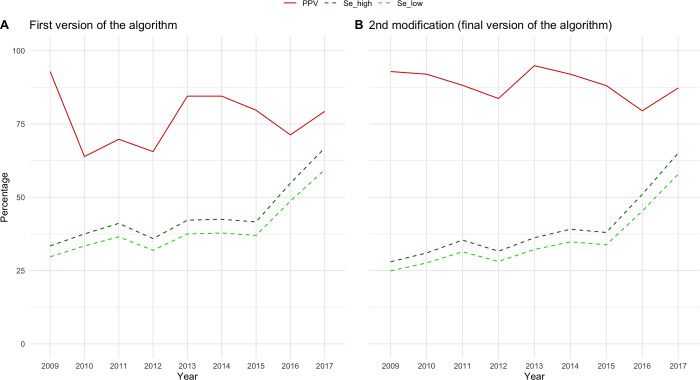
The first version of the algorithm showed a PPV of 74.7% and SE of 79% in PR of Siena. The final version of the algorithm had a SE in PR of Tuscany that grew with calendar time (2009 = [24.7%-28%]; 2017 = [57.9%-65.1%]) and a PPV of 93%.
The final NSCLC-finding algorithm showed with very high PPV. SE was in line with the expected contribution of PR to overall cases captured in the regional Cancer Registry, with a trend of increase over calendar time. Given the promising algorithm validity and the wide use of SNOMED terminology in electronic pathology records, the proposed algorithm is expected to be easily adapted to other electronic databases for (pharmaco)epidemiology purposes.
开发和验证一种在意大利区域病理登记处(PR)中识别非小细胞肺癌(NSCLC)病例的病例发现算法。
使用了 2009 年至 2017 年在 PR 和锡耶纳大学医院药房数据库以及托斯卡纳地区 PR 中收集的数据。设计了一种基于自由文本关键词和 SNOMED 形态和拓扑代码的 NSCLC 识别算法,并在锡耶纳的数据上进行了测试:药物使用的适应症(即 NSCLC)是敏感性(SE)的参考标准;阳性预测值(PPV)通过手动审查进行估计。然后对算法进行修改以提高算法性能:在锡耶纳 PR 的验证数据集上计算 PPV;在托斯卡纳 PR 中,使用假设 NSCLC 发生率等于托斯卡纳记录的所有肺癌发生率的 80%或 90%的分析公式来估计 SE 的范围[最小-最大]。选择性能最佳的算法修改作为算法的最终版本。从托斯卡纳 PR 中随机抽取 200 例进行手动审查。
算法的第一个版本在锡耶纳 PR 中显示出 74.7%的 PPV 和 79%的 SE。最终版本的算法在托斯卡纳 PR 中的 SE 随着日历时间的推移而增长(2009 年= [24.7%-28%];2017 年= [57.9%-65.1%]),PPV 为 93%。
最终的 NSCLC 发现算法具有非常高的 PPV。SE 与 PR 对区域癌症登记处中捕获的所有病例的预期贡献一致,随着日历时间的推移呈上升趋势。鉴于算法有效性的前景以及 SNOMED 术语在电子病理学记录中的广泛应用,预计该算法将易于适应其他电子数据库,以用于(药物)流行病学目的。