BirdLife South Africa, Seabird Conservation Programme, Cape Town, 8001, South Africa.
Institute for Coastal and Marine Research and Department of Zoology, Nelson Mandela University, Port Elizabeth, 6001, South Africa.
Sci Rep. 2022 Jun 8;12(1):9489. doi: 10.1038/s41598-022-12969-w.
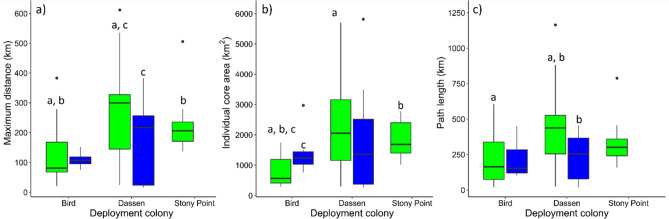
The population of the Endangered African penguin Spheniscus demersus has decreased by > 65% in the last 20 years. A major driver of this decrease has been the reduced availability of their principal prey, sardine Sardinops sagax and anchovy Engraulis encrasicolus. To date, conservation efforts to improve prey availability have focused on spatial management strategies to reduce resource competition with purse-seine fisheries during the breeding season. However, penguins also undergo an annual catastrophic moult when they are unable to feed for several weeks. Before moulting they must accumulate sufficient energy stores to survive this critical life-history stage. Using GPS tracking data collected between 2012 and 2019, we identify important foraging areas for pre- and post-moult African penguins at three of their major colonies in South Africa: Dassen Island and Stony Point (Western Cape) and Bird Island (Eastern Cape). The foraging ranges of pre- and post-moult adult African penguins (c. 600 km from colony) was far greater than that previously observed for breeding penguins (c. 50 km from colony) and varied considerably between sites, years and pre- and post-moult stages. Despite their more extensive range during the non-breeding season, waters within 20 and 50 km of their breeding colonies were used intensively and represent important foraging areas to pre- and post-moult penguins. Furthermore, penguins in the Western Cape travelled significantly further than those in the Eastern Cape which is likely a reflection of the poor prey availability along the west coast of South Africa. Our findings identify important marine areas for pre- and post-moult African penguins and support for the expansion of fisheries-related spatio-temporal management strategies to help conserve African penguins outside the breeding season.
在过去的 20 年里,濒危的非洲企鹅(Spheniscus demersus)数量减少了超过 65%。造成这种下降的一个主要原因是它们的主要猎物——沙丁鱼(Sardinops sagax)和凤尾鱼(Engraulis encrasicolus)的可获得性减少。迄今为止,为了增加猎物的可获得性,保护工作的重点一直是空间管理策略,以减少繁殖季节与围网渔业的资源竞争。然而,企鹅在每年的换羽期也会经历一次灾难性的换羽,在这段时间里它们无法进食数周。在换羽之前,它们必须积累足够的能量储备,以度过这个关键的生命阶段。我们使用 2012 年至 2019 年期间收集的 GPS 跟踪数据,确定了南非三个主要企鹅聚居地(达森岛、斯通尼角和鸟岛)的企鹅在换羽前和换羽后的重要觅食区域。换羽前和换羽后成年非洲企鹅(距聚居地约 600 公里)的觅食范围远远大于之前观察到的繁殖企鹅(距聚居地约 50 公里),并且在不同地点、年份和换羽前和换羽后阶段之间差异很大。尽管它们在非繁殖季节的活动范围更广,但它们在繁殖地 20 公里和 50 公里范围内的水域仍被密集利用,是换羽前和换羽后企鹅的重要觅食区域。此外,西开普省的企鹅比东开普省的企鹅旅行的距离要长得多,这可能反映了南非西海岸的猎物可获得性较差。我们的研究结果确定了非洲企鹅在换羽前和换羽后的重要海洋区域,并支持扩大渔业相关时空管理策略,以帮助保护繁殖季节外的非洲企鹅。