Leeds Community Healthcare NHS Trust, Leeds, UK.
Faculty of Medicine, University of Leeds, Leeds, UK.
BMC Musculoskelet Disord. 2022 Jun 8;23(1):550. doi: 10.1186/s12891-022-05485-5.
Lumbar spinal stenosis (LSS) is a common degenerative spinal condition in older adults associated with disability, diminished quality of life, and substantial healthcare costs. Individual symptoms and needs vary. With sparse and sometimes inconsistent evidence to guide clinical decision-making, variable clinical care may lead to unsatisfactory patient outcomes and inefficient use of healthcare resources.
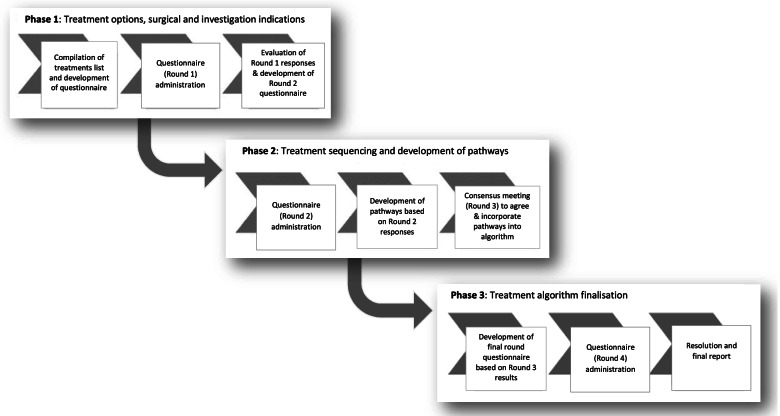
A three-phase modified Delphi study comprising four consensus rounds was conducted on behalf of the International Taskforce for the Diagnosis and Management of LSS to develop a treatment algorithm based on multi-professional international expert consensus. Participants with expertise in the assessment and management of people with LSS were invited using an international distribution process used for two previous Delphi studies led by the Taskforce. Separate treatment pathways for patients with different symptom types and severity were developed and incorporated into a proposed treatment algorithm through consensus rounds 1 to 3. Agreement with the proposed algorithm was evaluated in the final consensus round.
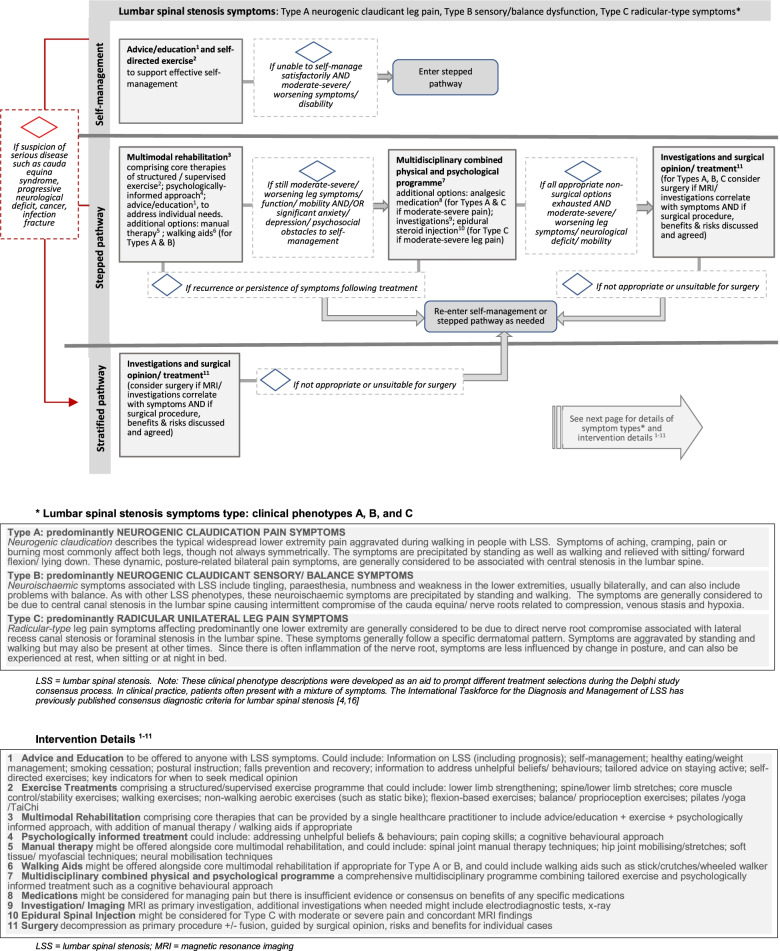
The final algorithm combines stratified and stepped approaches. When indicated, immediate investigation and surgery is advocated. Otherwise, a stepped approach is suggested when self-directed care is unsatisfactory. This starts with tailored rehabilitation, then more complex multidisciplinary care, investigations and surgery options if needed. Treatment options in each step depend on clinical phenotype and symptom severity. Treatment response guides pathway entrance and exit points. Of 397 study participants, 86% rated their agreement ≥ 4 for the proposed algorithm on a 0-6 scale, of which 22% completely agreed. Only 7% disagreed. Over 70% of participants felt that the algorithm would be useful for clinicians in public healthcare (both primary care and specialist settings) and in private healthcare settings, and that a simplified version would help patients in shared decision-making.
International and multi-professional agreement was achieved for a proposed LSS treatment algorithm developed through expert consensus. The algorithm advocates different pathway options depending on clinical indications. It is not intended as a treatment protocol and will require evaluation against current care for clinical and cost-effectiveness. It may, however, serve as a clinical guide until evidence is sufficient to inform a fully stratified care model.
腰椎管狭窄症(LSS)是一种常见的老年退行性脊柱疾病,与残疾、生活质量下降和大量医疗保健费用有关。个体症状和需求各不相同。由于指导临床决策的证据稀少且有时不一致,因此可变的临床护理可能导致患者结局不佳和医疗保健资源利用效率低下。
代表国际腰椎管狭窄症诊断和管理工作组进行了一项三阶段的改良 Delphi 研究,包括四轮共识会议,旨在根据多专业国际专家共识制定治疗算法。使用工作组之前进行的两项 Delphi 研究中使用的国际分发过程邀请了在 LSS 患者评估和管理方面具有专业知识的参与者。通过共识会议 1 至 3 开发了针对不同症状类型和严重程度患者的单独治疗途径,并将其纳入拟议的治疗算法中。在最后一轮共识会议中评估了对拟议算法的一致性。
最终算法结合了分层和阶梯式方法。有指征时,提倡立即进行调查和手术。否则,当自我指导的护理不满意时,建议采用阶梯式方法。这从量身定制的康复开始,如果需要,然后是更复杂的多学科护理、检查和手术选择。在每个步骤中的治疗选择取决于临床表型和症状严重程度。治疗反应指导途径的入口和出口点。在 397 名研究参与者中,86%的人在 0-6 分制上对该算法的建议评分为≥4,其中 22%完全同意,只有 7%不同意。超过 70%的参与者认为该算法对公共卫生保健(包括初级保健和专科设置)和私人卫生保健环境中的临床医生有用,简化版将有助于患者共同决策。
通过专家共识达成了针对 LSS 治疗算法的国际和多专业共识。该算法根据临床指征主张不同的途径选择。它不是作为一种治疗方案提出的,需要根据临床和成本效益评估现有护理情况。然而,在有足够证据支持分层护理模式之前,它可以作为临床指南。