Mungur Rajneesh, Zheng Jiesheng, Wang Ben, Chen Xinhua, Zhan Renya, Tong Ying
Department of Neurosurgery of the First Affiliated Hospital, School of Medicine, Zhejiang University, Hangzhou, China.
Key Laboratory of Cancer Prevention and Intervention, Key Laboratory of Molecular Biology in Medical Sciences, National Ministry of Education, Cancer Institute, The Second Affiliated Hospital, School of Medicine, Zhejiang University, Hangzhou, China.
Front Oncol. 2022 May 19;12:903059. doi: 10.3389/fonc.2022.903059. eCollection 2022.
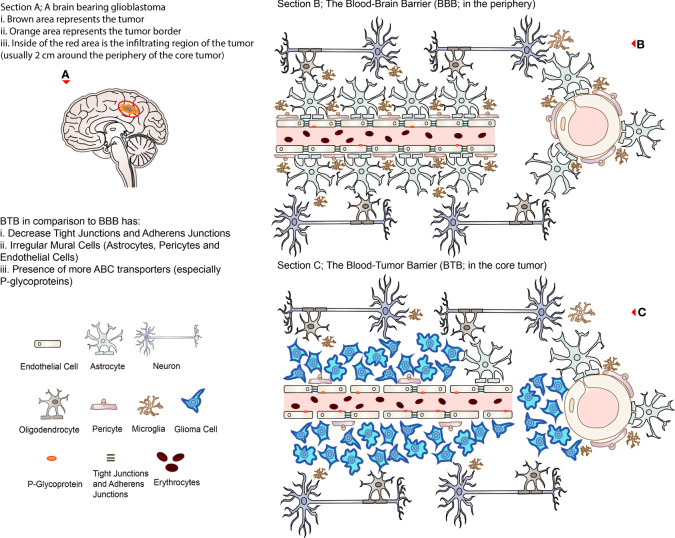
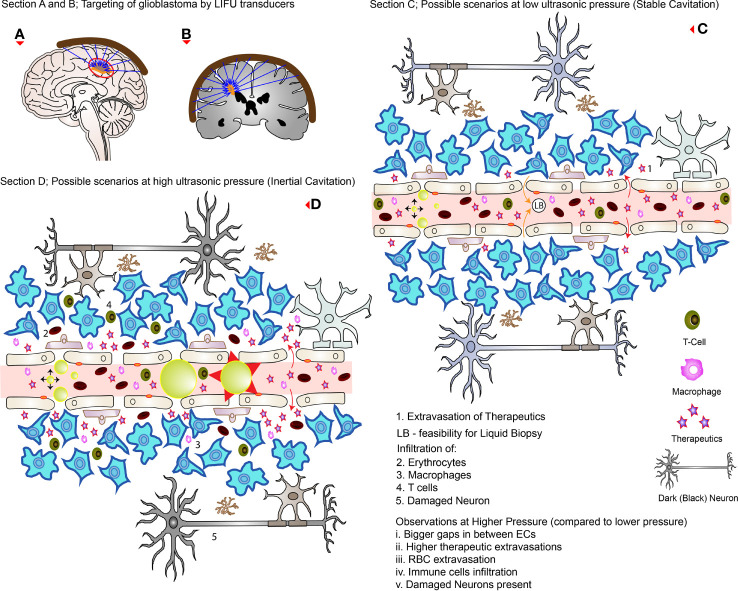
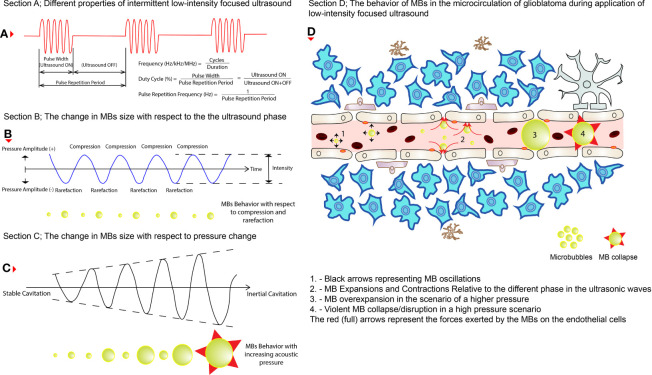
Glioblastoma is one of the central nervous system most aggressive and lethal cancers with poor overall survival rate. Systemic treatment of glioblastoma remains the most challenging aspect due to the low permeability of the blood-brain barrier (BBB) and blood-tumor barrier (BTB), limiting therapeutics extravasation mainly in the core tumor as well as in its surrounding invading areas. It is now possible to overcome these barriers by using low-intensity focused ultrasound (LIFU) together with intravenously administered oscillating microbubbles (MBs). LIFU is a non-invasive technique using converging ultrasound waves which can alter the permeability of BBB/BTB to drug delivery in a specific brain/tumor region. This emerging technique has proven to be both safe and repeatable without causing injury to the brain parenchyma including neurons and other structures. Furthermore, LIFU is also approved by the FDA to treat essential tremors and Parkinson's disease. It is currently under clinical trial in patients suffering from glioblastoma as a drug delivery strategy and liquid biopsy for glioblastoma biomarkers. The use of LIFU+MBs is a step-up in the world of drug delivery, where onco-therapeutics of different molecular sizes and weights can be delivered directly into the brain/tumor parenchyma. Initially, several potent drugs targeting glioblastoma were limited to cross the BBB/BTB; however, using LIFU+MBs, diverse therapeutics showed significantly higher uptake, improved tumor control, and overall survival among different species. Here, we highlight the therapeutic approach of LIFU+MBs mediated drug-delivery in the treatment of glioblastoma.
胶质母细胞瘤是中枢神经系统中最具侵袭性和致命性的癌症之一,总体生存率很低。由于血脑屏障(BBB)和血肿瘤屏障(BTB)的低渗透性,胶质母细胞瘤的全身治疗仍然是最具挑战性的方面,这限制了治疗药物主要在肿瘤核心及其周围侵袭区域的外渗。现在可以通过使用低强度聚焦超声(LIFU)和静脉注射振荡微泡(MBs)来克服这些屏障。LIFU是一种非侵入性技术,利用汇聚的超声波可以改变BBB/BTB对特定脑/肿瘤区域药物递送的渗透性。这种新兴技术已被证明既安全又可重复,不会对包括神经元和其他结构在内的脑实质造成损伤。此外,LIFU也已获得美国食品药品监督管理局(FDA)批准用于治疗特发性震颤和帕金森病。目前,它正在作为一种药物递送策略和胶质母细胞瘤生物标志物的液体活检,在胶质母细胞瘤患者中进行临床试验。LIFU+MBs的使用是药物递送领域的一个进步,不同分子大小和重量的肿瘤治疗药物可以直接递送到脑/肿瘤实质中。最初,几种靶向胶质母细胞瘤的强效药物仅限于穿过BBB/BTB;然而,使用LIFU+MBs,多种治疗药物在不同物种中显示出显著更高的摄取率、更好的肿瘤控制和总体生存率。在这里,我们重点介绍LIFU+MBs介导的药物递送在胶质母细胞瘤治疗中的治疗方法。