Tessema Belay, Sack Ulrich, König Brigitte, Serebrovska Zoya, Egorov Egor
Institute of Clinical Immunology, Faculty of Medicine, Leipzig University, Leipzig, Germany.
Institute of Medical Microbiology and Epidemiology of Infectious Diseases, Faculty of Medicine, Leipzig University, Leipzig, Germany.
Front Aging Neurosci. 2022 May 23;14:878278. doi: 10.3389/fnagi.2022.878278. eCollection 2022.
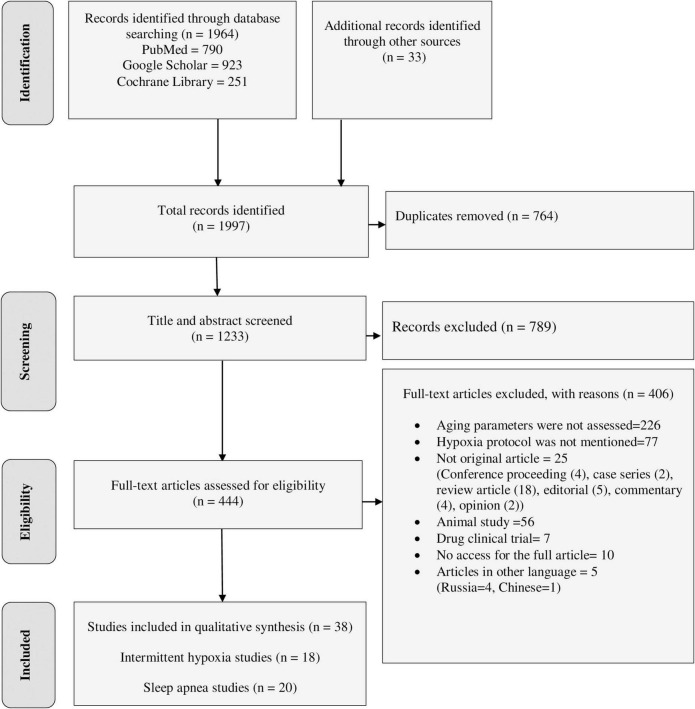
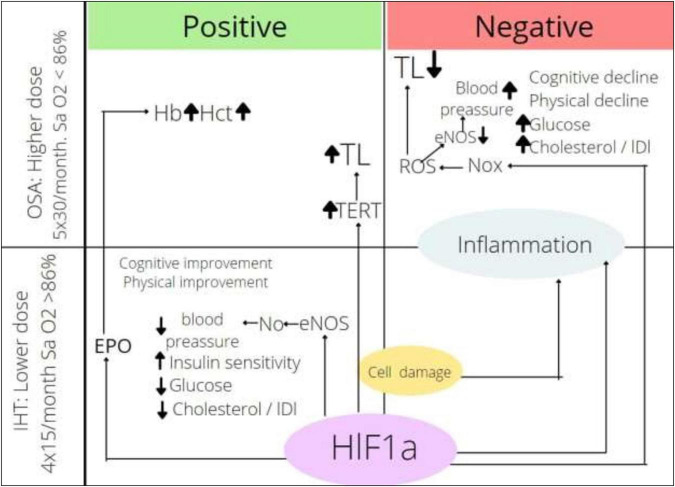
Several studies have assessed the effects of intermittent hypoxia-normoxia training (IHNT), intermittent hypoxia-hyperoxia training (IHHT), and obstructive sleep apnea (OSA) on aging and age-related diseases in humans; however, the results remain contradictory. Therefore, this review aims to systematically summarize the available studies on the effects of IHNT, IHHT, and OSA on aging and age-related diseases. Relevant studies were searched from PubMed, Google Scholar, Cochrane Library databases, and through manual searching from reference lists of eligible studies. A total of 38 eligible studies were included in this systematic review. IHHT and IHNT provide positive effects on several age-related parameters including quality of life, cognitive and physical functions, plasma level of glucose and cholesterol/LDL, systolic blood pressure, red blood cells, and inflammation. Moreover, moderate intermittent hypoxia induces telomerase reverse transcriptase (TERT) activity and telomere stabilization, delays induction of senescence-associated markers expression and senescence-associated β-galactosidase, upregulates pluripotent marker (Oct4), activates a metabolic shift, and raises resistance to pro-apoptotic stimuli. On the contrary, intermittent hypoxia in OSA causes hypertension, metabolic syndrome, vascular function impairment, quality of life and cognitive scores reduction, advanced brain aging, increase in insulin resistance, plasma hydrogen peroxide, GSH, IL-6, hsCRP, leptin, and leukocyte telomere shortening. Thus, it can be speculated that the main factor that determines the direction of the intermittent hypoxia action is the intensity and duration of exposure. There is no direct study to prove that IHNT/IHHT actually increases life expectancy in humans. Therefore, further study is needed to investigate the actual effect of IHNT/IHHT on aging in humans.
www.crd.york.ac.uk/prospero, identifier CRD42022298499.
多项研究评估了间歇性低氧-常氧训练(IHNT)、间歇性低氧-高氧训练(IHHT)和阻塞性睡眠呼吸暂停(OSA)对人类衰老及与年龄相关疾病的影响;然而,结果仍相互矛盾。因此,本综述旨在系统总结关于IHNT、IHHT和OSA对衰老及与年龄相关疾病影响的现有研究。通过在PubMed、谷歌学术、Cochrane图书馆数据库中检索相关研究,并通过手动检索符合条件研究的参考文献列表。本系统综述共纳入38项符合条件的研究。IHHT和IHNT对多个与年龄相关的参数具有积极影响,包括生活质量、认知和身体功能、血浆葡萄糖和胆固醇/低密度脂蛋白水平、收缩压、红细胞和炎症。此外,适度的间歇性低氧可诱导端粒酶逆转录酶(TERT)活性和端粒稳定,延迟衰老相关标志物表达和衰老相关β-半乳糖苷酶的诱导,上调多能性标志物(Oct4),激活代谢转变,并提高对促凋亡刺激的抵抗力。相反,OSA中的间歇性低氧会导致高血压、代谢综合征、血管功能损害、生活质量和认知评分降低、脑老化加剧、胰岛素抵抗增加、血浆过氧化氢、谷胱甘肽、白细胞介素-6、高敏C反应蛋白、瘦素升高以及白细胞端粒缩短。因此,可以推测决定间歇性低氧作用方向的主要因素是暴露的强度和持续时间。尚无直接研究证明IHNT/IHHT实际上能延长人类的预期寿命。因此,需要进一步研究来调查IHNT/IHHT对人类衰老的实际影响。