Agema Bram C, Veerman G D Marijn, Steendam Christi M J, Lanser Daan A C, Preijers Tim, van der Leest Cor, Koch Birgit C P, Dingemans Anne-Marie C, Mathijssen Ron H J, Koolen Stijn L W
Department of Medical Oncology, Erasmus MC Cancer Institute, Erasmus University Medical Center, Dr. Molewaterplein 40, Rotterdam 3015 GD, The Netherlands Department of Clinical Pharmacy, Erasmus University Medical Center, Rotterdam, The Netherlands.
Department of Medical Oncology, Erasmus MC Cancer Institute, Erasmus University Medical Center, Rotterdam, The Netherlands.
Ther Adv Med Oncol. 2022 Jun 3;14:17588359221103212. doi: 10.1177/17588359221103212. eCollection 2022.
Osimertinib is the cornerstone in the treatment of epidermal growth factor receptor-mutated non-small cell lung cancer (NSCLC). Nonetheless, ±25% of patients experience severe treatment-related toxicities. Currently, it is impossible to identify patients at risk of severe toxicity beforehand. Therefore, we aimed to study the relationship between osimertinib exposure and severe toxicity and to identify a safe toxic limit for a preventive dose reduction.
In this real-life prospective cohort study, patients with NSCLC treated with osimertinib were followed for severe toxicity (grade ⩾3 toxicity, dose reduction or discontinuation, hospital admission, or treatment termination). Blood for pharmacokinetic analyses was withdrawn during every out-patient visit. Primary endpoint was the correlation between osimertinib clearance (exposure) and severe toxicity. Secondary endpoint was the exposure-efficacy relationship, defined as progression-free survival (PFS) and overall survival (OS).
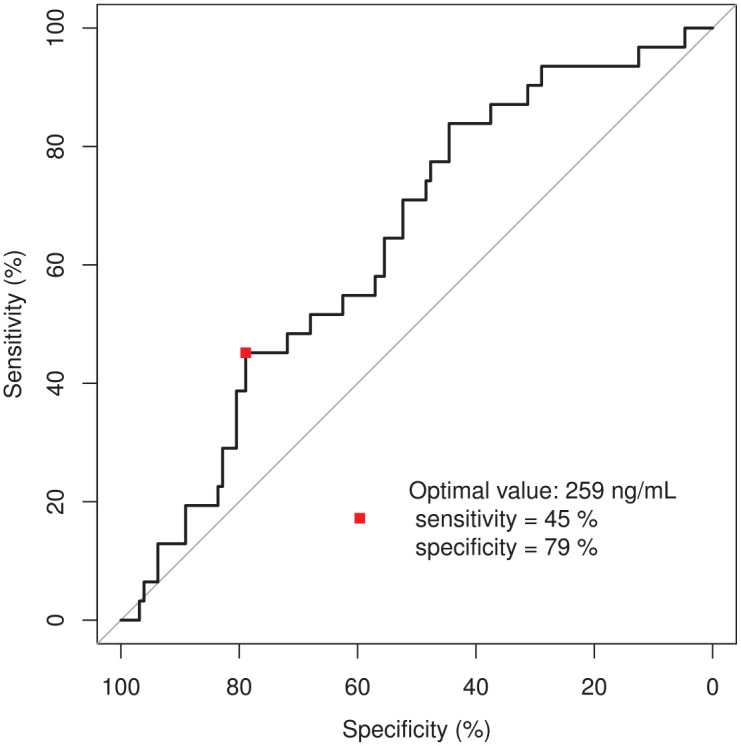
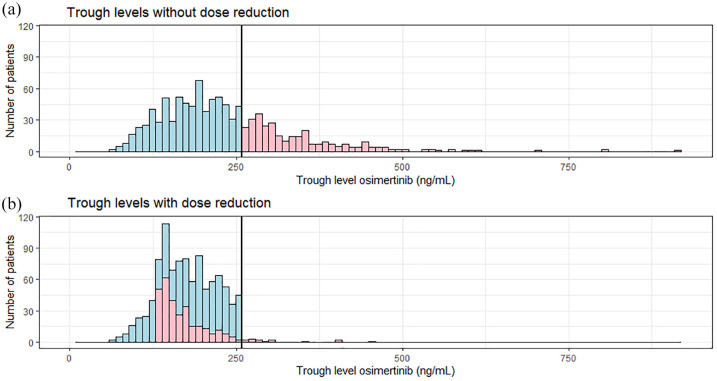
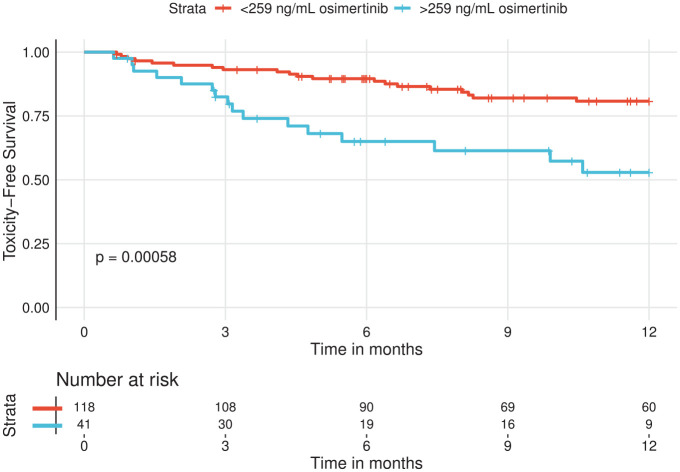
In total, 819 samples from 159 patients were included in the analysis. Multivariate competing risk analysis showed osimertinib clearance ( exposure) to be significantly correlated with severe toxicity (hazard ratio 0.93, 95% CI: 0.88-0.99). An relative operating characteristic curve showed the optimal toxic limit to be 259 ng/mL osimertinib. A 50% dose reduction in the high-exposure group, that is 25.8% of the total cohort, would reduce the risk of severe toxicity by 53%. Osimertinib exposure was not associated with PFS nor OS.
Osimertinib exposure is highly correlated with the occurrence of severe toxicity. To optimize tolerability, patients above the toxic limit concentration of 259 ng/mL could benefit from a preventive dose reduction, without fear for diminished effectiveness.
奥希替尼是表皮生长因子受体突变的非小细胞肺癌(NSCLC)治疗的基石。尽管如此,仍有±25%的患者经历严重的治疗相关毒性。目前,无法预先识别有严重毒性风险的患者。因此,我们旨在研究奥希替尼暴露与严重毒性之间的关系,并确定预防性剂量降低的安全毒性限值。
在这项真实世界的前瞻性队列研究中,对接受奥希替尼治疗的NSCLC患者进行随访,观察严重毒性(≥3级毒性、剂量减少或停药、住院或治疗终止)情况。每次门诊就诊时采集血样进行药代动力学分析。主要终点是奥希替尼清除率(暴露)与严重毒性之间的相关性。次要终点是暴露-疗效关系,定义为无进展生存期(PFS)和总生存期(OS)。
总共纳入了159例患者的819份样本进行分析。多变量竞争风险分析显示,奥希替尼清除率(暴露)与严重毒性显著相关(风险比0.93,95%置信区间:0.88-0.99)。相对操作特征曲线显示,最佳毒性限值为奥希替尼259 ng/mL。高暴露组(占总队列的25.8%)剂量降低50%可使严重毒性风险降低53%。奥希替尼暴露与PFS和OS均无关。
奥希替尼暴露与严重毒性的发生高度相关。为优化耐受性,高于259 ng/mL毒性限值浓度的患者可从预防性剂量降低中获益,而无需担心疗效降低。