Wang Lei, Chang Ruijie, Chen Xinyan
Department of Surgical Anesthesia, Shiyan Maternal and Child Health Care Hospital, Hubei Medical College, Shiyan, China.
Department of Anesthesiology, Taihe Hospital, Hubei Province, Shiyan, China.
Evid Based Complement Alternat Med. 2022 May 29;2022:2600755. doi: 10.1155/2022/2600755. eCollection 2022.
To evaluate the impact of intraspinal nerve block anesthesia on intrapartum fever and the neonate.
In this prospective study, between October 2019 and December 2020, 90 eligible primiparous women enrolled in the obstetrics and gynecology department of our hospital for delivery were recruited and assigned via the random number table method at a ratio of 1 : 1 to either an analgesic group given intraspinal nerve block anesthesia for labor or a nonanalgesic group without anesthesia for labor. Outcome measures included intrapartum body temperature, cases of intrapartum fever, Apgar scores of neonates, visual analogue scale (VAS) scores, delivery mode, and indomethacin use.
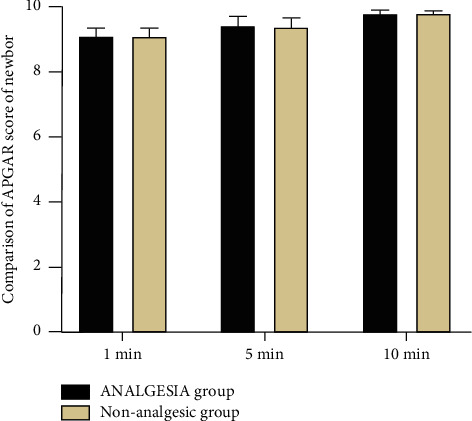
Intraspinal nerve block anesthesia was associated with a higher body temperature at 4 h and 5 h after analgesia and more cases of intrapartum fever versus no anesthesia ( < 0.05). There were no significant differences in the Apgar scores between the two groups ( > 0.05). Participants given intraspinal nerve block anesthesia had lower VAS scores during labor versus those without anesthesia ( < 0.05). The differences in the delivery mode between the two groups were not significant ( > 0.05). Intraspinal nerve block anesthesia resulted in a significantly higher demand for indomethacin versus no anesthesia ( < 0.05).
Intraspinal nerve block anesthesia is clinically effective in labor analgesia but may cause increased body temperature or even overt clinical fever, so close clinical observation of maternal temperature changes is required to mitigate the effects of anesthesia on the mothers. No adverse consequences of intraspinal nerve block anesthesia on the newborns were reported in this study.
评估脊髓神经阻滞麻醉对产时发热及新生儿的影响。
在这项前瞻性研究中,于2019年10月至2020年12月期间,招募了我院妇产科收治的90例符合条件的初产妇,通过随机数字表法按1∶1的比例将其分为接受分娩时脊髓神经阻滞麻醉的镇痛组或未接受麻醉的非镇痛组。观察指标包括产时体温、产时发热病例、新生儿阿氏评分、视觉模拟评分(VAS)、分娩方式及吲哚美辛使用情况。
与未麻醉相比,脊髓神经阻滞麻醉与镇痛后4小时和5小时体温较高以及更多产时发热病例相关(<0.05)。两组间阿氏评分无显著差异(>0.05)。接受脊髓神经阻滞麻醉的参与者在分娩期间的VAS评分低于未麻醉者(<0.05)。两组间分娩方式的差异不显著(>0.05)。与未麻醉相比,脊髓神经阻滞麻醉导致对吲哚美辛的需求显著增加(<0.05)。
脊髓神经阻滞麻醉在分娩镇痛中临床效果显著,但可能导致体温升高甚至出现明显的临床发热,因此需要密切临床观察产妇体温变化以减轻麻醉对母亲的影响。本研究未报告脊髓神经阻滞麻醉对新生儿有不良后果。