Dai Wenyu, Liu Jieyu, Qiu Yan, Teng Ziwei, Li Sujuan, Yuan Hui, Huang Jing, Xiang Hui, Tang Hui, Wang Bolun, Chen Jindong, Wu Haishan
National Clinical Research Center for Mental Disorders, Department of Psychiatry, China National Technology Institute on Mental Disorders, The Second Xiangya Hospital of Central South University, Changsha, China.
Department of Ultrasound Diagnostic, The Second Xiangya Hospital of Central South University, Changsha, China.
Front Pharmacol. 2022 May 23;13:893567. doi: 10.3389/fphar.2022.893567. eCollection 2022.
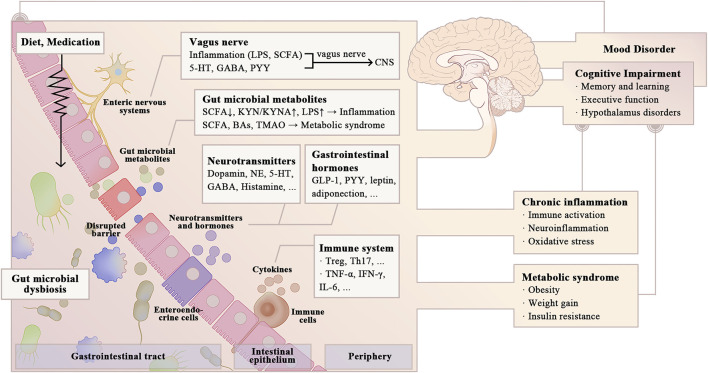
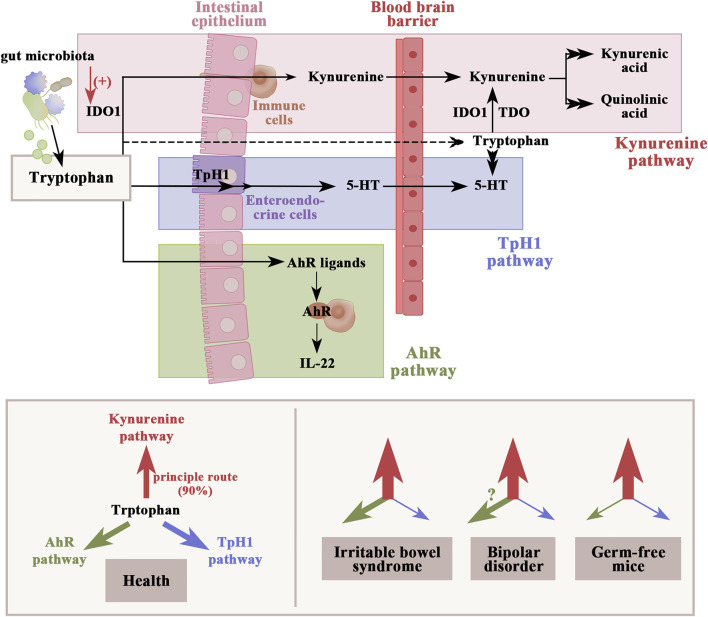
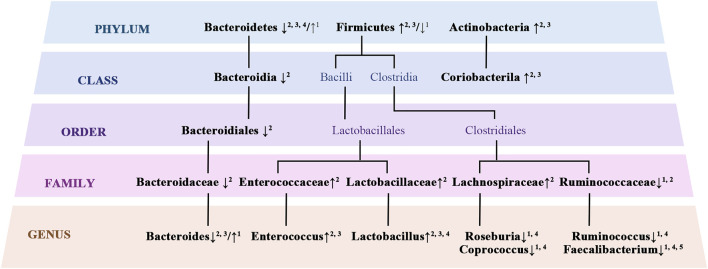
Recent studies have reported that the gut microbiota influences mood and cognitive function through the gut-brain axis, which is involved in the pathophysiology of neurocognitive and mental disorders, including Parkinson's disease, Alzheimer's disease, and schizophrenia. These disorders have similar pathophysiology to that of cognitive dysfunction in bipolar disorder (BD), including neuroinflammation and dysregulation of various neurotransmitters (i.e., serotonin and dopamine). There is also emerging evidence of alterations in the gut microbial composition of patients with BD, suggesting that gut microbial dysbiosis contributes to disease progression and cognitive impairment in BD. Therefore, microbiota-centered treatment might be an effective adjuvant therapy for BD-related cognitive impairment. Given that studies focusing on connections between the gut microbiota and BD-related cognitive impairment are lagging behind those on other neurocognitive disorders, this review sought to explore the potential mechanisms of how gut microbial dysbiosis affects cognitive function in BD and identify potential microbiota-centered treatment.
最近的研究报告称,肠道微生物群通过肠-脑轴影响情绪和认知功能,肠-脑轴参与了神经认知和精神障碍的病理生理学过程,包括帕金森病、阿尔茨海默病和精神分裂症。这些障碍与双相情感障碍(BD)的认知功能障碍具有相似的病理生理学,包括神经炎症和各种神经递质(即血清素和多巴胺)的失调。也有新出现的证据表明BD患者的肠道微生物组成发生了改变,这表明肠道微生物失调促成了BD的疾病进展和认知障碍。因此,以微生物群为中心的治疗可能是BD相关认知障碍的一种有效辅助治疗方法。鉴于目前关于肠道微生物群与BD相关认知障碍之间联系的研究落后于其他神经认知障碍的研究,本综述旨在探讨肠道微生物失调如何影响BD认知功能的潜在机制,并确定潜在的以微生物群为中心的治疗方法。