GreenUPorto-Sustainable Agrifood Production Research Centre/Inov4Agro, Faculty of Nutrition and Food Sciences, University of Porto, Porto, Portugal.
Faculty of Sciences, University of Porto, Porto, Portugal.
Adv Nutr. 2022 Oct 2;13(5):2015-2038. doi: 10.1093/advances/nmac066.
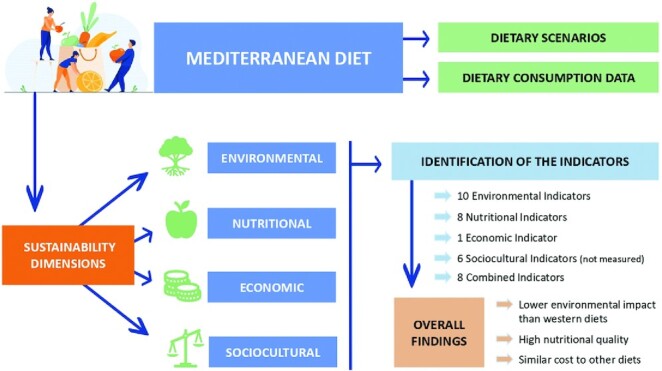
The concern about sustainability is growing and the Mediterranean diet has been extensively identified as a promising model, with benefits for human and environmental health. This systematic review aims to identify and describe the indicators that have been used to evaluate the sustainability of the Mediterranean diet and the results from their application. A methodology using PRISMA guidelines was followed, and searches were performed in Web of Science, PubMed, Scopus, and GreenFile. A total of 32 studies assessing the sustainability of the Mediterranean diet were identified. Twenty-five of these studies quantified the environmental impact, 7 studies evaluated the nutritional quality, and 12 studies assessed the daily cost of this dietary pattern. A total of 33 distinct indicators were identified, of which 10 were used to assess the environmental dimension (mainly, carbon, water, and ecological footprint), 8 were used to assess the nutritional dimension (mainly Health score and Nutrient Rich Food Index), 1 was used to assess the economic dimension (dietary cost), and 8 used combined indicators. The remaining 6 indicators for the assessment of sociocultural dimension were only identified in 1 study but were not measured. The Mediterranean diet had a lower environmental impact than Western diets and showed a carbon footprint between 0.9 and 6.88 kg CO2/d per capita, a water footprint between 600 and 5280 m3/d per capita, and an ecological footprint between 2.8 and 53.42 m2/d per capita. With regard to the nutritional dimension, the Mediterranean diet had a high nutritional quality and obtained 122 points on the Health score and ranged between 12.95 and 90.6 points on the Nutrient Rich Food Index. The cost of the Mediterranean diet is similar to other diets and varied between 3.33 and 14.42€/d per capita. These findings show that no uniformity in assessing the MDiet's sustainability exists.
对可持续性的关注日益增加,地中海饮食已被广泛认为是一种有前途的模式,对人类和环境健康都有益处。本系统评价旨在确定和描述用于评估地中海饮食可持续性的指标及其应用结果。采用 PRISMA 指南的方法,在 Web of Science、PubMed、Scopus 和 GreenFile 中进行了搜索。共确定了 32 项评估地中海饮食可持续性的研究。其中 25 项研究量化了环境影响,7 项研究评估了营养质量,12 项研究评估了这种饮食模式的日常成本。共确定了 33 个不同的指标,其中 10 个用于评估环境维度(主要是碳、水和生态足迹),8 个用于评估营养维度(主要是健康评分和营养丰富食物指数),1 个用于评估经济维度(饮食成本),8 个用于评估社会文化维度(主要是地中海饮食的社会文化接受度)。用于评估社会文化维度的其余 6 个指标仅在 1 项研究中被识别,但未进行测量。地中海饮食的环境影响低于西方饮食,其人均碳足迹为 0.9 至 6.88kg CO2/d,人均水足迹为 600 至 5280m3/d,人均生态足迹为 2.8 至 53.42m2/d。在营养维度方面,地中海饮食具有较高的营养质量,健康评分为 122 分,营养丰富食物指数在 12.95 至 90.6 分之间。地中海饮食的成本与其他饮食相似,人均在 3.33 至 14.42 欧元/天之间。这些发现表明,目前没有统一的方法来评估 MDiet 的可持续性。