Benacek Jiri, Martin-Key Nayra A, Spadaro Benedetta, Tomasik Jakub, Bahn Sabine
Department of Chemical Engineering and Biotechnology, University of Cambridge, Philippa Fawcett Drive, Cambridge, CB3 0AS, UK.
Int J Bipolar Disord. 2022 Jun 10;10(1):15. doi: 10.1186/s40345-022-00261-9.
Patients with bipolar disorder are often unrecognised and misdiagnosed with major depressive disorder leading to higher direct costs and pressure on the medical system. Novel screening tools may mitigate the problem. This study was aimed at investigating the direct costs of bipolar disorder misdiagnosis in the general population, evaluating the impact of a novel bipolar disorder screening algorithm, and comparing it to the established Mood Disorder Questionnaire. A decision analysis model was built to quantify the utility of one-time screening for bipolar disorder in primary care adults presenting with a depressive episode. A hypothetical population of interest comprised a healthcare system of one million users, corresponding to 15,000 help-seekers diagnosed with major depressive disorder annually, followed for five years. The model was used to calculate the impact of screening for bipolar disorder, compared to no screening, in terms of accuracy and total direct costs to a third-party payer at varying diagnostic cut-offs. Decision curve analysis was used to evaluate clinical utility.
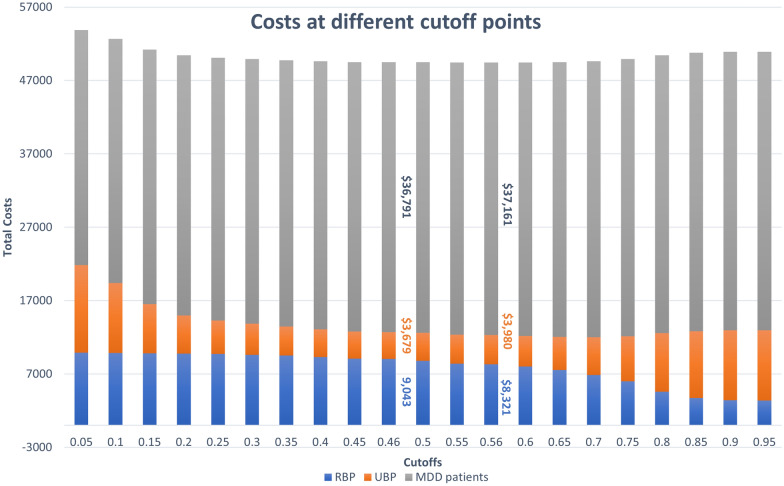
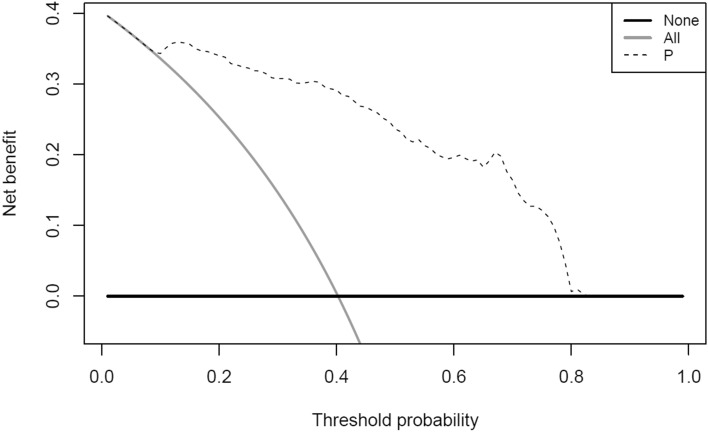
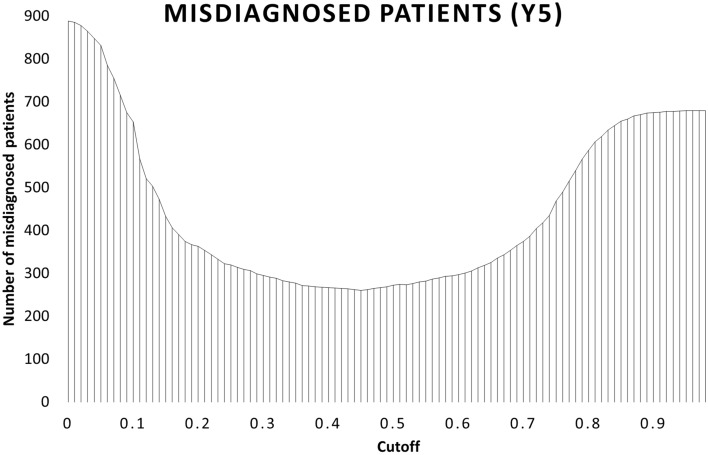
Compared to no screening, one-time screening for bipolar disorder using the algorithm reduced the number of misdiagnoses from 680 to 260, and overall direct costs from $50,936 to $49,513 per patient, accounting for $21.3 million savings over the five-year period. The algorithm outperformed the Mood Disorder Questionnaire, which yielded 367 misdiagnoses and $18.3 million savings over the same time. Decision curve analysis showed the screening model was beneficial.
Utilisation of bipolar disorder screening strategies could lead to a substantial reduction in human suffering by reducing misdiagnosis, and also lessen the healthcare costs.
双相情感障碍患者常未被识别,被误诊为重度抑郁症,导致直接成本增加和医疗系统压力增大。新型筛查工具可能会缓解这一问题。本研究旨在调查普通人群中双相情感障碍误诊的直接成本,评估一种新型双相情感障碍筛查算法的影响,并将其与已有的心境障碍问卷进行比较。构建了一个决策分析模型,以量化在出现抑郁发作的初级保健成年患者中一次性筛查双相情感障碍的效用。一个假设的目标人群包括一个拥有100万用户的医疗系统,相当于每年有15000名寻求帮助者被诊断为重度抑郁症,随访五年。该模型用于计算与不进行筛查相比,在不同诊断阈值下筛查双相情感障碍对第三方支付者的准确性和总直接成本的影响。采用决策曲线分析来评估临床效用。
与不进行筛查相比,使用该算法一次性筛查双相情感障碍可将误诊数量从680例减少至260例,每位患者的总体直接成本从50936美元降至49513美元,在五年期间节省了2130万美元。该算法的表现优于心境障碍问卷,后者在同一时期产生了367例假阳性诊断,节省了1830万美元。决策曲线分析表明筛查模型是有益的。
采用双相情感障碍筛查策略可通过减少误诊大幅减轻患者痛苦,同时降低医疗成本。