Graduate School of Human Sciences, Osaka University, Suita, Japan.
Faculty of Social Information Studies, Otsuma Women's University, Chiyoda-ku, Japan.
Nat Hum Behav. 2022 Sep;6(9):1234-1242. doi: 10.1038/s41562-022-01354-2. Epub 2022 Jun 9.
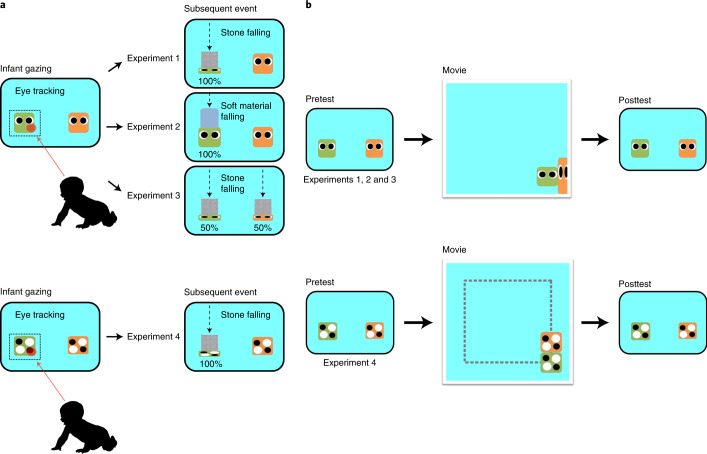
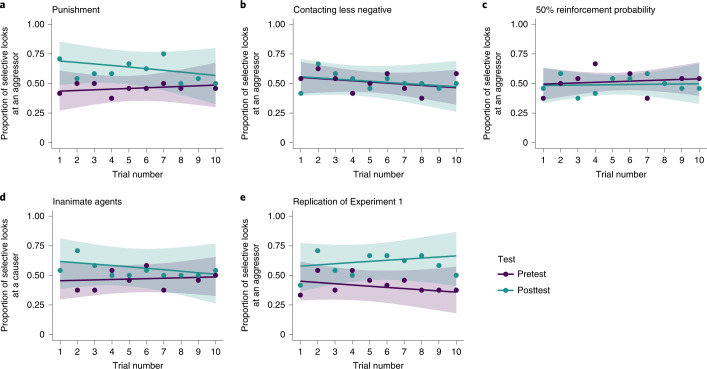
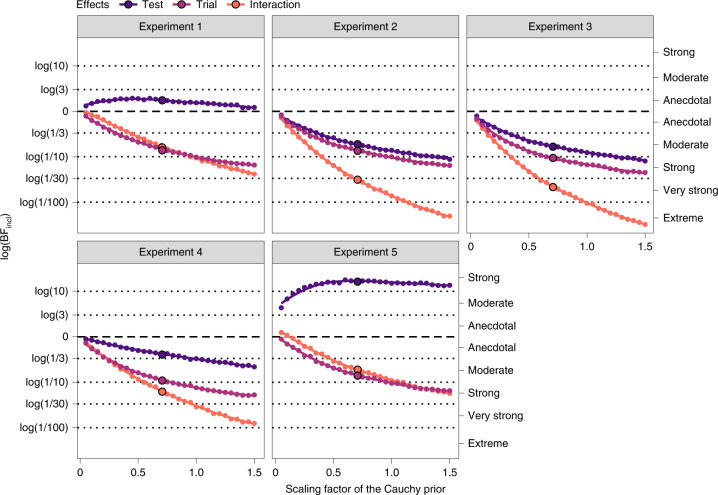
Third-party punishment of antisocial others is unique to humans and seems to be universal across cultures. However, its emergence in ontogeny remains unknown. We developed a participatory cognitive paradigm using gaze-contingency techniques, in which infants can use their gaze to affect agents displayed on a monitor. In this paradigm, fixation on an agent triggers the event of a stone crushing the agent. Throughout five experiments (total N = 120), we show that eight-month-old infants punished antisocial others. Specifically, infants increased their selective looks at the aggressor after watching aggressive interactions. Additionally, three control experiments excluded alternative interpretations of their selective gaze, suggesting that punishment-related decision-making influenced looking behaviour. These findings indicate that a disposition for third-party punishment of antisocial others emerges in early infancy and emphasize the importance of third-party punishment for human cooperation. This behavioural tendency may be a human trait acquired over the course of evolution.
第三方惩罚反社会行为者是人类独有的,似乎在不同文化中普遍存在。然而,其在个体发育中的出现仍然未知。我们使用注视条件技术开发了一种参与认知范式,婴儿可以用他们的注视来影响显示器上显示的代理。在这个范式中,对代理的注视会触发石头压碎代理的事件。在五个实验(总 N=120)中,我们表明 8 个月大的婴儿会惩罚反社会的人。具体来说,婴儿在观看攻击性互动后,会增加对攻击者的选择性注视。此外,三个控制实验排除了对他们选择性注视的替代解释,表明与惩罚相关的决策影响了注视行为。这些发现表明,对反社会者的第三方惩罚的倾向在婴儿早期就出现了,并强调了第三方惩罚对人类合作的重要性。这种行为倾向可能是人类在进化过程中获得的一种特质。