Moradi Mohammad Hossein, Nejati-Javaremi Ardeshir, Moradi-Shahrbabak Mohammad, Dodds Ken G, Brauning Rudiger, McEwan John C
Department of Animal Science, Faculty of Agriculture, Arak University, Arak 38156-8-8349, Iran.
Department of Animal Science, University of Tehran, Karaj 31587-1-1167, Iran.
Animals (Basel). 2022 May 31;12(11):1423. doi: 10.3390/ani12111423.
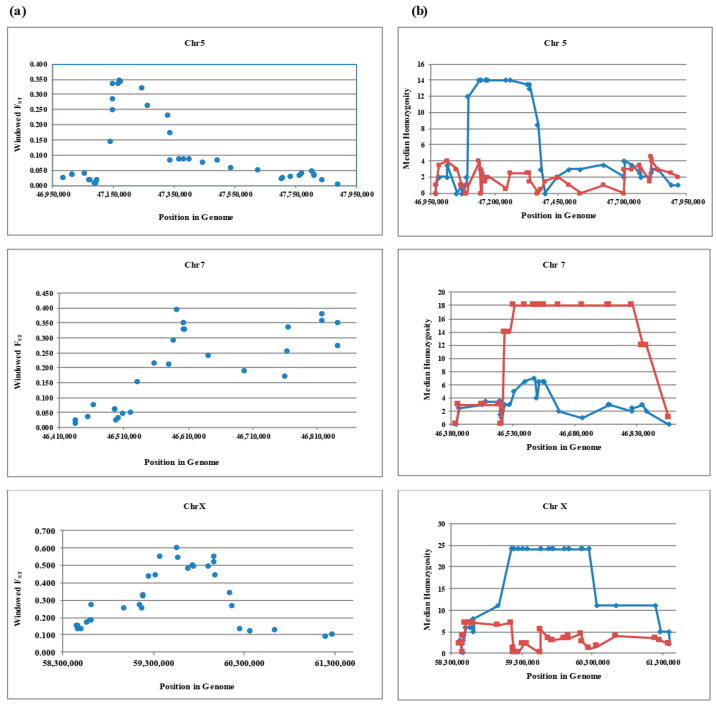
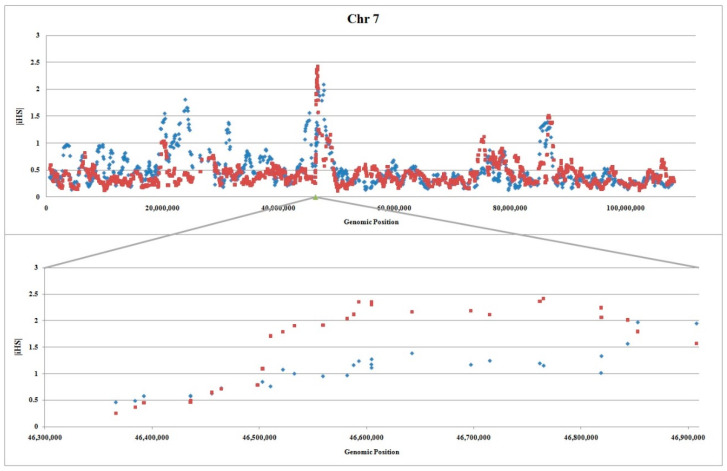
The fat tail is a phenotype that divides indigenous Iranian sheep genetic resources into two major groups. The objective of the present study is to refine the map location of candidate regions associated with fat deposition, obtained via two separate whole genome scans contrasting thin and fat tail breeds, and to determine the nature of the selection occurring in these regions using a hitchhiking approach. Zel (thin tail) and Lori-Bakhtiari (fat tail) breed samples that had previously been run on the Illumina Ovine 50 k BeadChip, were genotyped with a denser set of SNPs in the three candidate regions using a Sequenom Mass ARRAY platform. Statistical tests were then performed using different and complementary methods based on either site frequency (F and Median homozygosity) or haplotype (iHS and XP-EHH). The results from candidate regions on chromosome 5 and X revealed clear evidence of selection with the derived haplotypes that was consistent with selection to near fixation for the haplotypes affecting fat tail size in the fat tail breed. An analysis of the candidate region on chromosome 7 indicated that selection differentiated the beneficial alleles between breeds and homozygosity has increased in the thin tail breed which also had the ancestral haplotype. These results enabled us to confirm the signature of selection in these regions and refine the critical intervals from 113 kb, 201 kb, and 2831 kb to 28 kb, 142 kb, and 1006 kb on chromosome 5, 7, and X respectively. These regions contain several genes associated with fat metabolism or developmental processes consisting of and (OAR5), and (OAR7), , , , , , , and (OAR X), and each of which could potentially be the actual target of selection. The study of core haplotypes alleles in our regions of interest also supported the hypothesis that the first domesticated sheep were thin tailed, and that fat tail animals were developed later. Overall, our results provide a comprehensive assessment of how and where selection has affected the patterns of variation in candidate regions associated with fat deposition in thin and fat tail sheep breeds.
肥尾是一种将伊朗本土绵羊遗传资源分为两个主要类群的表型。本研究的目的是优化通过两次独立的全基因组扫描获得的与脂肪沉积相关的候选区域的图谱定位,这两次扫描对比了瘦尾和肥尾品种,并使用搭便车方法确定这些区域中发生的选择的性质。先前在Illumina绵羊50k SNP芯片上进行过检测的泽尔(瘦尾)和洛里 - 巴赫蒂亚里(肥尾)品种样本,使用Sequenom Mass ARRAY平台在三个候选区域用更密集的单核苷酸多态性(SNP)进行基因分型。然后基于位点频率(F和中位纯合度)或单倍型(iHS和XP - EHH)使用不同的互补方法进行统计检验。5号染色体和X染色体上候选区域的结果显示,有明确的选择证据表明,衍生单倍型与肥尾品种中影响肥尾大小的单倍型选择至接近固定相一致。对7号染色体上候选区域的分析表明,选择使品种间的有益等位基因产生分化,瘦尾品种中纯合度增加,而瘦尾品种具有祖先单倍型。这些结果使我们能够确认这些区域的选择特征,并将5号、7号和X染色体上的关键区间分别从113kb、201kb和2831kb优化至28kb、142kb和1006kb。这些区域包含几个与脂肪代谢或发育过程相关的基因,分别为5号染色体上的 和 (OAR5)、7号染色体上的 和 (OAR7)、X染色体上的 、 、 、 、 、 、 ,其中每个基因都可能是实际的选择目标。对我们感兴趣区域的核心单倍型等位基因的研究也支持了以下假设:最早驯化的绵羊是瘦尾的,而肥尾动物是后来培育出来的。总体而言,我们的结果全面评估了选择如何以及在何处影响了与瘦尾和肥尾绵羊品种脂肪沉积相关的候选区域的变异模式。