School of Economics and Management, Tongji University, Tongji Building A, Siping Road 1500, Shanghai 200092, China.
Int J Environ Res Public Health. 2022 Jun 2;19(11):6801. doi: 10.3390/ijerph19116801.
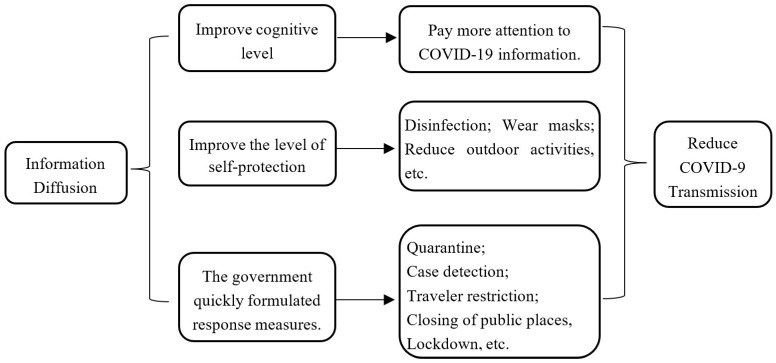
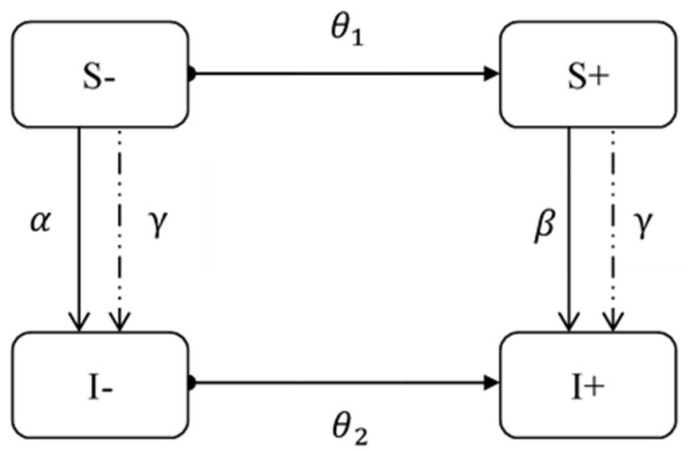
With the rapid development of the Mobile Internet in China, epidemic information is real-time and holographic, and the role of information diffusion in epidemic control is increasingly prominent. At the same time, the publicity of all kinds of big data also provides the possibility to explore the impact of media information diffusion on disease transmission. We explored the mechanism of the influence of information diffusion on the transmission of COVID-19, developed a model of the interaction between information diffusion and disease transmission based on the Susceptible-Infected-Recovered (SIR) model, and conducted an empirical test by using econometric methods. The benchmark result showed that there was a significant negative correlation between the information diffusion and the transmission of COVID-19. The result of robust test showed that the diffusion of both epidemic information and protection information hindered the further transmission of the epidemic. Heterogeneity test results showed that the effect of epidemic information on the suppression of COVID-19 is more significant in cities with weak epidemic control capabilities and higher Internet development levels.
随着中国移动互联网的快速发展,疫情信息实时呈现,全息呈现,信息传播在疫情防控中的作用日益凸显。同时,各类大数据的宣传也为探索媒体信息传播对疾病传播的影响提供了可能性。我们探讨了信息传播对 COVID-19 传播的影响机制,基于易感-感染-恢复(SIR)模型开发了一个信息传播与疾病传播相互作用的模型,并通过计量经济学方法进行了实证检验。基准结果表明,信息传播与 COVID-19 传播之间存在显著的负相关关系。稳健性检验结果表明,疫情信息和保护信息的传播都阻碍了疫情的进一步传播。异质性检验结果表明,在疫情防控能力较弱、互联网发展水平较高的城市,疫情信息对 COVID-19 的抑制作用更为显著。