Institute of Safety Management & Risk Control, Institute of Safety & Emergency Management, School of Safety Science and Engineering, Xi'an University of Science and Technology, No. 58 Yanta Road, Xi'an 710054 China.
Institute of Safety Management & Risk Control, Institute of Safety & Emergency Management, School of Safety Science and Engineering, Xi'an University of Science and Technology, No. 58 Yanta Road, Xi'an 710054 China.
Psychiatry Res. 2020 Jun;288:112992. doi: 10.1016/j.psychres.2020.112992. Epub 2020 Apr 11.
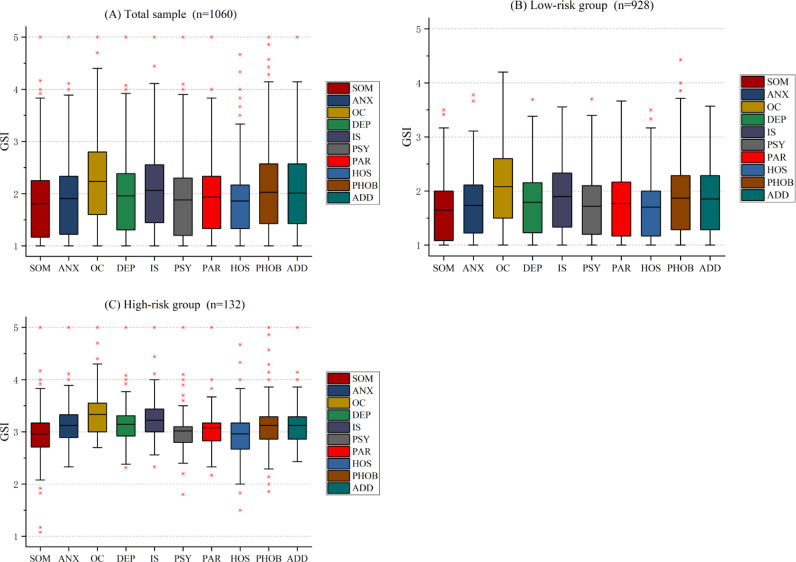
The World Health Organization (WHO) has declared that the Corona Virus (COVID-19) has become a global pandemic. This study aimed to investigate the psychological symptoms of ordinary Chinese citizens during the Level I Emergency Response throughout China. From January 31 to February 2 2020, an online questionnaire, Symptom Checklist 90 (SCL-90) was designed, and differences in GSI T-scores among subgroups were examined by ANOVA. Based on a cut-off point of the GSI T-scores of 63, the overall sample was divided into high and low-risk groups. of the 1,060 participants investigated in China, more than 70% of them have moderate and higher level of psychological symptoms specifically elevated scores for obsessive compulsion, interpersonal sensitivity, phobic anxiety, and psychoticism. There were no significant differences between males and females. Those who were of over 50 years old, had an undergraduate education and below, were divorced or widowed, and agricultural workers had significantly more symptoms. However, significantly more minors and medical staff were in the high-risk group. These results show that COVID-19 has a significant adverse socio-psychological influence on ordinary citizens. Therefore, governments should equip psychological health departments and pay attention to the people who are in high-risk groups, providing psychological interventions and assistance.
世界卫生组织(WHO)已宣布冠状病毒(COVID-19)已成为全球性大流行病。本研究旨在调查中国一级应急响应期间普通中国公民的心理症状。从 2020 年 1 月 31 日至 2 月 2 日,设计了一个在线问卷,症状清单 90(SCL-90),并通过 ANOVA 检查了亚组间 GSI T 评分的差异。基于 GSI T 评分的截止点为 63,将整个样本分为高风险和低风险组。在中国调查的 1060 名参与者中,超过 70%的人具有中度及以上水平的心理症状,特别是强迫观念,人际关系敏感,恐怖症和精神病。男女之间没有显着差异。那些年龄超过 50 岁,受过本科及以下教育,离婚或丧偶以及农业工人的症状明显更多。但是,未成年人和医务人员中处于高风险组的比例明显更高。这些结果表明,COVID-19 对普通市民的社会心理产生了重大的负面影响。因此,政府应配备心理健康部门,并关注高风险人群,提供心理干预和援助。