Franz Daniel, Häfner Tom, Kunz Tim, Roth Gian-Luca, Rung Stefan, Esen Cemal, Hellmann Ralf
Applied Laser and Photonics Group, University of Applied Sciences Aschaffenburg, Würzburger Straße 45, 63743 Aschaffenburg, Germany.
Schmoll Maschinen GmbH, Odenwaldstraße 67, 63322 Rödermark, Germany.
Materials (Basel). 2022 May 31;15(11):3932. doi: 10.3390/ma15113932.
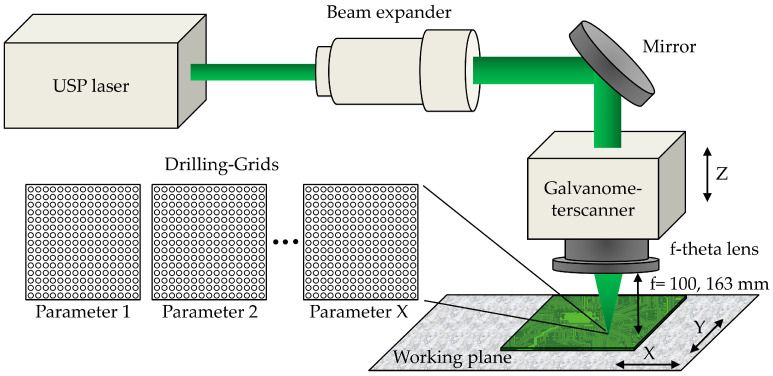
We report on a comprehensive study of laser percussion microvia drilling of FR-4 printed circuit board material using ultrashort pulse lasers with emission in the green spectral region. Laser pulse durations in the pico- and femtosecond regime, laser pulse repetition rates up to 400 kHz and laser fluences up to 11.5 J/cm2 are applied to optimize the quality of microvias, as being evaluated by the generated taper, the extension of glass fiber protrusions and damage of inner lying copper layers using materialography. The results are discussed in terms of the ablation threshold for FR-4 and copper, heat accumulation and pulse shielding effects as a result of pulse to pulse interactions. As a specific result, using a laser pulse duration of 2 ps appears beneficial, resulting in small glass fiber protrusions and high precision in the stopping process at inner copper layer. If laser pulse repetition rates larger than 100 kHz are applied, we find that the processing quality can be increased by heat accumulation effects.
我们报告了一项关于使用绿色光谱区域发射的超短脉冲激光对FR-4印刷电路板材料进行激光冲击微孔钻孔的综合研究。应用皮秒和飞秒量级的激光脉冲持续时间、高达400 kHz的激光脉冲重复率以及高达11.5 J/cm²的激光能量密度来优化微孔质量,通过材料显微镜检查所产生的锥度、玻璃纤维突出物的延伸以及内部铜层的损伤来评估微孔质量。根据FR-4和铜的烧蚀阈值、脉冲间相互作用导致的热积累和脉冲屏蔽效应来讨论结果。作为一个具体结果,使用2 ps的激光脉冲持续时间似乎是有益的,这会导致玻璃纤维突出物较小,并且在内层铜层处的停止过程具有高精度。如果应用大于100 kHz的激光脉冲重复率,我们发现通过热积累效应可以提高加工质量。