Csoma Balázs, Vulpi Maria Rosaria, Dragonieri Silvano, Bentley Andrew, Felton Timothy, Lázár Zsófia, Bikov Andras
Department of Pulmonology, Semmelweis University, 25-29 Tömő Str., 1083 Budapest, Hungary.
School of Medicine: Basic Medical Sciences, Neuroscience and Sense Organs, University of Bari Aldo Moro, 11 Piazza G. Cesare-Bari, 70124 Bari, Italy.
J Clin Med. 2022 Jun 2;11(11):3180. doi: 10.3390/jcm11113180.
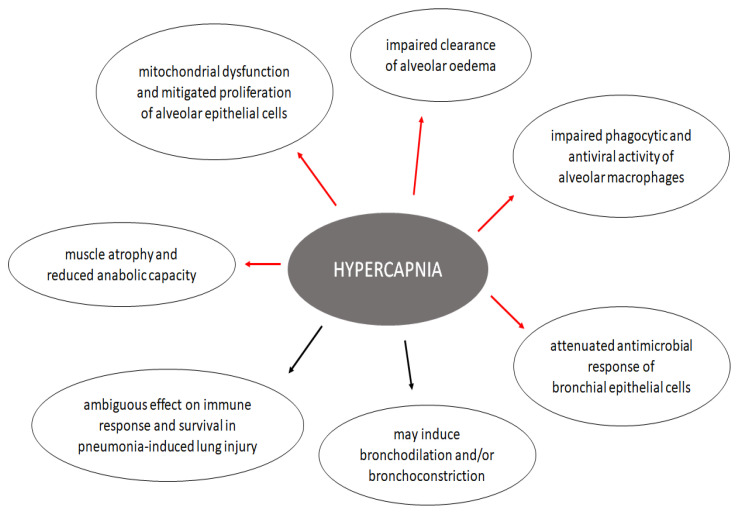
Chronic obstructive pulmonary disease (COPD) is a progressive respiratory disorder that may lead to gas exchange abnormalities, including hypercapnia. Chronic hypercapnia is an independent risk factor of mortality in COPD, leading to epithelial dysfunction and impaired lung immunity. Moreover, chronic hypercapnia affects the cardiovascular physiology, increases the risk of cardiovascular morbidity and mortality, and promotes muscle wasting and musculoskeletal abnormalities. Noninvasive ventilation is a widely used technique to remove carbon dioxide, and several studies have investigated its role in COPD. In the present review, we aim to summarize the causes and effects of chronic hypercapnia in COPD. Furthermore, we discuss the use of domiciliary noninvasive ventilation as a treatment option for hypercapnia while highlighting the controversies within the evidence. Finally, we provide some insightful clinical recommendations and draw attention to possible future research areas.
慢性阻塞性肺疾病(COPD)是一种进行性的呼吸系统疾病,可能导致气体交换异常,包括高碳酸血症。慢性高碳酸血症是COPD患者死亡的独立危险因素,可导致上皮功能障碍和肺免疫受损。此外,慢性高碳酸血症会影响心血管生理功能,增加心血管疾病的发病风险和死亡率,并促进肌肉萎缩和肌肉骨骼异常。无创通气是一种广泛应用于去除二氧化碳的技术,已有多项研究探讨了其在COPD中的作用。在本综述中,我们旨在总结COPD中慢性高碳酸血症的病因和影响。此外,我们讨论了使用家庭无创通气作为高碳酸血症的治疗选择,同时强调证据中的争议点。最后,我们提供了一些有见地的临床建议,并提请关注未来可能的研究领域。