Hwang Jae Kyoon, Na Jae Yoon, Kim Jihye, Oh Jae-Won, Kim Yong Joo, Choi Young-Jin
Department of Pediatrics, Hanyang University Guri Hospital, Guri 11923, Korea.
Department of Pediatrics, Hanyang University Seoul Hospital, Seoul 04763, Korea.
J Clin Med. 2022 Jun 3;11(11):3197. doi: 10.3390/jcm11113197.
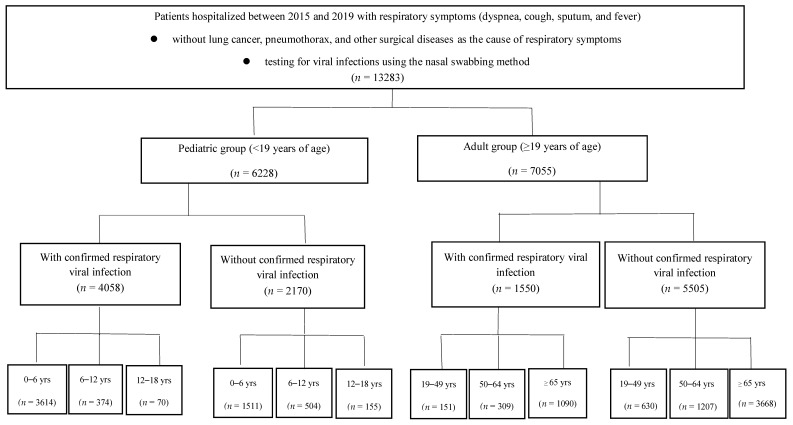
This study aimed to identify age-specific characteristics of respiratory viral infections. Hospitalized patients with confirmed viral respiratory infections were included in the sample. The patients were divided into the pediatric group (<19 years old) and the adult group (≥19 years old). The groups were then subdivided based on age: 0−6, 7−12, 13−18, 19−49, 50−64, and ≥65 years old. These groups were compared to evaluate the differences in the pattern of respiratory viral infections. Among a total of 4058 pediatric patients (mean age 3.0 ± 2.9 years, n = 1793 females), 2829 (48.9%) had mono-infections, while 1229 (51.1%) had co-infections. Co-infections were the most common in the 0−6-year-old group (31.6%). Among 1550 adult patients (mean age 70.2 ± 15.3 years, n = 710 females), 1307 (85.6%) had mono-infections and 243 (14.4%) had co-infections. Co-infections were most common in the ≥65-year-old group (16.8%). Viral infection and co-infection rates decreased with age in pediatric patients but increased with increasing age in adults. In pediatric patients, the rates of viral infections and co-infections were high; the rate of co-infections was higher in younger patients. In adult patients, the rates of viral infections and co-infections were lower than those in pediatric patients; the rate of co-infections was higher in older patients.
本研究旨在确定呼吸道病毒感染的年龄特异性特征。样本纳入确诊为病毒性呼吸道感染的住院患者。患者被分为儿科组(<19岁)和成人组(≥19岁)。然后根据年龄将这些组进一步细分:0 - 6岁、7 - 12岁、13 - 18岁、19 - 49岁、50 - 64岁和≥65岁。对这些组进行比较,以评估呼吸道病毒感染模式的差异。在总共4058名儿科患者(平均年龄3.0±2.9岁,女性1793名)中,2829名(48.9%)为单一感染,而1229名(51.1%)为合并感染。合并感染在0 - 6岁组最为常见(31.6%)。在1550名成年患者(平均年龄70.2±15.3岁,女性710名)中,1307名(85.6%)为单一感染,243名(14.4%)为合并感染。合并感染在≥65岁组最为常见(16.8%)。儿科患者中病毒感染和合并感染率随年龄增长而下降,但在成人中随年龄增长而上升。在儿科患者中,病毒感染和合并感染率较高;年轻患者的合并感染率更高。在成年患者中,病毒感染和合并感染率低于儿科患者;老年患者的合并感染率更高。